
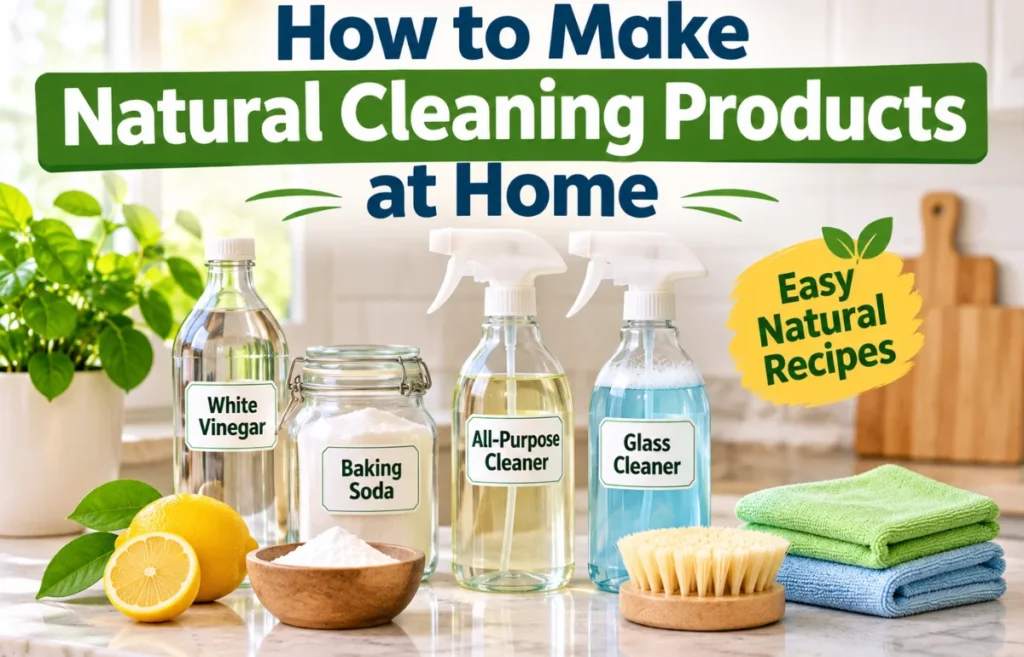
Learning how to make natural cleaning products starts with a few familiar ingredients: water, mild dish soap, white vinegar, and baking soda. These ingredients can help remove everyday dirt, grease, soap residue, and mineral deposits when used correctly. For example, diluted dish soap works well for routine surface cleaning, vinegar can dissolve some hard-water buildup, and baking soda provides gentle scrubbing action.
The key is choosing the right ingredient for the right surface rather than mixing everything together.
Homemade cleaners can be affordable, simple to prepare, and useful for everyday household maintenance. However, natural does not automatically mean safe, and most homemade recipes are not reliable disinfectants.
I recommend starting with small batches, avoiding unnecessary fragrances, and checking surface-care instructions before applying anything new.
Why Make Your Own Natural Cleaning Products?
Store-bought cleaners are convenient, but keeping a different bottle for every surface isn’t always necessary.
For routine cleaning, a mild solution and a good microfiber cloth can handle many household messes without a complicated ingredient list.
Making your own cleaners can also help you control fragrances, reduce the number of products in your cupboard, and reuse suitable spray bottles.
There are a few practical advantages:
- You know which ingredients are going into each mixture.
- Basic recipes can be inexpensive to prepare.
- Small batches help reduce unused cleaning solution.
- Unscented options are available for people who dislike strong fragrances.
- Different mixtures can target grease, mineral buildup, or stubborn residue.
Still, I wouldn’t replace every commercial product with a homemade version.
Specialized cleaners and properly labeled disinfectants have their place, especially when dealing with illness, food contamination, or delicate finishes.
Essential Ingredients for Homemade Natural Cleaners
You don’t need a long shopping list to get started.
In fact, I prefer simple recipes because they’re easier to prepare, label, and use correctly.
| Ingredient | What it does | Best everyday use | Main precaution |
|---|---|---|---|
| Mild dish soap | Loosens grease and dirt | Washable countertops and kitchen surfaces | Use sparingly to prevent residue |
| White vinegar | Helps dissolve mineral deposits | Suitable glass and certain acid-resistant fixtures | Avoid natural stone and sensitive finishes |
| Baking soda | Provides gentle abrasive action | Scrubbing suitable sinks and stubborn spots | Can scratch delicate surfaces |
| Water | Dilutes and rinses away loosened dirt | General cleaning | Make water-based mixtures in small batches |
| Microfiber cloth | Lifts and traps loosened dirt | Dusting, wiping, and polishing | Wash cloths regularly |
White Vinegar
Distilled white vinegar commonly contains about 5% acetic acid.
Its acidity makes it useful for certain mineral deposits, including some hard-water marks.
However, vinegar can damage acid-sensitive materials such as marble, limestone, and travertine. It may also affect some seals, coatings, and appliance components.
I would use it selectively rather than treating it as a universal cleaner.
Baking Soda
Baking soda is useful when a damp cloth isn’t enough to loosen a stubborn mark.
Its fine particles provide mild abrasion, making it suitable for some sinks and durable surfaces.
But mild doesn’t mean scratch-proof. Glossy, painted, polished, or easily damaged finishes may still suffer from rubbing.
Mild Dish Soap
For general household cleaning, this is often the ingredient I’d reach for first.
A small quantity of unscented dish soap in water can loosen fingerprints, food residue, and everyday grease.
Choose a plain product without added bleach or specialized cleaning ingredients, and follow its label. Homemade mixtures are easiest to manage when they contain as few components as possible.
7 Easy Natural Cleaning Products You Can Make at Home
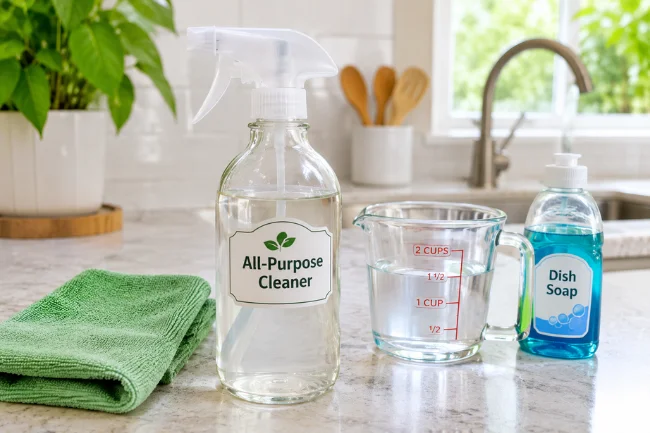
These recipes are intended for routine cleaning, not disinfection.
Before using any mixture, test it on an inconspicuous area and confirm that the surface manufacturer allows the ingredients.
1. Homemade All-Purpose Cleaner
This is the simplest recipe on my list and the most useful starting point.
Ingredients:
- 2 cups of water
- 3–5 drops of mild, unscented dish soap
- 1 clean, labeled spray bottle
How to make it:
Add the water to the bottle, followed by the dish soap. Close it and gently turn the bottle to combine the ingredients without creating excessive foam.
Spray a little onto a microfiber cloth and wipe a compatible, washable surface.
For surfaces that touch food, rinse with clean water if the soap label or surface instructions require it. Dry with a fresh cloth.
This mixture is suitable for many everyday messes on compatible countertops, cabinet exteriors, and other washable household surfaces.
I recommend preparing only what you need for the current cleaning session rather than storing diluted soap indefinitely.
2. Natural Glass and Mirror Cleaner
Fingerprints and water spots can make a clean bathroom mirror look messy.
For compatible, uncoated household glass, a diluted vinegar solution may help remove light residue.
Ingredients:
- ½ cup distilled white vinegar
- ½ cup water
- 1 clean spray bottle
How to make it:
Pour both ingredients into the bottle and gently mix.
Apply a small amount to a microfiber cloth, wipe the glass, and finish with a dry cloth to reduce streaks.
Avoid spraying directly toward mirror edges, frames, or surrounding painted woodwork, where liquid could seep into vulnerable areas.
Do not use this recipe on electronic screens, specialty coated glass, natural stone, or surfaces whose manufacturer advises against vinegar.
For many mirrors, plain water and a clean microfiber cloth may be sufficient.
3. Baking Soda Scrubbing Paste
Some kitchen and bathroom marks need a little more attention than ordinary wiping.
A baking soda paste can help loosen stuck-on residue from suitable, scratch-resistant surfaces.
Ingredients:
- 2 tablespoons baking soda
- Approximately 1 tablespoon water
How to make it:
Place the baking soda in a small bowl. Add just enough water to produce a spreadable paste.
Apply a little to the stained area and gently rub with a damp, soft cloth.
Rinse thoroughly and dry the surface.
I would start with very light pressure. Scrubbing harder doesn’t necessarily clean better, and abrasive particles can damage finishes.
This recipe is best avoided on delicate metals, polished stone, acrylic, nonstick coatings, and other scratch-sensitive materials.
4. Homemade Kitchen Degreaser
Grease collects around stovetops, cabinet handles, and nearby work surfaces.
Fortunately, you usually don’t need an acidic cleaner to deal with ordinary cooking oil.
Ingredients:
- 2 cups warm water
- ½ teaspoon mild dish soap
- 1 soft sponge or microfiber cloth
How to make it:
Mix the soap into the water in a small bowl.
Dip the cloth into the solution, wring out excess liquid, and wipe compatible kitchen surfaces.
For stubborn grease, allow a small amount of solution to remain on the mark briefly before wiping again.
Finish with a clean, damp cloth and dry the area.
Never apply liquid to hot burners or allow it to enter electrical controls, vents, or appliance openings.
For painted cabinets, I recommend using as little moisture as possible.
5. Natural Bathroom Sink Cleaner
Bathroom sinks collect toothpaste residue, hand soap, and ordinary grime.
A mild soap solution is often enough for routine cleaning, while a little baking soda can help with certain stubborn marks.
Ingredients:
- 1 cup water
- A few drops of mild dish soap
- 1 teaspoon baking soda, used separately if needed
How to make it:
Use the soapy water and a soft cloth to clean a compatible sink.
If residue remains, put a small amount of baking soda directly onto a damp cloth and gently work on the affected spot.
Rinse thoroughly and dry.
Avoid abrasive scrubbing on sensitive finishes, and check care instructions for natural stone, specialty ceramics, and coated fixtures.
I prefer this two-part approach because it lets me use extra scrubbing action only where necessary.
6. Hard-Water Spot Cleaner for Compatible Fixtures
White mineral marks often appear around faucets, shower fittings, and glass shower doors.
Vinegar can help dissolve certain deposits, but it needs careful handling.
Ingredients:
- ¼ cup distilled white vinegar
- ¼ cup water
- 1 soft cloth
How to make it:
Mix the vinegar and water in a small bowl.
Dampen the cloth with the solution and gently wipe a small area of a fixture that its manufacturer confirms is acid-resistant.
Rinse promptly with clean water and dry.
Do not soak plated fixtures or leave vinegar sitting on metal finishes, grout, sealants, or surrounding stone.
For chrome, brushed finishes, and specialty coatings, the manufacturer’s approved cleaner is the safer default.
Also, never apply vinegar to a surface recently treated with bleach or another cleaning chemical.
7. Simple Toilet Bowl Cleaner for Everyday Soil
For regular toilet maintenance, physical scrubbing does much of the work.
A little soap can help remove visible dirt without requiring a complicated homemade formula.
Ingredients:
- A small amount of mild dish soap
- A toilet brush
- Water for flushing
How to use it:
Add a small amount of soap to the toilet bowl.
Brush the bowl thoroughly, including beneath the rim where accessible, then flush.
This is a routine cleaning method, not a disinfecting procedure.
If someone in the household is sick or the bathroom requires disinfection, use an appropriate labeled product according to its instructions.
Never add homemade mixtures to a toilet containing bleach, disinfectant tablets, or another chemical cleaner.
Which Natural Cleaner Works Best on Each Surface?
The most useful homemade cleaning recipe isn’t necessarily the strongest one.
It’s the mildest option that removes the dirt without damaging the surface.
| Household surface | Recommended starting method | What to avoid |
|---|---|---|
| Compatible laminate countertops | Mild soap and water | Excess moisture around seams |
| Marble or limestone | Manufacturer-approved pH-neutral cleaner | Vinegar, lemon juice, acidic mixtures |
| Ordinary uncoated glass | Water and microfiber; diluted vinegar if approved | Abrasive paste and damage to surrounding frames |
| Painted cabinet doors | Slightly damp cloth with mild soap | Soaking, harsh scrubbing |
| Stainless steel appliances | Manufacturer-approved cleaner or mild soapy cloth | Abrasives and liquid entering controls |
| Ceramic sink | Mild soap; gentle baking soda only if finish permits | Aggressive abrasion |
| Wood flooring | Manufacturer-approved floor cleaner | Standing water and unapproved vinegar |
| Electronic screens | Screen manufacturer’s recommended method | Homemade sprays applied directly |
This comparison explains why I don’t recommend keeping one homemade cleaner for every room.
Surfaces are made from different materials, and their protective finishes can react differently even to familiar household ingredients.
Natural Cleaning Mistakes That Can Cause Problems
Some popular homemade cleaning tips are ineffective, while others can be dangerous.
Before experimenting with ingredients, it’s worth understanding which combinations to avoid.
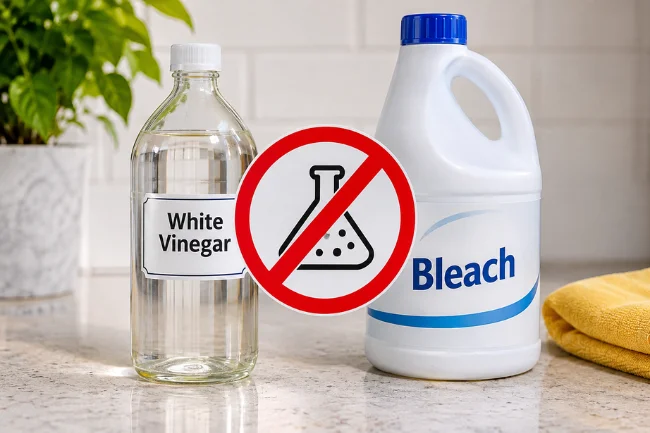
Don’t Mix Vinegar With Bleach
This is one of the most important household cleaning rules.
Vinegar is acidic, and mixing it with chlorine bleach can release dangerous chlorine gas.
Never combine bleach with vinegar, ammonia, or other cleaning products.
The same caution applies when using products one after another. If a surface has been treated with a chemical cleaner, follow its label before applying anything else.
The CDC’s household cleaning guidance recommends avoiding chemical mixtures and following product instructions.
Don’t Store Vinegar and Baking Soda Together
Combining vinegar and baking soda produces fizzing as the acid reacts with the baking soda.
Although the reaction looks impressive, it also consumes much of what makes the individual ingredients useful.
Storing the mixture in a closed container is especially unwise because gas production can create pressure.
I would use baking soda for gentle scrubbing and vinegar separately for appropriate mineral deposits, rather than making a bottled combination.
Don’t Assume Essential Oils Make Cleaners Safer
A few drops of lemon, peppermint, or tea tree oil may make a recipe smell pleasant, but fragrance isn’t necessary for cleaning.
Essential oils can irritate skin or airways, may damage finishes, and can present risks to pets depending on the oil and exposure.
They also don’t turn a homemade cleaner into a proven disinfectant.
For practical everyday cleaning, my preference is to leave them out.
Don’t Use Homemade Cleaners as Disinfectants
Cleaning, sanitizing, and disinfecting are different processes.
Cleaning physically removes dirt and many germs. Sanitizing reduces germs to defined levels, while disinfecting uses products or methods intended to kill specified microorganisms.
According to the CDC, routine cleaning with soap and water is generally sufficient in many household situations.
However, when a household member is ill or when a surface needs disinfection, an appropriate EPA-registered disinfectant or correctly prepared bleach solution may be necessary.
Homemade vinegar, baking soda, and soap recipes should not be presented as substitutes for tested disinfectants.
How to Store Homemade Cleaning Products Safely
Storage is often overlooked when people learn how to make natural cleaning products.
A mixture may be simple, but an unlabeled bottle can still cause confusion or accidental misuse.
I recommend following a few basic habits.
Label Every Container
Write the ingredients and preparation date on each bottle.
Include the intended surface or task, such as “Glass Cleaner — Vinegar and Water.”
Never store cleaning mixtures in drink bottles or food containers.
Make Small Batches
Water-based homemade mixtures don’t usually contain the preservatives found in commercially formulated cleaning products.
There is no universal shelf life that applies to every recipe.
For diluted dish soap mixtures, I would make enough for one cleaning session and discard unused solution afterward.
Mix baking soda paste immediately before use. Vinegar-water mixtures should also be prepared in modest quantities, with bottles kept clean and clearly labeled.
If a mixture changes appearance, develops an unusual odor, or becomes contaminated, discard it safely.
Keep Supplies Away From Children and Pets
Store ingredients and finished cleaners in a secure cupboard.
Use clean, compatible containers, and don’t repurpose bottles that previously held bleach or other chemicals.
I would also keep homemade solutions separate from disinfectants to reduce the risk of accidental mixing.
Are Homemade Natural Cleaning Products Really Better?
That depends on what you’re cleaning and what you’re comparing them with.
Homemade cleaners can be economical for routine tasks, particularly when you already have suitable ingredients.
Using a washable cloth and preparing only the amount you need may also reduce unnecessary packaging and waste.
However, a product isn’t automatically environmentally friendly or harmless because its ingredients come from the kitchen.
The EPA’s Safer Choice guidance explains that the word “natural” does not, by itself, establish that a cleaning ingredient is safer.
A well-formulated commercial cleaner with clear instructions may sometimes be a better choice than an improvised household mixture.
I would judge a cleaner by whether it works, suits the surface, and can be used safely—not simply by whether it’s homemade.
Build a Simple Natural Cleaning Routine
If you’re new to homemade cleaners, there’s no need to prepare seven different bottles immediately.
I would start with a mild soap-and-water mixture for ordinary washable surfaces, a microfiber cloth for glass, and a small container of baking soda for occasional gentle scrubbing.
Keep vinegar available separately for suitable mineral deposits.
Then match the cleaning method to the problem.
For kitchen grease, begin with mild soap. For fingerprints on glass, try a damp microfiber cloth. For stubborn residue on a durable sink, consider a small amount of baking soda.
This approach avoids unnecessary mixtures and makes cleaning supplies easier to manage.
It also reduces the temptation to use stronger ingredients when ordinary wiping would work perfectly well.
Frequently Asked Questions About Natural Cleaning Products
What is the easiest homemade natural cleaner?
A few drops of mild dish soap mixed with two cups of water is a simple option for everyday cleaning on compatible washable surfaces.
Can I use vinegar and baking soda together for cleaning?
You can use them separately, but combining them causes a reaction that reduces their individual cleaning properties. Never store the fizzing mixture in a sealed bottle.
Is vinegar a natural disinfectant?
Vinegar can help clean certain surfaces, but household vinegar solutions are not reliable substitutes for EPA-registered disinfectants.
How long do homemade cleaning products last?
Shelf life varies by ingredients and storage conditions. Prepare water-based mixtures in small batches and avoid keeping diluted soap solutions indefinitely.
Can natural cleaning products damage countertops?
Yes. Vinegar can etch marble and limestone, while baking soda may scratch delicate finishes. Always check the manufacturer’s cleaning recommendations.
Start With Simple Ingredients and Safer Habits
Learning how to make natural cleaning products doesn’t mean replacing every bottle beneath the sink.
It means understanding which basic ingredients work for everyday dirt, grease, and mineral residue—and knowing when they aren’t appropriate.
Start with one mild soap-based cleaner, use small batches, and test unfamiliar surfaces before cleaning large areas.
Once you’ve established what works in your home, you’ll have a simpler routine without relying on complicated recipes or unnecessary ingredients.