

Curtains for large windows are window coverings designed to fit wide, tall, or oversized glass openings while providing privacy, light control, and a finished appearance. They typically use wider fabric panels, longer curtain rods or tracks, and additional fabric fullness to cover the entire window properly. Popular options include sheer curtains, blackout drapes, linen-look panels, and floor-to-ceiling curtains.
Choosing the right curtains depends on your window measurements, ceiling height, fabric preferences, and how much natural light you want to keep.
I recommend measuring the full hanging area before choosing a curtain style. A beautiful fabric can still look disappointing when the panels are too narrow or the rod is positioned incorrectly.
The goal is to make a large window feel like a natural part of the room while keeping it easy to use every day.
Why Large Windows Need Special Curtain Planning
Large windows bring natural light into a home and can make even an ordinary room feel more spacious.
However, their size introduces challenges that smaller windows rarely present.
A wide window needs enough fabric to close without stretching the panels flat. Tall windows require accurate length measurements, and heavier curtains need reliable support.
There’s also the question of balance.
If the curtains are too short, they can make the window look awkward. If the fabric is excessively bulky, it may dominate the room or cover too much glass when opened.
I would begin by answering three questions: Do the curtains need to close every day? How much light should they block? Where will the fabric gather when opened?
Those answers influence almost every decision that follows.
Best Types of Curtains for Large Windows

The best curtain style depends on the room’s purpose and the amount of light entering through the glass.
Some fabrics are chosen mainly for decoration, while others provide privacy or help manage sunlight.
1. Floor-to-Ceiling Curtains
Floor-to-ceiling curtains are one of my favorite design choices for oversized windows.
By extending the fabric from near the ceiling to the floor, they create a continuous vertical line that makes the room feel taller.
They work especially well in living rooms with high ceilings, wide picture windows, or several windows arranged together.
I would choose a fabric with enough weight to hang neatly without creating excessive bulk.
Keep the panels just above the floor for easier cleaning and everyday operation.
2. Sheer Curtains for Large Windows
Sheer curtains soften strong daylight while allowing much of the natural light to enter.
They are particularly useful in living rooms where you want a bright atmosphere without leaving large windows completely uncovered.
White, ivory, and soft beige sheers complement many decorating styles.
However, sheer fabric provides limited privacy, especially at night when interior lights are on.
For bedrooms or street-facing windows, I recommend combining sheers with a more opaque window treatment.
3. Blackout Curtains for Large Windows
Blackout curtains are designed to block most or nearly all light passing through the curtain fabric.
They can be useful in bedrooms, nurseries, media rooms, and spaces where strong morning sunlight is a problem.
Actual room-darkening performance depends on fabric construction, installation, and gaps around the edges.
Even an effective blackout panel may allow light around the top, bottom, or sides.
For better coverage, consider a suitable track or rod arrangement that lets the fabric overlap the window edges.
4. Linen and Linen-Look Curtains
Linen curtains offer a relaxed appearance that suits modern, farmhouse, coastal, and traditional interiors.
Natural linen may wrinkle and can require more careful maintenance, while linen-look polyester blends often provide a similar appearance with simpler upkeep.
For a large window, I would choose fabric samples based on how they hang rather than judging color alone.
Light passing through an entire wall of fabric can make a material appear different from a small showroom sample.
5. Pleated Curtains
Pleated curtains create controlled, evenly spaced folds that look polished across wide windows.
Pinch pleats work particularly well when you want a more tailored finish.
They can also be easier to manage with appropriate curtain tracks and compatible carriers.
Because many pleated curtains are sold by their finished coverage width, check the supplier’s measuring instructions carefully.
You shouldn’t automatically apply an additional fullness multiplier to a custom panel that already includes its fullness.
Comparing Curtain Fabrics for Large Windows
Fabric affects more than appearance. It also determines privacy, maintenance, weight, and how the panels move.
| Curtain fabric | Light control | Best room | Main consideration |
|---|---|---|---|
| Sheer polyester | Filters daylight | Living room or dining room | Limited nighttime privacy |
| Linen or linen blend | Softens light | Living room or bedroom | Natural linen can wrinkle |
| Cotton | Varies by weave and lining | Casual family rooms | May shrink if washed incorrectly |
| Velvet | Often substantial light reduction | Formal living room or bedroom | Heavy fabric needs strong hardware |
| Blackout-lined fabric | Strong light reduction | Bedroom or media room | Edge gaps may still admit light |
| Textured polyester | Depends on weave and lining | Busy family spaces | Check quality and care instructions |
For frequently used windows, I would prioritize easy movement and manageable cleaning over a fabric that looks impressive but is difficult to maintain.
How to Measure Curtains for Large Windows
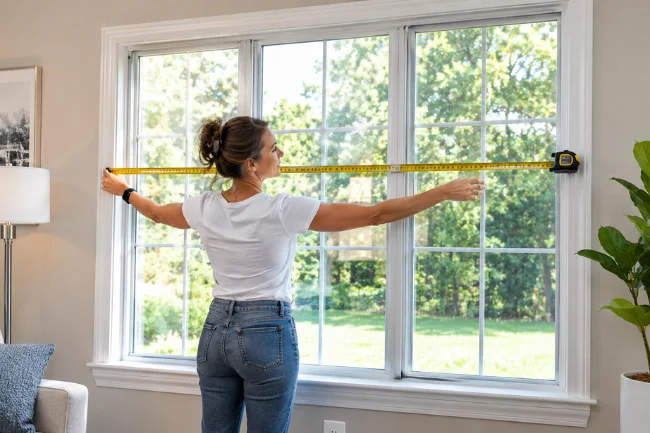
Accurate measuring is the most important part of choosing oversized curtains.
Don’t assume that the dimensions printed on the curtain packaging match the area you need to cover.
Curtain width, hanging length, rod placement, and fabric fullness are separate measurements.
Measure the Full Window Width
Use a metal tape measure to record the width from one side of the window frame to the other.
Then decide how far the curtain rod should extend beyond the frame.
A common starting point is approximately 6–12 inches on each side, where wall space allows.
The extra width helps the open curtains gather beside the glass instead of blocking it.
For very wide windows, more space may be necessary.
Calculate Curtain Fullness
Fullness describes the additional fabric that creates folds when curtains are closed.
For many flat ready-made panels, a total fabric width of around 1.5–2.5 times the curtain rod width provides a useful starting range.
About twice the rod width works well for many conventional arrangements.
For example:
- Window width: 96 inches
- Rod extension: 8 inches on each side
- Total rod width: 112 inches
- Desired fabric fullness: 2 times the rod width
- Total flat curtain width needed: 224 inches
If each ready-made panel is 56 inches wide, four panels provide 224 inches of flat fabric.
This calculation applies to panels sold by their flat fabric width. Custom pleated and ripple-fold curtains may use different ordering measurements.
I recommend checking the specific heading system before buying.
Measure the Correct Curtain Length
Decide where the rod or track will be installed before calculating the curtain length.
Measure from the appropriate hanging point—such as the rod, ring, or track carrier—to the desired bottom edge.
For floor-length curtains, leaving approximately half an inch of clearance is a common practical choice.
Also measure at several points along the window.
Floors and ceilings aren’t always perfectly level, particularly in older homes.
Choosing the Right Curtain Length
Curtain length changes the overall appearance of a room.
For large windows, floor-length panels usually create a more cohesive look than curtains ending halfway down the wall.
Curtains That Hover Above the Floor
Panels ending slightly above the floor are practical for busy households.
They are easier to open and close without dragging, and the bottom edges are less likely to collect dust.
This is the option I would choose for everyday living rooms.
Curtains That Just Touch the Floor
Curtains that lightly meet the floor can create a tailored appearance.
However, they require accurate measuring because even a small installation difference may cause uneven contact.
Puddled Curtains
Puddled curtains extend beyond floor level, creating folds of fabric on the ground.
They can look decorative in formal spaces but are less practical around pets, children, and frequently used doors.
I generally prefer avoiding puddling where curtains need to move daily.
Where Should You Hang Curtains on Large Windows?
Rod placement is one of the simplest ways to improve the appearance of oversized windows.
A rod installed directly above the frame may make the window look shorter than it really is.
Hang the Rod Higher
Depending on ceiling height and available wall space, positioning the rod several inches above the window frame can create a taller appearance.
For some rooms, mounting closer to the ceiling produces a particularly clean result.
But don’t choose an arbitrary height without checking available panel lengths.
I would mark the proposed rod position with painter’s tape before drilling.
Stand back and look at the whole wall to see whether the height feels balanced.
Extend the Rod Beyond the Window
A curtain rod that ends exactly at the window frame forces the fabric to gather in front of the glass.
This can reduce daylight and make the opening appear narrower.
Extending the hardware beyond the window allows the curtains to frame the view more effectively.
For extra-wide windows, account for how much space the gathered fabric occupies.
Designers often call this the stack-back.
Don’t Forget the Curtain Stack-Back
Stack-back is the width occupied by curtains when they are fully opened.
It’s one of the most overlooked details in large-window planning.
A thick velvet curtain may gather into a substantial bundle. A lightweight sheer curtain generally occupies less space.
If you want an unobstructed view, the rod or track needs enough length beyond the glass to accommodate the gathered panels.
Here’s the practical approach I recommend: before ordering, ask the curtain supplier for the expected stack-back of your chosen fabric and heading style.
That measurement is more reliable than assuming every curtain gathers into the same amount of space.
It’s particularly valuable for sliding glass doors and windows overlooking a garden.
Best Curtain Heading Styles for Wide Windows
The heading is the way fabric attaches to the curtain rod or track.
It affects appearance, movement, and the amount of fabric required.
| Heading style | Appearance | Best use | Consideration |
|---|---|---|---|
| Grommet | Large, regular folds | Casual modern rooms | Needs compatible pole and clearance |
| Pinch pleat | Tailored, structured folds | Formal or classic interiors | Accurate measuring is essential |
| Ripple fold | Continuous, even waves | Wide modern windows | Requires compatible track system |
| Rod pocket | Soft, gathered top | Mostly decorative curtains | Can be difficult to slide |
| Back tab | Neat, relaxed folds | Simple room designs | Frequent opening may be less convenient |
For curtains that will open and close every day, I would lean toward a smooth-running track or a compatible ring-and-rod system.
Rod-pocket curtains can look attractive, but repeated movement across a wide window may become frustrating.
Curtain Ideas for Different Rooms
The same curtain design won’t suit every large window in the house.
I recommend selecting the fabric and hanging system according to how the room is used.
Living Room Curtains
A large living room window often benefits from curtains that frame the view without making the space feel crowded.
Light-colored linen-look panels, textured neutrals, or layered sheers work well.
For a room with dark furniture, lighter curtains can help balance the visual weight.
I would avoid overly complicated patterns if the window already occupies most of the wall.
Bedroom Curtains
Large bedroom windows need a balance between privacy, daylight, and sleep comfort.
Blackout-lined curtains can reduce unwanted light, while a sheer layer allows some privacy during the day.
If you’re updating a bedroom without major construction, my renter-friendly bedroom makeover ideas offer other practical ways to refresh the space.
Dining Room Curtains
Dining rooms can accommodate slightly more decorative fabrics.
Pleated curtains, subtle patterns, and warm neutral colors can complement dining furniture without overwhelming the windows.
Keep the fabric clear of furniture that could interfere with opening and closing.
Sliding Glass Door Curtains
Wide sliding doors need a treatment that works with frequent movement.
A ceiling-mounted track or appropriate traverse system can be more practical than a basic rod.
Check that the curtains stack away from the main walking path and don’t become trapped in the door.
Should You Layer Curtains on Large Windows?
Layering combines two different window treatments, usually a sheer layer and a more substantial curtain.
It’s useful when you want soft daylight during the day and greater privacy after dark.
For example, the sheer curtains can remain closed while the heavier panels are opened.
At night, the heavier panels can be drawn across the glass.
I like this arrangement in bedrooms and living rooms, but it requires additional planning.
Two layers need suitable hardware, enough clearance between fabrics, and sufficient wall space for their combined stack-back.
Also consider maintenance. More fabric means more dusting, washing, or professional cleaning.
Can Curtains Help With Heat and Cold?
Curtains can help manage indoor comfort, particularly when they are lined and fitted close to the window.
In warm weather, closing suitable curtains against strong sunlight can reduce solar heat entering the room.
During colder periods, closing curtains at night can help reduce heat transfer around windows.
However, fabric type, installation gaps, climate, and window construction all affect the result.
The Australian Government’s household window guidance recommends close-fitting, lined curtains as one way to improve temperature control.
I wouldn’t assume every heavy-looking curtain provides the same insulation.
A properly designed lining and careful fit may matter more than decorative thickness alone.
How to Install Curtains on Large Windows Safely
Large curtains can place substantial weight on a rod or track.
Long spans also increase the chance of bending or sagging.
Choose Hardware Rated for the Load
Before purchasing a curtain rod, check its supported span, weight capacity, and bracket requirements.
A lightweight decorative rod may not be suitable for wide, lined drapes.
Longer installations often require additional brackets or a track designed for continuous support.
Follow the hardware manufacturer’s instructions, especially when using extension rods.
Check the Wall Before Drilling
Brackets should be secured using fixings suitable for the actual wall structure.
Drywall alone may not provide adequate support for heavy curtains unless correctly rated anchors are used.
Locate suitable structural support where required and check for concealed electrical cables or plumbing before drilling.
For unusually heavy installations or difficult surfaces, professional fitting is worth considering.
Consider Child Safety
Window coverings with accessible cords can present a strangulation hazard to young children.
The U.S. Consumer Product Safety Commission recommends cordless window coverings wherever young children are present.
I would prioritize cordless systems over decorative cord-operated arrangements in family homes.
Budget-Friendly Curtains for Large Windows
Covering an oversized window can become expensive, particularly when custom fabric and installation are involved.
Fortunately, there are ways to control costs without sacrificing appearance.
Combine Ready-Made Panels
Using several matching ready-made panels can be more affordable than ordering custom curtains.
Choose panels with consistent fabric, length, and color.
Before buying, confirm that the total width provides enough fullness.
Also check whether the panels can be joined or arranged neatly without noticeable gaps.
Choose Simple Hardware
A reliable, appropriately rated rod or track matters more than decorative finials.
I would direct more of the budget toward suitable fabric and dependable support rather than unnecessarily elaborate accessories.
Consider Alterations
If ready-made curtains are slightly too long, professional hemming may be an economical option.
Shortening is usually easier than adding significant length.
Measure carefully before purchasing, especially if the fabric might shrink during its first wash.
Common Mistakes When Choosing Curtains for Large Windows
Some curtain problems become obvious only after installation.
The most common issues I would watch for include:
- Buying panels based on window width without allowing for fullness.
- Ignoring the extra rod length needed for open curtains.
- Choosing fabric that is too heavy for the hardware.
- Forgetting to measure from the actual hanging position.
- Blocking heating vents, doors, or frequently used furniture.
- Using sheer curtains where nighttime privacy is necessary.
- Choosing curtains without checking washing instructions.
- Installing brackets without suitable structural support.
I would also avoid buying every panel before checking a fabric sample in the room.
Large windows expose more material to natural light, which can dramatically change how a color appears.
A Simple Checklist Before You Buy
Before ordering curtains for large windows, I recommend recording the following details:
- Window width and height
- Planned rod or track position
- Total hanging width
- Required curtain length
- Desired fabric fullness
- Preferred heading style
- Expected stack-back
- Privacy and light-control needs
- Hardware weight capacity
- Cleaning and maintenance requirements
Keep these measurements together with a photo of the window.
That gives you a much stronger starting point when comparing ready-made curtains, requesting custom quotes, or discussing installation with a supplier.
Frequently Asked Questions About Curtains for Large Windows
What type of curtains looks best on large windows?
Floor-to-ceiling curtains, ripple-fold drapes, and full-width linen-look panels often complement large windows while creating a balanced appearance.
How wide should curtains be for a large window?
For many ready-made flat panels, aim for a combined fabric width of approximately 1.5–2.5 times the rod width, depending on the desired fullness.
Should large-window curtains touch the floor?
Floor-length curtains usually look balanced. Leaving about half an inch above the floor is practical for everyday use and cleaning.
Are sheer curtains good for large windows?
Yes. Sheer curtains soften daylight and preserve an open appearance, but they offer limited privacy at night.
Do large windows need special curtain rods?
Often, yes. Wide spans and heavy fabrics may require stronger rods, additional brackets, or appropriately rated curtain tracks.
Choose Curtains That Fit the Window and Your Lifestyle
The best curtains for large windows do more than fill an oversized opening.
They control light, provide the privacy you need, complement the room, and operate smoothly without blocking the view unnecessarily.
I recommend starting with accurate measurements, deciding how much light control you need, and choosing fabric that suits your daily routine.
Before placing an order, confirm the panel width, hanging length, stack-back, and hardware requirements.
With those details settled, a large window can become one of the most attractive and functional features of your home.