
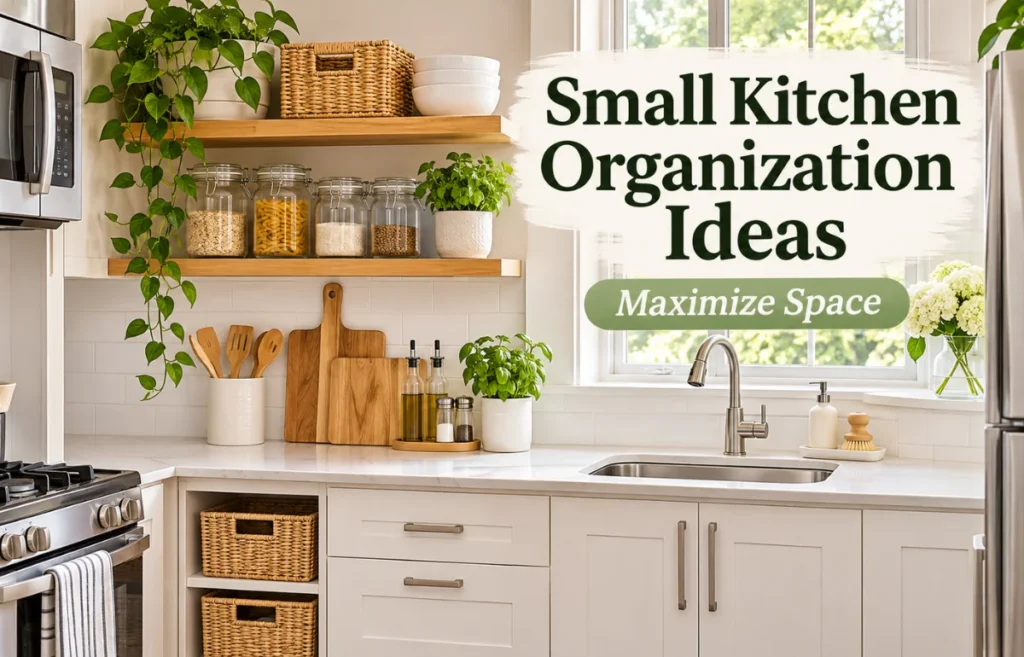
Small Kitchen Organization Ideas are practical ways to arrange food, cookware, dishes, and everyday tools so a compact kitchen is easier to use. They include clearing countertops, assigning storage by activity, adding adjustable organizers, using cabinet space more efficiently, and keeping frequently used items within reach. The goal is not to squeeze more belongings into every inch. It is to make cooking, cleaning, and putting things away simpler without expensive remodeling.
A kitchen can feel crowded even when its cabinets aren’t full. A toaster, a drying rack, and a few unopened grocery bags may leave no safe place to chop vegetables. I would begin by fixing that daily frustration rather than buying a matching set of containers. The most effective change is often to give each important task an uncluttered place to happen.
Begin With a Kitchen Traffic Check
Before moving everything, observe the room during one ordinary meal. Where do you place groceries? Where do you wash produce? Which cupboard makes you cross the kitchen repeatedly? Notice what ends up on the counter because its proper home is inconvenient.
I use a simple reach-and-return test: take out an everyday item, use it, then put it away. If returning it requires moving three other objects, that storage spot isn’t working. The problem may be accessibility rather than a shortage of cabinets.
Make a short inventory of the trouble spots
Write down the three biggest annoyances, such as no chopping space, pans stacked too high, or food hidden at the back of a deep cabinet. Photograph the counters before reorganizing. This gives you a more useful before-and-after comparison than judging how tidy the room looks for five minutes.
Start with the problem that interrupts you most frequently. An efficient kitchen is organized around what actually happens there, not a showroom layout.
Protect One Clear Countertop Work Zone
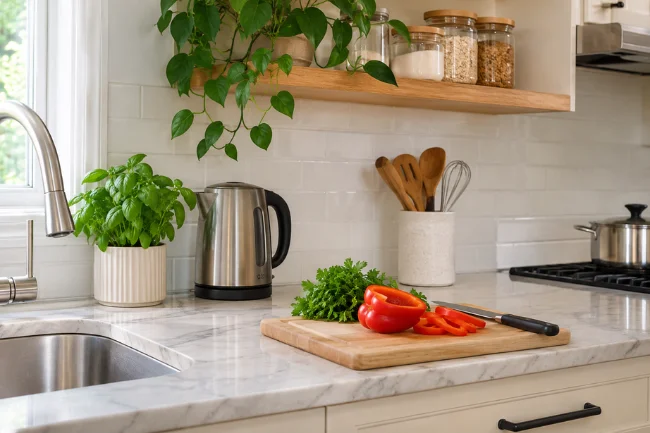
Counter space is precious because it performs several jobs. I would choose one stable, easy-to-clean section for everyday food preparation, ideally near the sink without crowding the cooking area. Move unopened mail, decorative trays, rarely used appliances, and surplus utensils somewhere else.
You don’t have to keep every counter bare. A kettle used daily may deserve a permanent place. A bread maker used twice a month probably doesn’t. The distinction is frequency, not whether an appliance looks attractive.
Give the counter a landing place, not a dumping place
Keep a small, defined area for groceries as they come in, but clear it after unpacking. Don’t let this area overlap the main chopping space. If there is almost no spare countertop, a stable, purpose-made over-sink cutting board may provide occasional extra workspace when used as directed. It should fit securely and never interfere with safe sink access.
Avoid placing boards or accessories over active burners. A temporary work surface must not introduce a heat, tipping, or cutting hazard.
Organize Cabinets Around Daily Activities
Instead of sorting every cabinet by object category, group items by their point of use. Place drinking glasses near where you fill them, everyday dishes near the serving area, and cooking utensils close enough to reach without leaning over a hot stove.
I think of a small kitchen in four practical zones: preparation, cooking, washing, and pantry storage. They may overlap in a tiny room, and that’s fine. The goal is to cut unnecessary steps and keep the main path clear.
| Kitchen zone | Keep within easy reach | Move elsewhere |
|---|---|---|
| Preparation | Cutting board, frequently used knife, mixing bowl | Duplicate gadgets and occasional baking tools |
| Cooking | Daily pan, spatula, commonly used seasonings | Specialty cookware and backup utensils |
| Washing | Dish soap, sponge, drying essentials | Extra cleaning stock and unused bottles |
| Pantry | Regular ingredients and open packages | Excess duplicates and seasonal serving pieces |
Put weight and reach first
Heavy pots, cast-iron pans, and bulky appliances belong on sturdy lower shelves wherever possible. Reserve eye-level space for light items used often. I would not put a heavy stand mixer above shoulder height simply to make the counter look clear.
Check shelf load limits before adding risers or stacking dishes. If a cabinet is awkward to reach, keep it for lightweight, occasional-use items rather than daily essentials.
Give Deep Cabinets a Better System
Deep cabinets often look spacious but hide forgotten ingredients behind the front row. Begin by removing expired products and duplicates. Group similar packages in washable, appropriately sized bins that can be pulled out without tipping.
A turntable can work for small jars where it fits and rotates freely. Shelf risers can separate low stacks of plates or cups. Neither is useful if it jams the door or makes the contents harder to see.
Measure the opening, not just the shelf
Here’s a detail I always include in a storage plan: measure the usable door opening as well as the interior width, depth, and height. A bin may fit on the shelf but fail to pass the hinges. Leave clearance for handles and for pulling the organizer toward you.
Try a cardboard template before purchasing an expensive slide-out unit. It’s a simple way to test whether the motion works in your particular cabinet.
Make Drawers Easier to Use Without Overfilling Them
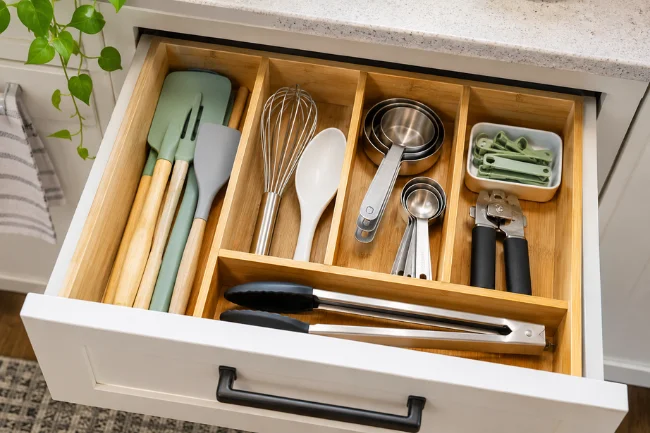
Drawers can hold plenty of utensils yet feel chaotic when everything rolls together. Start by emptying one drawer, wiping it clean, and sorting out doubles. Keep the tools used for daily cooking near the front and specialized gadgets toward the back.
Adjustable dividers are useful when they truly separate categories. A few small boxes you already own may work just as well, provided they’re clean, stable, and suitable for the drawer.
Check the drawer in motion
Open and close the drawer several times after arranging it. Tall tools can snag inside, and loose dividers can slide around. A useful organizer should make a drawer easier to open, not merely look neat in a photograph.
For knives, choose a suitable protective drawer insert, block, or other secure storage that protects blades and hands. Avoid a loose pile of sharp tools.
Use Vertical Space Carefully
Walls, cabinet doors, and upper shelves can help, but not every empty surface should become storage. I prefer low-profile solutions that don’t reduce walking clearance or interfere with opening doors.
A properly installed rail can hold appropriate utensils away from the cooking heat. An over-cabinet hook may work for a lightweight cloth if it doesn’t damage the door or prevent it from closing. For renters, check lease restrictions before drilling or making permanent changes.
Keep stove and electrical areas clear
The U.S. Fire Administration’s kitchen safety advice says to keep towels, paper products, curtains, and other combustible materials away from the stovetop. Don’t install shelves, adhesive hooks, or hanging baskets where heat or steam could loosen them or make their contents unsafe.
Keep outlets accessible and follow appliance instructions. A microwave or another cooking appliance shouldn’t be connected through an extension cord simply to free a counter corner.
Organize the Pantry So You Can See What You Own
Food storage works best when it reduces forgotten purchases. I would group everyday staples—rice, pasta, beans, flour, cereal, and canned foods—by how they’re used. Keep labels facing forward and put opened packages where they’re easy to notice.
Clear containers are optional, not a requirement. Original packaging often carries cooking instructions, allergens, expiration information, and storage directions. If you decant food, transfer essential label details and keep containers food-safe and clean.
Adopt a first-in, first-out habit
Place older suitable products in front of newer ones, using dates and package guidance rather than appearance alone. Keep dry food away from leaks, excess humidity, heat, and household chemicals. The FDA’s food-storage guidance specifically advises separating food from cleaning chemicals.
Don’t buy uniform jars until you’ve counted what you actually store. A collection of beautiful but half-empty containers can waste more room than the original packages.
Give the Refrigerator Breathing Room
A small refrigerator can become just as crowded as the cupboards. Group foods by type, use a designated spot for leftovers, and check dates regularly. Avoid packing shelves so tightly that cold air cannot circulate.
For food safety, the FDA recommends keeping the refrigerator at or below 40°F (4°C) and the freezer at 0°F (-18°C), checking with appliance thermometers. Store raw meat, poultry, and seafood in leakproof containers, preferably low enough to prevent drips onto ready-to-eat foods.
I would rather use two practical bins than six narrow ones that prevent the refrigerator door from closing properly. Never block vents or change the appliance’s intended airflow.
Choose Organizers for Problems, Not Appearances
Small kitchen storage ideas are often sold as collections of matching products. Before buying, I ask what the organizer actually fixes. Does it make something easier to reach, protect a fragile item, or create more usable working space? If not, it may simply turn clutter into organized clutter.
| Organizer | Useful when | Check before using |
|---|---|---|
| Adjustable drawer divider | Utensils mix together | Drawer clearance and stability |
| Cabinet shelf riser | Vertical room is wasted | Shelf strength and safe stacking |
| Pull-out bin | Deep items are difficult to reach | Door hinges and full extension |
| Small turntable | Jars hide in a corner | Base grip, clearance, and load |
| Over-cabinet hook | A lightweight item needs a home | Door closure and surface protection |
Try repurposing a sturdy existing tray or container before buying anything. Reuse is especially practical when cabinet dimensions are unusual.
Make the Kitchen Look Bigger Without Remodeling
A kitchen feels visually busier when many small objects compete for attention. Clear one sightline from the doorway, remove unused decorations from the counter, and store mismatched packages inside cabinets where practical. These changes don’t alter the room’s square footage, but they can make its layout easier to read.
Use light and color with restraint
Clean windows, wipe reflective surfaces, and make sure task lighting reaches the preparation area. If choosing a new bulb, confirm compatibility with the fixture; don’t improvise hardwired electrical changes. A consistent color palette for the few items left on display can soften visual clutter.
Painting is optional, and organization should come first. If you’re considering refreshing kitchen walls, my guide to preparing a room for painting explains the preparation basics. Choose finishes suitable for kitchen conditions and resolve any moisture problem before repainting.
Create a Realistic Small Kitchen Budget
I’d begin with a no-spend reset, then set a modest cap for products that solve persistent problems. The example below is a planning allowance in US dollars, not a claim about current store prices.
A possible $75 budget might allow $20 for drawer dividers, $20 for a cabinet riser or bin, $15 for food-safe pantry containers only if needed, and $20 reserved for one problem you discover during the reset. You may spend less if you already own useful organizers.
Don’t buy first and measure later. For every item, write down the cabinet dimensions and the exact job it will perform. If the intended benefit isn’t clear, keep the money.
For more affordable ways to improve your living space, explore my budget-friendly home makeover ideas without taking on an expensive renovation.
Use a 30-Minute Reset to Keep Clutter From Returning
Reorganizing everything in one day can be exhausting. I would start with thirty minutes and one visible problem. Clear the food-prep counter, put frequently used tools close to their actual tasks, and remove obvious duplicates.
Then establish a short evening reset: return appliances to their assigned homes, clear the sink area, wipe preparation surfaces, and check for food that needs refrigeration. Keep the routine realistic; a system that takes twenty minutes after every meal is unlikely to last.
Try the seven-day return test
After a week, notice which items keep returning to the countertop. That is useful feedback, not failure. Maybe the blender belongs in a lower cabinet instead of a high shelf, or the dishcloth needs a more convenient safe hook. Adjust the system to the way you actually cook.
The best small kitchen organization ideas should make ordinary days easier, even when the room isn’t picture-perfect.
Mistakes That Make Small Kitchens Feel More Crowded
One common mistake is storing everything vertically without checking safety or reach. Another is buying duplicate racks for items that should have been donated or moved first. I also avoid placing the trash bin where it blocks the dishwasher or keeping a rolling cart in a path too narrow for comfortable movement.
Don’t sacrifice ventilation, electrical access, or safe cooking clearances for a tidy appearance. Keep emergency exits unobstructed, and make sure cabinet doors and appliance doors can open without collisions.
If a storage solution adds another task every time you cook, it probably needs simplifying.
Frequently Asked Questions About Small Kitchen Organization
How do I organize a small kitchen with very little cabinet space?
Keep daily essentials in the easiest-to-reach cabinets, remove duplicates, and use measured dividers or shelf risers where they genuinely improve access.
What should I keep on a small kitchen countertop?
Keep only regularly used appliances and tools that fit without crowding a clear, safe food-preparation area.
How can I organize a small kitchen on a budget?
Start by decluttering and rearranging what you already own. Buy one measured organizer only after identifying a specific storage problem.
How do I make a small kitchen look less cluttered?
Clear countertops, group visible items, improve task lighting, and keep frequently used supplies in convenient, assigned places.
Are wall-mounted storage racks safe near a stove?
Avoid placing racks or combustible items near stove heat. Follow installation and appliance-clearance instructions, and keep cooking areas accessible.
Make Every Inch Work Without Filling Every Inch
I wouldn’t judge a kitchen makeover by how many containers fit inside the cupboards. I’d judge it by whether I can unload groceries, prepare a meal, and clean up without moving the same objects repeatedly.
Choose one frustrating area today—your prep counter, a deep cabinet, or a crowded drawer—and give its contents better homes. A small kitchen can feel noticeably more comfortable when the space you already have finally works for you.

Nora Ellis writes about practical kitchen organization, space-saving storage, and affordable upgrades for DIY Home Makeovers. With 5 years of experience in kitchen improvement projects, she focuses on realistic solutions that help homeowners make better use of limited space, reduce clutter, and create more functional kitchens.