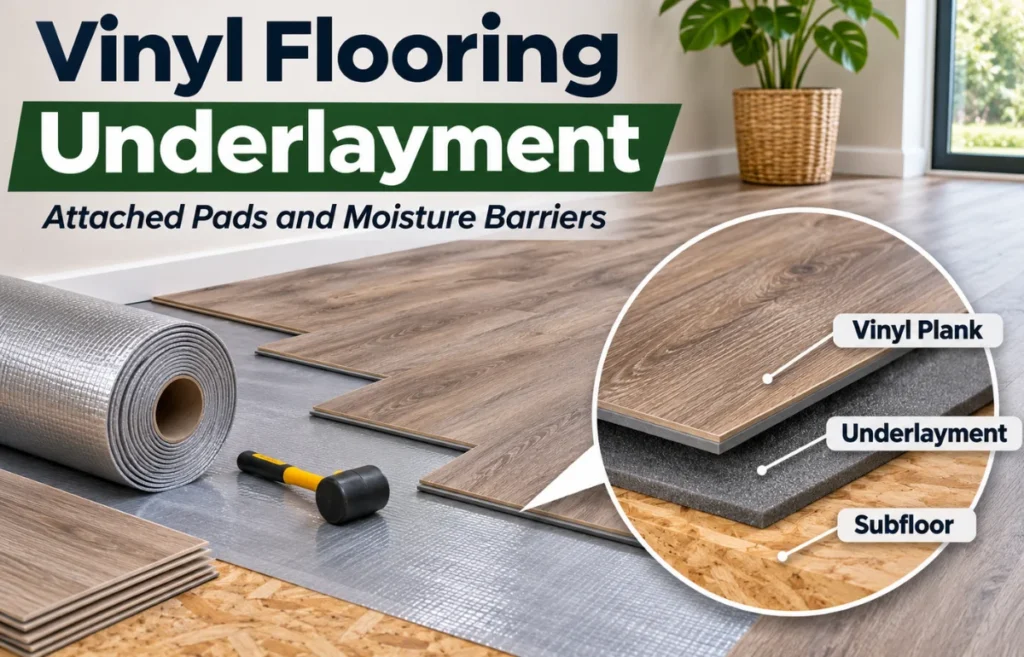
Vinyl flooring underlayment is a layer installed between a subfloor and vinyl flooring to provide support, reduce some noise, or help manage moisture, depending on the product. It may be a thin foam or cork-based layer, a specialized acoustic material, or a rigid underlayment panel used to smooth a subfloor.
Not every vinyl floor needs one. Many luxury vinyl planks (LVP) have a pad already attached, while glue-down vinyl generally needs a smooth, firm surface rather than a loose cushioning layer.
The right choice depends on the flooring’s installation method, the subfloor, and the manufacturer’s instructions. If I had to give one rule before buying anything, it would be this: never assume that adding more padding makes a vinyl floor better.
Why Underlayment Is Not an Automatic Upgrade
A good underlayment can make footsteps sound less sharp and improve the feel of a floating floor. Certain products also help separate vinyl from minor subfloor texture or provide a specified moisture-control layer.
But underlayment cannot repair a moving subfloor, fill significant low spots, or stop an active water problem. In fact, an overly soft layer allows click-lock planks to flex at their joints, potentially causing gaps or broken locking edges.
I think of underlayment as part of an engineered flooring system, not an accessory chosen by thickness or softness alone. The floor, backing, and subfloor have to work together.
Do You Need Underlayment for Vinyl Flooring? Start Here
The quickest way to narrow your options is to identify the installation method and inspect the underside of a sample plank.
| Flooring situation | Usually appropriate approach | What to check first |
|---|---|---|
| Floating LVP with an attached pad | No additional cushion unless expressly approved | Rules for extra underlayment and concrete vapor barriers |
| Floating LVP without a pad | Vinyl-rated underlayment if required or permitted | Approved type, thickness, density, and compression limits |
| Glue-down luxury vinyl tile (LVT) | Smooth, solid substrate or approved underlayment panel | Adhesive and subfloor preparation specifications |
| Sheet vinyl | Method-specific smooth substrate or approved panel | Whether the sheet is loose-laid, perimeter-bonded, or fully glued |
| Vinyl over concrete | Moisture testing, then the specified protection | Whether a polyethylene film or other system is required |
These are starting points, not universal installation instructions. One manufacturer may require a separate vapor retarder beneath padded planks, while another may specify a different assembly.
Before I would purchase underlayment, I would locate the exact flooring model number. Brand-level advice is not enough when the same company sells several locking systems and backing types.
Attached-Pad Vinyl Flooring: When More Padding Becomes a Problem
An attached pad is a thin backing bonded to the underside of the vinyl plank. Common backing materials include foam and cork. Its job is to supply the support and sound-damping properties designed into that particular product.
Adding another soft roll underneath might feel appealing in a store sample, but floors behave differently under a refrigerator, dining table, or repeated foot traffic. Extra compression can let individual planks move more than their click joints were designed to tolerate.
I would not try to make a hard vinyl floor feel like carpet by stacking padding. If softness is a top priority, I would compare flooring products with different integrated backing systems instead.
A Real Manufacturer Difference Worth Understanding
Pergo’s October 2026 vinyl warranty conditions state that a product with integrated underlay must not be installed over another underlay or an overly soft support. The document also warns against unsuitable laminate underlayments beneath click vinyl.
By contrast, Floor & Decor’s attached-pad guidance describes certain approved supplementary products for some flooring installations. This is why the blanket advice “never add underlayment under padded vinyl” is too broad, even though avoiding extra padding is often the safest default.
The takeaway is not that one company is stricter. It is that approvals are product-specific. A label reading “for luxury vinyl” does not override the instructions for your exact flooring.
Comparing Underlayment Materials for Vinyl Plank Flooring
I look at a material’s purpose before its advertised comfort. A dense, thin underlayment designed for click-lock vinyl is a different product from a soft, thick foam roll intended for laminate.
| Material or layer | Main purpose | Main limitation |
|---|---|---|
| Vinyl-rated high-density foam | Modest cushioning and sound reduction | Must meet the flooring’s compression and thickness limits |
| Cork underlayment | Acoustic comfort and a resilient surface | Not inherently a vapor barrier; approval matters |
| Rubber or composite acoustic mat | Impact-noise control in specified systems | Thickness and flexibility may exceed click-floor limits |
| Polyethylene vapor-retarder film | Limits moisture-vapor movement from concrete when specified | Does not level the floor or add meaningful cushioning |
| Flooring-grade plywood underlayment | Creates a smoother substrate for certain adhered vinyl floors | Must be installed and finished correctly; not a soft pad |
Foam chemistry, density, and advertised thickness alone cannot establish suitability. A 1.5 mm product might be acceptable for one floating vinyl line and prohibited for another.
Be especially careful with products marketed for laminate or hardwood. Those floors can tolerate different loading and movement characteristics. I would rather see explicit compatibility with the exact vinyl system than a long list of flooring categories on a package.
Vinyl Flooring Underlayment Over Concrete
Concrete changes the decision because moisture can migrate through a slab even when its surface looks dry. Waterproof vinyl planks resist water damage to the planks themselves, but that does not mean trapped moisture cannot affect adhesives, nearby materials, or conditions beneath the floor.
A thin polyethylene film—often specified as 6 mil, or approximately 0.15 mm—is required for certain floating vinyl installations over concrete. Floor & Decor’s DuraLux guidance, for example, calls for a minimum 6-mil film. Never treat that figure as a rule for every vinyl product.
Moisture Barrier Versus Moisture Testing
A vapor retarder limits vapor movement; it does not certify that a slab is suitable for flooring. If moisture is a concern, obtain the testing required for the flooring and adhesive system before installation.
ASTM F2170 measures internal relative humidity in concrete using in-situ probes. The acceptable result comes from the selected flooring or adhesive instructions, not from a universal number circulating online.
I would also investigate visible dampness, leaks, hydrostatic pressure, and missing ground-vapor protection rather than hoping plastic film will fix them. An underlayment is no substitute for correcting the source of water.
What About Plywood and Existing Wood Subfloors?
On wood, my first concern would be movement. Loose boards, squeaks, damaged panels, and raised seams should be repaired before any foam or vinyl goes down. Padding may soften a minor sound, but it will not strengthen weak framing or stabilize a shifting board.
Wood subfloors also need appropriate moisture conditions and ventilation. Do not automatically place an impermeable plastic sheet over plywood just because it is recommended over concrete; the construction and flooring instructions may call for a different approach.
If the vinyl is glued down, a properly installed flooring-grade plywood underlayment panel may be used to create a smooth surface. That is a structural preparation layer, not a cushion.
Glue-Down LVT and Sheet Vinyl Need a Different Approach
Floating click-lock planks need controlled support beneath their locking edges. Glue-down LVT needs a substrate suitable for adhesive bonding. A loose foam pad between glue-down vinyl and the floor generally prevents the installation from working as designed.
Karndean’s glue-down installation guidance calls for a firm, flat, smooth, dry, clean substrate and describes appropriate underlayment panels and moisture testing. Specialized adhesive-compatible acoustic systems exist, but they must be approved as a complete installation method.
Sheet vinyl varies by product, too. A loose-lay sheet, a cushion-backed sheet, and a fully adhered sheet may have different substrate requirements. I would always check the sheet manufacturer’s installation category before selecting a layer beneath it.
Can Underlayment Really Make Vinyl Floors Quieter?
Yes, but there are two different questions: Will footsteps sound quieter inside the room, and will less impact noise reach the room below? A backing can improve one without delivering the performance required for the other.
For an upstairs bedroom or condo, I would request the tested Impact Insulation Class (IIC) information for the actual floor-ceiling construction. ASTM E492 measures impact transmission through a floor-ceiling assembly, not an isolated pad sitting on a counter.
A high advertised acoustic rating may depend on a concrete slab, suspended ceiling, or insulation that your building does not have. If a homeowners association specifies an acoustic minimum, verify the assembly and obtain written approval before installation.
The Specifications I Check Before Buying
I start with the flooring’s instructions, then compare the underlayment technical sheet against them. Relevant details include thickness, compressive strength, long-term compression resistance, moisture-vapor performance, and whether the material is approved beneath an attached pad.
The biggest mistake is choosing solely by thickness. Thicker does not always mean quieter, stronger, or more comfortable. Support under concentrated loads and click-lock joints matter more than a plush feel in your hand.
Radiant floor heating adds another check. Extra layers can increase thermal resistance and may conflict with temperature limits or installation instructions. I would confirm that the entire flooring-and-underlayment assembly is approved for the specific heating system.
Also watch floor height. A few extra millimeters can affect door clearance, dishwasher removal, transition strips, and adjoining rooms. These details are much easier to handle before the flooring is installed.
Match the Decision to the Room
For a basement, I would prioritize concrete moisture evaluation and the manufacturer-specified barrier over extra cushioning. A damp basement requires moisture remediation, not simply a thicker underlayment.
In a kitchen, I would focus on a flat, well-supported installation that can tolerate concentrated loads and normal appliance use. Cabinet and island restrictions for floating floors should be checked separately; cushioning will not fix an incorrect installation around fixed structures.
For an upstairs room, noise may justify selecting a vinyl floor with a tested acoustic backing or a compatible underlayment system. In a bathroom, waterproof flooring still does not excuse unresolved leaks or poor perimeter detailing.
Prepare the Subfloor Before Opening the Underlayment
A flat surface usually matters more than adding another layer. To illustrate how specific these limits can be, Floor & Decor’s NuCore guidance calls for a flatness tolerance of 3/16 inch over a 10-foot span. Other products may set different tolerances.
Check high and low spots with a straightedge, then repair them with materials suitable for your subfloor. Remove dirt and debris, secure loose panels, and address protruding fasteners. Do not assume a cushion will hide a ridge or bridge a dip.
Next, follow the required moisture tests and acclimation or room-temperature instructions. If a film or roll underlayment is approved, follow its overlap, taping, orientation, and seam requirements rather than improvising.
I would also make a small dry layout near a doorway. It helps expose floor-height and transition problems before the main room is covered.
Five Costly Mistakes I Would Avoid
The first is doubling the padding beneath an attached-back product without written authorization. The second is substituting laminate foam for vinyl-rated material simply because it is cheaper or thicker.
The third is confusing a waterproof plank with a moisture-proof installation. The fourth is using underlayment to hide an uneven or moving subfloor. The fifth is treating an acoustic number as proof that a product will satisfy condo noise rules in any building.
Each mistake starts with the same assumption: an underlayment is a universal problem-solver. It is not. Its performance depends on the specific flooring assembly.
How to Protect Your Budget and Warranty
Skipping a separate pad can be the most economical choice when the flooring already includes one. You avoid unnecessary material, labor, and added floor height. A budget underlayment that damages click joints is not a saving.
I recommend keeping a simple compatibility record: flooring SKU, current installation guide, proposed underlayment model, subfloor type, moisture test results if required, and written manufacturer approval for any unusual combination.
This small documentation habit is easy to overlook. It helps installers work from the same specifications and provides useful records if an installation question or warranty dispute appears later. Keep your receipts and dated instructions alongside it.
Final Verdict: Buy Compatibility, Not Extra Cushion
Vinyl flooring underlayment is useful when it solves a specific, approved problem: sound, substrate preparation, or moisture management. It is unnecessary—and sometimes harmful—when a vinyl floor already has the backing it needs.
Before you buy a roll, identify your flooring model, inspect the subfloor, and read the latest installation and warranty instructions. If the proposed combination is not clearly permitted, ask the manufacturer for written guidance. That one check can protect both your floor and your renovation budget.
Frequently Asked Questions
Do I need underlayment for vinyl plank flooring with an attached pad?
Usually not an additional cushion. Some manufacturers prohibit it; others allow specified products, so check the exact plank’s instructions.
Can I put vinyl plank flooring directly on concrete?
Often yes, after required preparation and moisture checks, but some floating products require a separate polyethylene vapor retarder.
What thickness underlayment is best for luxury vinyl plank?
There is no universal ideal thickness. Use a vinyl-rated product within the flooring manufacturer’s stated thickness and compression limits.
Does vinyl flooring underlayment help with soundproofing?
It can reduce some impact noise, but results depend on the entire floor-ceiling assembly. Check tested ratings for multi-story buildings.
Can I use laminate underlayment under vinyl flooring?
Not unless the vinyl manufacturer specifically approves it. Laminate underlayments can be too soft or thick for click-lock vinyl joints.