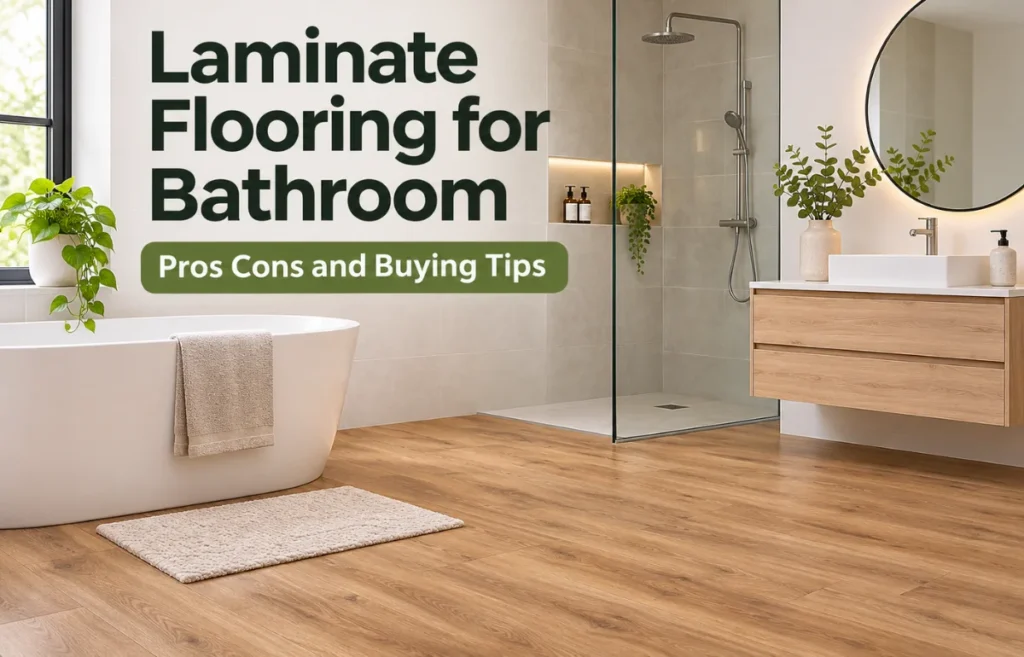
Laminate flooring for bathroom use is a wood-look or stone-look floating floor made from layered planks, typically with a wood-fiber core and a protective surface. Unlike ordinary laminate, bathroom-approved products have water-resistant joints, edges, or surface treatments designed to handle occasional splashes and wet feet. They can work in a family bathroom or powder room, but only when the manufacturer specifically permits bathroom installation and the floor is fitted and sealed as instructed. They are not a substitute for a waterproof shower base or a wet-room membrane.
I like laminate’s warm appearance and relatively straightforward upkeep, but a bathroom changes the buying decision. The question isn’t simply whether water beads on a sample plank. It’s whether the entire installed floor can cope with the way your bathroom gets wet.
Can You Put Laminate Flooring in a Bathroom?
Yes, with conditions. Modern bathroom-rated laminate can be suitable for enclosed bathrooms that experience normal splashes, provided water is wiped up promptly and the room is ventilated. Standard laminate without explicit bathroom approval is a gamble, even if its packaging says “water-resistant.”
The North American Laminate Flooring Association (NALFA) advises against using laminate in excessively moist areas such as bathrooms unless the manufacturer specifies that the product is waterproof. Quick-Step’s bathroom guidance provides an example of a product system intended for bathroom use, including special edge-sealing materials.
My rule is simple: product approval, installation instructions, and actual bathroom habits must all agree. If any one fails, I would choose another floor.
Why Bathroom Moisture Is Different From an Ordinary Spill
A kitchen spill is usually visible. Bathroom moisture can arrive from several directions at once: shower spray, damp towels, condensation, a toilet connection, or a slow leak under a vanity.
Most laminate has a decorative printed layer and wear layer above a high-density fiberboard core. The top may repel water, but exposed cuts and imperfect joints can still allow moisture to reach the core. If it swells, planks may develop raised edges, peaking, or gaps. Drying the surface won’t necessarily reverse the damage.
Water-Resistant Does Not Mean Floodproof
Water-resistant describes protection against specified exposure under stated conditions. “Waterproof” is often used for a complete flooring system, not permission to leave a bathroom flooded. A warranty may cover everyday surface spills while excluding overflowing tubs, plumbing leaks, or water underneath the planks.
For more on the construction, terminology, and waterproof claims themselves, see my companion guide to waterproof laminate flooring. Here, I’m focusing on what those claims mean inside a real bathroom.
The Hidden Risk Is the Edge of the Room
Even excellent plank joints cannot protect an open expansion gap beside a bathtub, toilet, doorway, or pipe. Water entering these places can travel beneath the floor, where it is harder to spot and dry.
This is why finishing details deserve as much attention as the planks.
Which Bathrooms Are Suitable for Laminate?
I would judge the bathroom by its daily water exposure rather than its size. A large bathroom with a walk-in shower that regularly sprays across the floor can be riskier than a small powder room with no shower.
| Bathroom type | Suitability for bathroom-approved laminate | My recommendation |
|---|---|---|
| Powder room with toilet and sink | Generally favorable | A sensible option if plumbing is sound |
| Main bathroom with enclosed shower | Conditional | Use only a bathroom-rated system and control splashes |
| Family bathroom used by young children | Higher risk | Consider vinyl or porcelain if bathwater often reaches the floor |
| Wet room with floor drain or open shower | Usually unsuitable | Use a properly waterproofed wet-room flooring assembly |
| Bathroom with recurring leaks or poor ventilation | Unsuitable until corrected | Fix the moisture problem before choosing a surface |
These are practical risk categories, not manufacturer ratings. Always check the exact product’s approved locations and local waterproofing requirements.
Some brands explicitly exclude shower rooms with built-in drains even when they approve conventional bathrooms.
What to Look for When Buying Bathroom Laminate
Written Bathroom Approval, Not a Shelf Label
Find the product’s current installation instructions and warranty. I would look for the word “bathroom” in the approved-use section, then read the exclusions.
Ask whether the warranty addresses surface water, joint penetration, or water reaching the subfloor, and what conditions must be met to retain coverage.
If the retailer says a floor is waterproof but cannot provide documentation for your specific collection, keep looking. Different lines from one manufacturer may have different protections.
Protected Joints and Edges
Tight click-lock profiles, coated bevels, and water-repellent edge treatments help limit water entering the seams.
They aren’t interchangeable with a properly sealed perimeter, though. Check whether the manufacturer requires its own sealant, foam backer rod, trims, or matching transition pieces.
Slip Resistance and Surface Texture
A textured wood-look plank can feel more reassuring than a glossy, polished finish, but texture alone does not prove slip resistance.
Ask for the product’s relevant wet-slip test results, especially if children or older adults use the bathroom.
A bath mat can help with wet feet, provided it is compatible with the floor and doesn’t trap moisture underneath.
Durability, Appearance, and Indoor Air Quality
Bathroom floors face dropped toiletries, cleaning products, and daily foot traffic. A durable wear layer and easy-clean finish matter, but an abrasion rating doesn’t tell you how waterproof the seams are.
For appearance, I tend to favor natural oak tones, subtle grain, and medium-width planks. They disguise ordinary marks better than very dark, shiny floors.
For indoor air quality, look for credible low-emission or compliant composite-wood certifications rather than vague “eco-friendly” claims.
Bathroom Laminate vs. Vinyl and Tile
Bathroom flooring comparisons are most useful when they account for moisture and daily comfort. These materials can all imitate wood, yet they behave very differently when water stays on the floor.
| Flooring | Main advantage | Main limitation in bathrooms | Best fit |
|---|---|---|---|
| Bathroom-approved laminate | Convincing wood look and comfortable feel | Wood-based core and installation details can remain vulnerable | Relatively dry bathrooms |
| Luxury vinyl plank (LVP) | Water-tolerant planks and easy upkeep | Water can still reach the subfloor at edges or gaps | Busy family bathrooms |
| Sheet vinyl | Few seams when correctly installed | Subfloor flaws can show; edges need careful detailing | Budget-conscious bathrooms |
| Porcelain tile | Highly water-resistant tile surface and durable finish | Harder and colder underfoot; grout needs care | High-splash bathrooms and properly designed wet areas |
Porcelain tile isn’t a waterproofing system on its own: wet areas still need an appropriate membrane and correctly built substrate.
Likewise, water-tolerant vinyl doesn’t prevent leaks at walls or fixtures. The whole floor assembly matters.
If the bathroom sees puddles every day, I’d generally choose a suitable vinyl system or tile over laminate. If splashes are occasional and the wood effect is a priority, approved laminate becomes a reasonable contender.
How to Install Laminate Flooring in a Bathroom Without Inviting Water Damage
The installation is where many otherwise sound choices become vulnerable. Treat the following as a planning checklist, not a replacement for your product’s instructions or local building rules.
1. Inspect the Subfloor Before Covering It
Look for stains, soft patches, loose tiles, musty smells, damaged toilet seals, and damp areas around the tub. Repair leaks first.
A new floor can hide a problem, not solve it.
The base must meet the product’s requirements for dryness, flatness, and stability. Concrete may need moisture testing and a specified vapor-control layer; wood subfloors need their own moisture assessment.
A generic “waterproof underlayment” cannot fix an actively wet subfloor.
2. Plan for Door Clearance and Floor Movement
Floating laminate expands and contracts. The manufacturer will specify perimeter and obstacle clearances, often in the neighborhood of 1/4 to 3/8 inch, but use the exact figure for your product.
Do not wedge planks tightly against a bathtub, vanity, or wall.
Check finished floor height at the toilet flange, doorway, and adjoining rooms. A poorly planned height change can create an awkward threshold or plumbing issue.
Where required, use a suitable transition profile rather than running planks uninterrupted into the hallway.
3. Seal the Entire Perimeter the Approved Way
This step is bathroom-specific. Some manufacturers require compressible foam backer rod plus flexible waterproof sealant in expansion gaps. Others specify proprietary trims or a sealing system.
The aim is to block surface water while preserving the floor’s ability to move.
Pay close attention to tub aprons, toilet areas, pipe penetrations, vanity edges, doorframes, and thresholds.
Follow the written detailing for each location; don’t simply fill every movement gap with rigid adhesive. Never assume a decorative baseboard alone provides a watertight barrier.
4. Keep the Shower Area Separate
Laminate belongs outside the shower enclosure unless a specific system and local rules explicitly allow otherwise.
It should not be installed as a shower pan, on a sloped shower floor, or over an integrated drain.
If you have a curbless shower, water can travel farther than you expect. I would plan the splash boundary with the installer before ordering a single box of flooring.
5. Test the Finished Details Before Normal Use
Inspect every seal, trim, pipe opening, and transition visually. Check for damaged locking edges or planks that rock underfoot.
Follow sealant curing instructions before exposing the room to water.
Avoid inventing a “bucket test” by pouring water over the new floor. A visual inspection and an installation checklist are safer than deliberately flooding an assembly that may have hidden weaknesses.
How to Keep a Laminate Bathroom Floor Looking Good
My preferred routine is deliberately simple: remove grit, prevent puddles, and give the room a chance to dry. Harsh cleaning is less useful than consistent moisture control.
Use a soft vacuum head or dry microfiber mop for dust and hair. For marks, use a lightly damp cloth or a cleaner specifically approved for the floor.
Avoid soaking the planks, leaving wet towels down, or using a steam cleaner unless the particular manufacturer explicitly allows it.
Run an exhaust fan that vents outside during showers and afterward, or use appropriate ventilation.
The EPA recommends ideally keeping indoor relative humidity between 30% and 50% when possible. A small hygrometer can tell you whether dampness lingers long after the mirror clears.
Pick up bath mats to let their undersides dry, and check around the toilet and sink periodically.
If a spill happens, wipe it promptly rather than relying on a water-resistance claim to give you extra time.
What Does Bathroom Laminate Really Cost?
The price on a box isn’t the whole project. Compare the installed cost, including removal of the old floor, subfloor repairs, underlayment, waterproof perimeter details, trims, door adjustments, and professional labor where needed.
In a small bathroom, cutting around fixtures and sealing edges can consume a surprisingly large share of the budget.
A cheap laminate plank may no longer be the economical option if its wet-area installation is complicated or the bathroom already has moisture damage.
I would request two itemized quotes: one for the exact bathroom-approved laminate system, and one for a suitable vinyl or tile alternative.
Then compare maintenance demands and the cost of repairing water damage, not just the initial purchase price.
Warning Signs Your Laminate Bathroom Floor Is Failing
Raised seams, curling edges, unexpected gaps, soft or bouncy spots, darkened joints, and a persistent musty smell deserve attention.
They don’t all prove water damage, but they should not be ignored.
First, investigate the moisture source: a leaking toilet, failed tub seal, condensation, or water entering at the doorway.
Dry the area and contact an appropriate flooring professional if moisture may be trapped underneath. Swollen fiberboard generally doesn’t return to its original shape just because the room dries.
Avoid covering damaged seams with another layer of caulk and calling the issue fixed.
Repairing the leak and assessing the subfloor matter more than making the surface look tidy.
My Bathroom Suitability Check Before Buying
Before choosing a plank, I run through five questions: Does the manufacturer name bathrooms as an approved location? Is the shower enclosed? Does the room dry out quickly after use? Are the subfloor and plumbing sound? Can the installer follow every required sealing detail?
If the answers are all yes, laminate may offer the look I want without the feel of cold tile.
If the bathroom regularly floods with splashes, has no reliable ventilation, or includes a floor drain, I would prioritize a different flooring assembly.
The biggest lesson is that bathroom suitability isn’t a label printed on the carton. It’s a combination of product design, installation quality, moisture exposure, and ordinary household behavior.
Frequently Asked Questions
Is waterproof laminate flooring good for bathrooms?
It can be, if the specific product is approved for bathrooms, installed with the required sealing system, and kept free of standing water.
Can I put laminate flooring around a toilet?
Yes, where the manufacturer permits it. The flange area, cut edges, and perimeter must be detailed correctly, and any toilet leak should be repaired first.
What happens if water gets under bathroom laminate?
Trapped moisture can damage the subfloor or swell a wood-fiber core. Find the source, dry the assembly, and assess whether planks need replacement.
Is laminate or vinyl better for a bathroom?
Vinyl is generally more forgiving in splash-prone bathrooms; approved laminate is appealing when the room stays relatively dry and wood-look realism matters.
Can you mop laminate flooring in the bathroom?
Use a lightly damp mop and an approved cleaner. Avoid puddles and steam cleaning unless the exact flooring instructions explicitly permit it.
The Bottom Line
Laminate flooring for bathroom spaces is worth considering when you want a convincing wood look and can control everyday moisture.
I would never choose it on appearance alone: check the exact bathroom approval, warranty, subfloor, and sealing requirements first.
Before ordering, download the manufacturer’s installation sheet and compare it with a vinyl or tile quote. That small bit of homework can prevent a much bigger bathroom repair later.