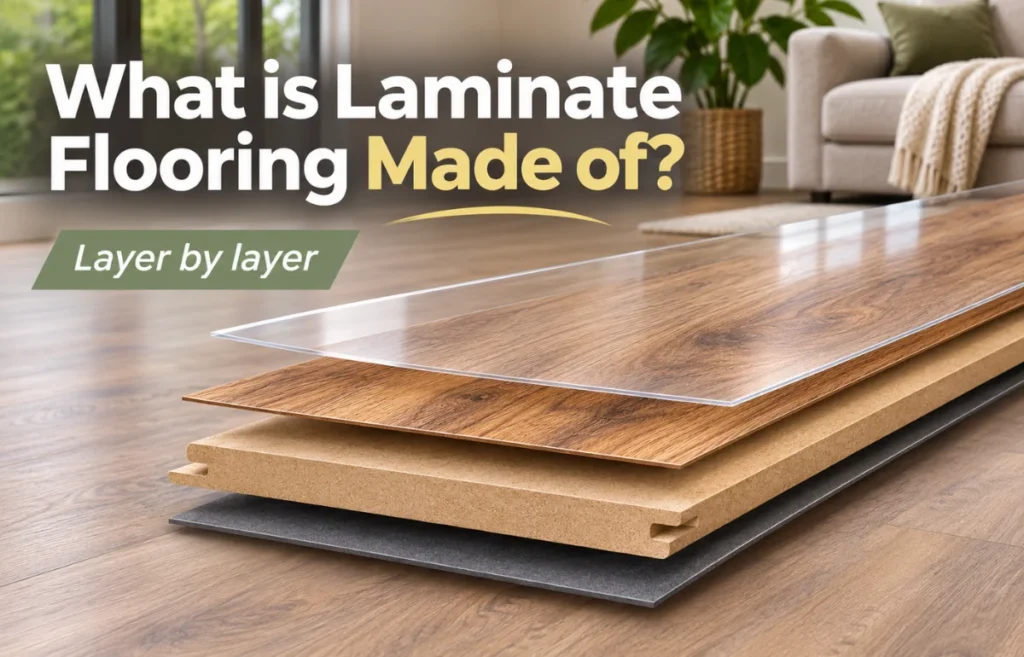
Laminate flooring is made of several layers bonded into a rigid plank, usually with a wood-fiber core, a printed decorative surface, and a protective resin coating. If you’re wondering “what is laminate flooring made of,” the simplest answer is compressed wood fibers, paper, resins, and wear-resistant minerals—not a solid piece of hardwood. Most conventional laminate planks have four main parts: a transparent wear layer, a design layer, a high-density fiberboard (HDF) core, and a stabilizing backing layer.
These materials work together to give laminate its realistic wood appearance, firm feel, and resistance to everyday scuffs. But each layer has a different job, and knowing what sits beneath the surface makes it much easier to judge quality, understand water-damage claims, and choose flooring that suits your room.
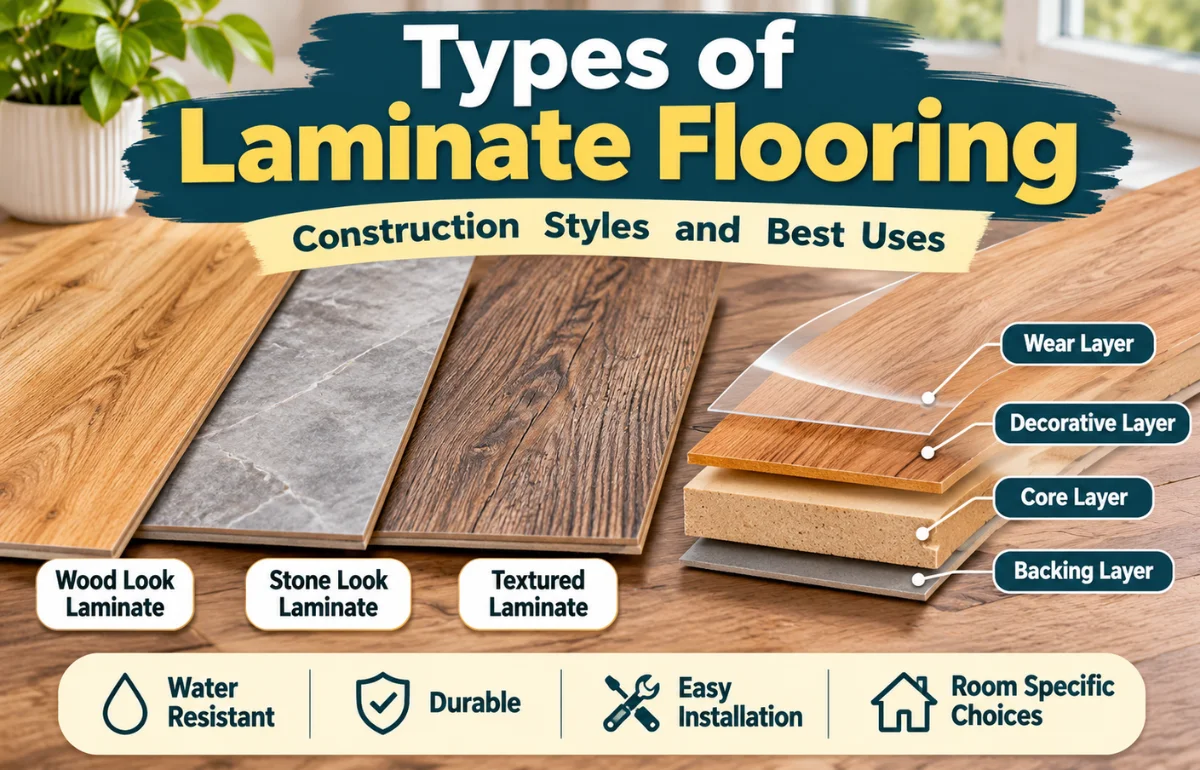
The Four Layers That Make Up Laminate Flooring
I think of laminate flooring as an engineered sandwich. Its upper layers protect and decorate; its center carries the load; and its underside helps the plank stay balanced. Manufacturers vary the ingredients and construction, but this is the typical arrangement from top to bottom.
| Layer | Common materials | Main purpose |
|---|---|---|
| Wear layer | Melamine-based resin, often with aluminum oxide | Resists abrasion, stains, and surface wear |
| Decorative layer | Printed paper and pigments, bonded with resin | Creates the wood, stone, or tile appearance |
| Core layer | Compressed wood fibers and bonding resins, usually HDF | Provides thickness, strength, and locking edges |
| Backing layer | Resin-impregnated balancing paper | Helps control warping and dimensional movement |
The North American Laminate Flooring Association (NALFA) describes laminate as a wood-based, multilayer floor covering with an overlay, décor, core, and backer. That’s a useful distinction: laminate may look like timber, but its decorative face isn’t usually a slice of real wood.
Layer 1: The Transparent Wear Layer
What Is the Wear Layer Made Of?
The top surface is generally a clear, hardened coating formed from melamine-based resin, often supported by paper and enhanced with tiny aluminum oxide particles. Under heat and pressure, the resin cures into a tough, protective finish bonded to the layer below.
Aluminum oxide is a hard mineral, not a sheet of metal. Its job is to improve abrasion resistance, especially against grit carried in on shoes. The amount and formulation vary by product, which helps explain why two visually similar laminates can perform very differently.
I pay attention to this layer because it’s the part that meets chair legs, pet claws, dropped crumbs, and frequent cleaning. It protects the printed pattern from ordinary wear, but it doesn’t make laminate indestructible. Sharp objects can still scratch or gouge the finish.
Does a Thicker Plank Have a Better Wear Layer?
Not necessarily. Overall plank thickness mainly reflects the core, while surface durability depends on the wear-layer formulation and performance testing. A 12 mm plank isn’t automatically more scratch-resistant than an 8 mm plank.
An abrasion classification, such as AC3 or AC4, tells you more about tested surface wear than thickness alone. I’ll explain how to use those ratings when comparing products.
Layer 2: The Decorative Paper That Creates the Wood Look
Is the Wood Grain Real?
In standard laminate flooring, the visible grain is a high-resolution image printed on decorative paper. Manufacturers use pigments and printing techniques to imitate oak, walnut, hickory, marble, concrete, and other materials.
This explains an often-misunderstood point: laminate can contain a substantial amount of real wood fiber without having a real-wood surface. The pattern you see is manufactured, not a natural veneer with unique grain running through the board.
Why Does Some Laminate Look More Realistic?
The picture is only half the story. Manufacturers can emboss texture into the surface so that it feels like pores, knots, or brushed wood. With embossing-in-register technology, the raised and recessed areas align with the printed grain.
Look closely at several planks laid side by side. If the same knot repeats at regular intervals, you’re seeing the limits of the printed design. Products with more pattern variations tend to create a less repetitive floor.
If the protective layer wears through, the printed image underneath can become damaged. Unlike hardwood, ordinary laminate can’t be sanded back to expose fresh natural timber. That difference is built into its construction.
Layer 3: The HDF Core—Where Most of the Plank’s Substance Lives
What Is High-Density Fiberboard Made From?
The thick middle layer is commonly high-density fiberboard, or HDF. Manufacturers break wood material into fibers, combine those fibers with binding resins, and compress the mixture under heat and pressure to form a dense, stable panel.
The wood feedstock may include manufacturing offcuts, sawmill residues, and other processed wood material. HDF is not solid lumber, and it’s not the same as plywood: its wood fibers are redistributed and bonded into a uniform board rather than arranged in veneers.
Some laminate uses medium-density fiberboard (MDF) or other wood-based panels, but HDF is especially common because its density supports strong, precisely machined click-lock edges. In industry terminology, HDF generally has a density of at least about 800 kilograms per cubic meter.
What Holds the Wood Fibers Together?
Synthetic binders hold the fibers in place. The exact resin chemistry varies by manufacturer and product; some composite boards use formaldehyde-based adhesives, while other formulations reduce or avoid added formaldehyde.
This matters for two reasons. First, the binder affects the board’s integrity. Second, resin chemistry and manufacturing controls influence emissions. I wouldn’t assume every product uses the same adhesive just because its packaging says HDF.
Why Does the Core Matter So Much?
The core supplies most of a plank’s thickness and stiffness. It also carries the tongue-and-groove profiles that allow neighboring boards to lock together without being glued to the subfloor.
Its weakness is prolonged moisture exposure. Wood fibers can absorb water and swell, particularly where liquid reaches the joints or exposed edges. Once a core expands permanently, wiping the surface dry won’t return it to its original shape.
That’s why I consider core quality and edge protection just as important as a convincing wood-grain finish.
Layer 4: The Backing Layer That Keeps the Plank Balanced
The underside may look unremarkable, but it has a structural purpose. A backing sheet, typically made from resin-impregnated paper, is bonded beneath the core to help balance the forces created by the upper layers.
Heat, humidity, and changes in moisture can make materials expand or contract differently. A balanced construction reduces the tendency of a plank to bow or cup as conditions change. It doesn’t prevent all movement, which is why manufacturers still require perimeter expansion gaps.
The backer also provides a finished underside, but I wouldn’t treat it as a waterproof membrane. Most laminate backings aren’t designed to protect an installed floor from standing water or moisture coming up through a damp concrete slab.
How Are the Layers Bonded Together?
The manufacturing process is what turns separate materials into one solid-looking plank. In common direct-pressure laminate (DPL) construction, the overlay, printed decorative paper, core, and backing are pressed together in a single heat-and-pressure operation.
The heat cures the resins, creating a durable bond. A textured press plate can give the upper surface its wood-like relief. After pressing, panels are cut into planks and the edges are machined to create the locking profile.
High-pressure laminate (HPL) uses a different approach: surface layers are consolidated under higher pressure before being attached to the core. Both methods produce laminate flooring, but their manufacturing details and performance can differ.
One small detail is worth remembering: a pressed surface is not simply a printed sticker pasted onto a board. It is part of a bonded, multilayer structure. Still, when that structure is damaged deeply enough, the layers generally can’t be refinished like solid wood.
Are Click-Lock Edges and Underlayment Part of the Materials?
A click-lock joint is usually not an extra substance. It is a carefully shaped profile milled into the fiberboard core. Some products add edge treatments or coatings to limit water entry at seams, but the joint still relies on accurate machining and proper installation.
Underlayment is different. It’s a separate cushioning material beneath the flooring, although certain planks arrive with a pad already attached. Common underlayments include foam, felt, and other purpose-made resilient materials.
They can reduce footfall noise, smooth very minor subfloor irregularities, and provide support. A specified moisture-vapor barrier may also be needed, especially over concrete. Not every soft pad blocks vapor, and using the wrong or overly thick underlayment can strain the locking joints.
I always separate the plank’s four construction layers from the installation system around it. The pad and vapor barrier matter, but they’re not automatically built into every board.
Is Laminate Flooring Made of Plastic or Real Wood?
The answer is a combination, not either extreme. The core is predominantly wood-based; the surface contains cured synthetic resins; and the appearance usually comes from printed paper. Melamine resin is a polymer, but that doesn’t make conventional laminate equivalent to flexible vinyl flooring.
Here’s how laminate differs from two alternatives people often confuse with it:
| Flooring type | What the main body is made of | What you walk on | Can it be sanded and refinished? |
|---|---|---|---|
| Laminate | Wood-fiber board, usually HDF | Protective resin over printed décor | Generally no |
| Engineered hardwood | Multiple wood layers or wood-based core | Real hardwood veneer | Sometimes, depending on veneer thickness |
| Luxury vinyl plank (LVP) | Vinyl-based or other polymer-containing construction | Printed design beneath a protective vinyl/urethane surface | No |
The distinction matters when a salesperson describes a product as “wood-look flooring.” Appearance alone doesn’t identify the material. Ask for the product’s construction specification, not just the style name.
What Makes Some Laminate More Water-Resistant?
A laminate surface can repel ordinary spills while its wood-fiber center remains vulnerable. Manufacturers address that mismatch through denser or modified cores, treated edges, improved locking systems, and surface coatings that slow water from reaching the fiberboard.
The crucial word is slow. Water resistance usually refers to defined test conditions, not unlimited exposure. A product advertised for a specified spill duration still needs prompt cleaning and must be installed according to its warranty.
Also think about where water arrives from. A spill on top challenges the wear layer and seams. Moisture rising from below challenges the subfloor preparation, vapor-control system, and underside. These are different problems requiring different safeguards.
NALFA has separate testing and certification provisions addressing moisture-related performance. When evaluating a claim, I’d ask whether the manufacturer tested the assembled joints, what exposure period applies, and which installation conditions the warranty excludes.
How Can You Tell Which Layer Is Failing?
Looking at the location of damage can offer clues before you blame the entire floor. Fine scuffs usually involve the protective surface. If the printed grain is visibly scraped away, the damage has reached the decorative layer.
Raised seams, swollen corners, or edges that no longer sit flush often point toward moisture affecting the core. A board that curls or bows can reflect moisture imbalance, inadequate expansion space, or installation conditions—not necessarily a defective backer alone.
Hollow sounds and clicking underfoot can come from subfloor unevenness, underlayment problems, or joint movement. They don’t automatically mean the wear coating is poor.
I find this layer-by-layer diagnosis more useful than calling every mark a “scratch” or every raised edge “warping.” It helps decide whether cleaning, installation correction, or plank replacement is the realistic remedy.
Which Material Details Matter When Buying Laminate?
Start with wear performance. AC ratings describe abrasion resistance: AC3 is commonly suited to heavy household use, while AC4 and above can meet progressively more demanding environments when the entire product is rated appropriately. An AC number doesn’t guarantee resistance to every impact or scratch.
Next, study the core and locking edges. Look for a clear HDF specification, a suitable thickness for your installation, and reliable joint and moisture test information. Thicker isn’t automatically better, but dimensional stability and secure connections are valuable.
Finally, read the installation instructions before you buy. A beautiful plank may still be unsuitable for bathrooms, below-grade rooms, or damp subfloors if its maker excludes those conditions. Product warranty language is often more revealing than advertising on the box.
What About Formaldehyde, Indoor Air, and Sustainability?
Because laminate commonly contains bonded wood fibers, indoor air quality deserves attention. Some adhesives can emit formaldehyde. In the United States, covered composite wood products and finished goods must meet EPA TSCA Title VI requirements; an appropriate compliance label is a practical starting point.
That label addresses regulated formaldehyde emissions, not every possible indoor pollutant. For broader emissions information, I would also look for credible product-specific testing or certification, such as FloorScore, and compare the exact flooring line rather than assuming an entire brand performs identically.
Laminate can use wood-processing residues efficiently, but I wouldn’t call it automatically sustainable or recyclable. Its cured resins and bonded layers can complicate end-of-life recycling, while manufacturing impacts and sourcing vary. A declared recycled content, responsible fiber sourcing, verified emissions, and a long service life tell a more useful story than vague “eco-friendly” packaging.
Frequently Asked Questions
Is laminate flooring made from real wood?
Yes, its core usually contains real wood fibers, but the visible wood pattern is printed rather than a natural hardwood veneer.
Is laminate flooring made from MDF or HDF?
Most modern laminate uses HDF, although MDF or other wood-based cores are also used. Check the product specification for certainty.
Does laminate flooring contain plastic?
It contains synthetic resin-based materials in its protective and bonding layers, but conventional laminate is not the same as vinyl flooring.
Is laminate flooring waterproof?
Not inherently. Some products resist topical water for specified periods, but moisture can still damage exposed joints or the wood-fiber core.
Can you sand and refinish laminate flooring?
No. Sanding removes the protective finish and printed design; damaged planks usually need replacement rather than refinishing.
Final Thoughts
Understanding what is laminate flooring made of changes how I compare products. The top layer governs everyday wear, the printed paper creates the appearance, the fiberboard core provides strength, and the backing helps maintain balance.
Before choosing a color, check the core material, abrasion performance, joint protection, emissions documentation, and installation requirements. Those details tell you far more about how a laminate floor will perform than its wood-look finish alone.