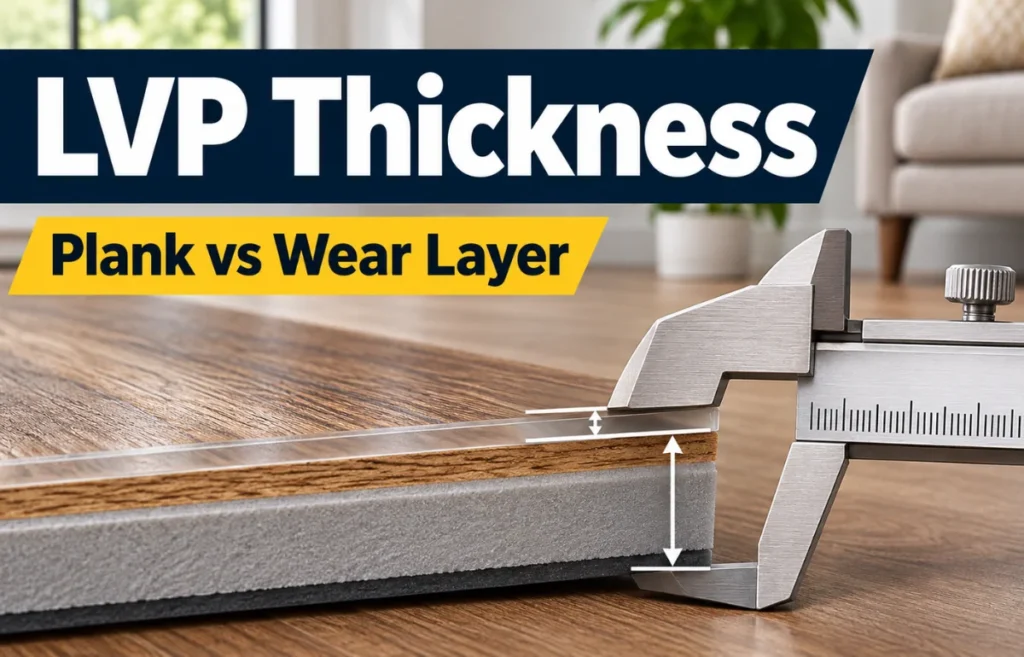
LVP thickness is the total thickness of a luxury vinyl plank, usually measured in millimeters (mm) from its top surface to the bottom of the plank, including any factory-attached backing. It commonly ranges from about 2 mm for some glue-down products to 8 mm or more for thicker rigid-core styles.
However, plank thickness is not the same as wear-layer thickness. The wear layer is the thin, protective surface above the printed design, and manufacturers typically measure it in mils, or thousandths of an inch.
When I compare vinyl flooring, I look at both measurements: overall thickness helps me assess construction, floor height, and underfoot feel, while wear-layer thickness helps me judge expected surface wear. Neither number, by itself, guarantees quality.
What Does LVP Thickness Actually Include?
Luxury vinyl plank flooring is built in layers, rather than cut from one solid material. Depending on the product, those layers may include a protective finish, a clear wear layer, a decorative print, a vinyl or rigid core, and an attached acoustic pad.
The number on the carton generally describes the assembled plank, but specifications aren’t always presented consistently. One brand may advertise a 5 mm plank with an additional 1 mm attached pad; another may call a similar construction 6 mm overall.
Before comparing prices, I check whether the published measurement includes the backing.
LVP Plank Thickness vs. Wear-Layer Thickness
These two specifications solve different problems. Confusing them is one of the easiest ways to spend more without getting the performance you need.
| Specification | Plank thickness | Wear-layer thickness |
|---|---|---|
| What it measures | Entire plank, usually including attached backing | Clear protective layer above the design |
| Typical unit | Millimeters (mm) | Mils (thousandths of an inch) |
| Common examples | 4 mm, 5 mm, 6 mm, 8 mm | 6 mil, 12 mil, 20 mil |
| Main buying relevance | Construction, floor height, comfort, installation fit | Resistance to wear-through from foot traffic |
| What it cannot prove | Scratch resistance or overall durability | Core strength, comfort, or locking-joint quality |
Why Millimeters and Mils Are Not Interchangeable
One mil equals 0.001 inch, or 0.0254 mm. That means a 20-mil wear layer is approximately 0.508 mm thick—not 20 mm. A 12-mil layer is about 0.305 mm, and a 6-mil layer is about 0.152 mm.
This small conversion prevents a surprisingly large misunderstanding. A 5 mm plank with a 20-mil wear layer has a thicker protective layer than a 7 mm plank with a 6-mil wear layer, even though the second product is thicker overall.
The 5 mm plank is not automatically the better floor, but it may be the better option when surface wear is the deciding concern.
How Thick Should Luxury Vinyl Plank Flooring Be?
There isn’t a universal best thickness. Installation method and core construction change what a sensible number looks like. I use the following ranges as shopping reference points, not strict quality grades.
| Overall thickness | Common construction or application | What to consider |
|---|---|---|
| About 2–3 mm | Many glue-down LVP products | Low finished height; requires a very smooth, well-prepared substrate |
| About 4–5 mm | Slim rigid-core or some flexible products | Useful for modest height restrictions; inspect the locking system |
| About 5.5–6.5 mm | Many midrange rigid-core planks | Practical starting point for busy homes if construction and wear layer are suitable |
| About 7–8 mm or more | Thicker rigid-core, often cushioned products | Consider underfoot feel, price, door clearance, and whether added thickness is actually beneficial |
Is 4 mm LVP Too Thin?
Not necessarily. A well-made 4 mm rigid-core floor can serve a bedroom or living space perfectly well when installed over a suitable subfloor. The problem comes when someone assumes that a thinner click-lock plank can tolerate uneven support or rough handling simply because it’s labeled waterproof.
I would pay close attention to the joint design, subfloor requirements, and warranty. For glued flooring, a much thinner plank can be appropriate because adhesive supports it across its surface.
Is 6 mm LVP a Good Choice?
For many residential projects, a 5–6.5 mm rigid-core product is a sensible place to begin comparing options. It offers room for a substantial core and possibly an attached pad, without automatically creating the floor-height complications associated with bulkier products.
Is 8 mm LVP Better Than 5 mm?
An 8 mm floor may feel more cushioned or reduce some walking noise, especially when it uses a WPC core and integrated backing. But thickness alone doesn’t create those benefits.
A dense SPC plank and a cushioned WPC plank can behave differently even at similar heights.
How Thick Should the LVP Wear Layer Be?
The wear layer protects the printed wood- or stone-look pattern from gradual surface abrasion. A higher mil rating generally gives more material before the design layer is exposed, but it doesn’t make the surface scratch-proof.
For quieter residential rooms, 6 mil may be adequate in a suitable product. Around 12 mil is a reasonable starting point for many family living spaces.
I usually prioritize 20 mil when comparing options for busy entryways, frequently used kitchens, households with energetic pets, or areas with consistent heavy traffic.
Why a 20-Mil Wear Layer Isn’t a Scratch-Proof Shield
A wear layer is a thickness measurement, not a scratch-hardness score. Fine grit tracked indoors, dragging furniture, and certain chair casters can mark a surface with any mil rating.
The factory finish also matters. Manufacturers use different urethane coatings, sometimes enhanced with ceramic or aluminum-oxide particles, to influence scratch, stain, and scuff performance. Texture and gloss affect how visible marks appear.
I’d rather compare published performance testing and care instructions than accept a blanket promise that every 20-mil floor outperforms every 12-mil floor.
A Real Product Comparison That Changes the Conversation
A useful example comes from Mannington’s published ADURA specifications. Its Max, Rigid, and Flex constructions have been listed at 8.0 mm, 5.5 mm, and 2.5 mm overall, respectively, while all three carry 20-mil wear layers.
That is a powerful reminder: the same surface-wear specification can sit on three very different constructions. Max is a floating WPC format, Rigid is a floating SPC format, and Flex is a glue-down format.
I wouldn’t rank those products by thickness alone. I’d first decide which installation system and walking feel fit the room, then assess their finishes, warranties, and individual specifications.
Product lines can change, so confirm the current data sheet for the exact style you plan to buy.
SPC, WPC, and Glue-Down LVP: Why Construction Matters
SPC: Firm, Dense, and Often Slimmer
Stone-polymer composite (SPC) uses a relatively dense, rigid core. It typically feels firm underfoot and can offer good resistance to indentation, depending on its formulation and construction.
That doesn’t mean SPC is immune to dropped objects or that a thin locking joint can withstand a poorly prepared subfloor.
If I were choosing SPC for an active household, I’d balance core quality, joint strength, and a suitable wear layer rather than chase maximum thickness.
WPC: Often Warmer-Feeling and More Cushioned
Wood-polymer composite (WPC) is generally a lighter, more cushioned rigid-core construction. Many WPC products are thicker, partly because of their core and backing design.
I would consider WPC where walking comfort and perceived sound matter. However, softer construction can respond differently to concentrated furniture loads, so product-specific indentation ratings deserve attention.
Glue-Down: Thin Doesn’t Mean Weak
Glue-down vinyl is a good example of why thickness comparisons need context. A properly bonded 2.5 mm product can perform very well in a suitable setting because it doesn’t rely on floating-floor joints.
The trade-off is preparation. Imperfections in the substrate may show through the plank, and adhesive selection, moisture conditions, and installation skill become especially important.
Choosing LVP Thickness by Room
I start with the room’s actual problems rather than choosing the thickest box in the store.
| Room or situation | Practical starting point | Additional priority |
|---|---|---|
| Bedroom or low-traffic office | Roughly 4–6 mm rigid-core | Appropriate wear layer, comfort, and price |
| Family room or hallway | Roughly 5–7 mm rigid-core | Around 12–20 mil wear layer; sound and joint quality |
| Busy kitchen or entryway | Roughly 5–8 mm rigid-core | Often 20 mil; grit control and water-management details |
| Bathroom or laundry room | Product approved for wet-area use | Perimeter sealing instructions and moisture-resistant subfloor |
| Basement | Approved SPC, WPC, or glue-down system | Concrete moisture testing and required vapor-control measures |
| Height-sensitive renovation | Slim rigid-core or suitable glue-down LVP | Door, cabinet, stair, and transition clearances |
These are starting ranges, not installation prescriptions. A manufacturer’s approval for the room, substrate, and intended use takes priority over any general chart.
Five Factors That Matter More Than One Extra Millimeter
1. Subfloor Flatness
This is the detail I would check before ordering anything. Rigid planks can bridge certain minor irregularities, but they are not a substitute for leveling or patching a damaged floor.
Uneven support can stress locking joints and create movement or noise.
For example, Mannington’s ADURA Rigid guidance specifies flatness within 3/16 inch over 10 feet, with an additional shorter-distance requirement. Other products may differ. Always follow the instructions for your exact flooring.
2. Finished Floor Height
A thicker plank can cause unexpected problems at doorways, stair landings, appliances, and adjoining surfaces. Measure the current finished height and compare it with the proposed flooring system, including permitted underlayment or adhesive.
Here’s a simple check I like: if the existing surface is 3 mm high and your new assembly is 7 mm, you’re introducing roughly a 4 mm height difference before considering removal or preparation work.
That can determine which transition profile you’ll need.
3. Attached Pad and Acoustics
An attached pad can change how a floor sounds and feels, but a thick pad isn’t automatically a better pad. Density, floor assembly, and the building’s acoustic requirements all play a role.
Don’t add a separate cushioned underlayment unless the flooring manufacturer explicitly permits that combination.
Too much compressibility can put unwanted stress on click joints; some brands approve only specific secondary underlayments.
4. Moisture and Temperature Conditions
Waterproof planks are not a waterproof building assembly. Water can still reach seams, walls, and the substrate, while moisture vapor from concrete can create installation problems.
Basements, sunrooms, and floors with radiant heat deserve a review of product-specific limits. A thicker plank cannot compensate for unsupported temperature exposure or an unsuitable moisture condition.
5. Surface Finish and Maintenance
Think about the way you’ll actually live on the floor. Felt pads, clean entry mats, manufacturer-approved chair protection, and regular grit removal often matter more to appearance than another millimeter of core.
If indoor air quality matters to your household, look for independently verified low-emissions certifications such as FloorScore, while remembering that such certifications address specified emissions criteria rather than every possible health concern.
How to Compare Two LVP Products Without Guessing
When two samples look nearly identical, I use a short comparison routine. First, I confirm whether both prices cover the same square footage and whether the thickness includes the attached pad.
Next, I check the actual wear-layer measurement, coating, core type, installation method, and subfloor tolerances.
I also read the warranty exclusions, especially those addressing rolling loads, scratches, water damage beneath the floor, and improper installation.
Finally, I take the samples home. I compare the texture in daylight, place them beside adjoining flooring, and examine the edge-locking profile without trying to turn a casual bend test into a scientific durability test.
A sample is useful for judging looks and fit, not proving lifespan.
Common LVP Thickness Buying Mistakes
One mistake is assuming a thicker plank automatically has a thicker wear layer. As the Mannington example shows, that isn’t necessarily true.
Another is treating 20 mil as a guarantee against dog claws or chair scratches. It measures the depth of a protective layer, not the surface’s resistance to every type of damage.
The third is overlooking the floor below the floor. Spending more for an 8 mm plank while skipping necessary subfloor preparation can undermine the entire project.
I would put money toward proper preparation before paying solely for another millimeter or two.
What’s the Best Value for Your Budget?
For a typical busy home, I would begin by comparing reputable midrange rigid-core products around 5–6.5 mm with roughly 12–20 mil wear layers. From there, I would adjust based on traffic, installation conditions, and budget.
A guest room may not need the same specification as a busy hallway.
A taller WPC product may be worth paying for if you prefer its feel; a slimmer SPC product may make more sense when finished height is tight. A quality glue-down option may be the smarter purchase for a suitable professionally prepared substrate.
The real value is the combination of appropriate construction, good installation, maintainable surface, and credible warranty—not the greatest thickness printed on a display card.
Final Thoughts: Choose the Two Numbers Together
LVP thickness matters, but it tells only half the story. Overall thickness shapes how a plank is built and how it fits your project; wear-layer thickness is one indicator of how long its printed design may resist everyday abrasion.
Before you buy, compare three candidates using both numbers, check their installation guides, and take samples to the actual room.
The best floor is the one whose complete construction matches your needs—not simply the thickest plank on the shelf.
Frequently Asked Questions About LVP Thickness
Is 5 mm thick enough for luxury vinyl plank flooring?
Yes, a well-constructed 5 mm rigid-core plank can suit many residential rooms when its wear layer, locking system, and subfloor requirements are appropriate.
Is 6 mil or 20 mil wear layer better?
A 20-mil layer provides more protective material against wear-through, making it a common choice for heavy traffic. Surface finish still affects scratching and scuffing.
Does thicker LVP feel more like hardwood?
Not necessarily. Core type, backing, texture, and subfloor construction affect the feel more than thickness alone.
Can I install 8 mm LVP over an uneven floor?
Not as a substitute for preparation. Even thick rigid-core flooring must meet the manufacturer’s flatness and support requirements.
Is 12 mil wear layer enough for dogs and kids?
It can be suitable for many homes, but active households may prefer 20 mil. Choose a durable finish and use mats and furniture protection, too.