The main types of laminate flooring are direct-pressure laminate (DPL) and high-pressure laminate (HPL). You can also compare laminate by water resistance, surface texture, plank shape, installation method, and wear rating. Laminate flooring itself is a layered, wood-based floor covering designed to look like hardwood, stone, or tile without using those materials as its visible surface. Most planks combine a protective top layer, a printed design, a fiberboard core, and a stabilizing backing.
I choose based on what the room demands. Bedrooms, busy hallways, and spill-prone kitchens need different features. Understanding construction helps me prioritize useful performance over attractive packaging or thickness alone.
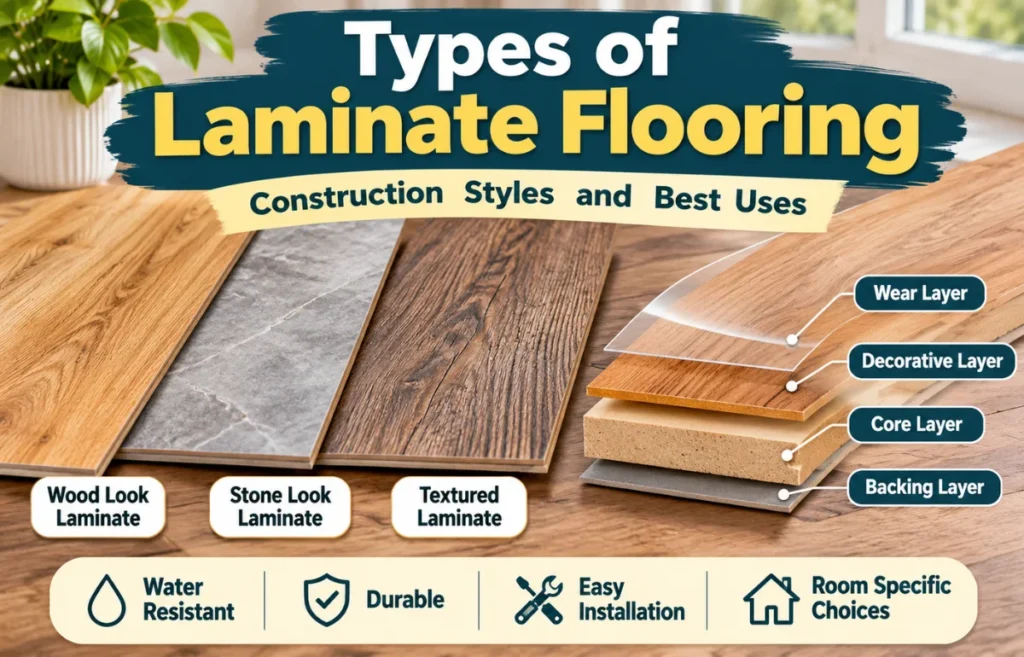
How Laminate Flooring Is Constructed
Although a finished plank looks like one solid piece, its layers do different jobs. The North American Laminate Flooring Association describes this layered construction in its product standards.
- Wear layer: A clear, resin-based surface protects the printed design against everyday abrasion and stains.
- Decorative layer: A detailed image creates the appearance of oak, walnut, marble, concrete, or another material.
- Core board: Usually high-density fiberboard (HDF), this provides rigidity and holds the locking profile along the edges.
- Backing layer: A balancing layer helps the plank remain dimensionally stable.
Some products add treated joints, specialized core formulations, or attached underlayment. Similar-looking planks can perform differently.
One distinction I always make is that laminate is not engineered hardwood. Engineered hardwood has real wood on top; laminate has a decorative image beneath a manufactured wear surface. That difference matters because laminate generally cannot be sanded and refinished later.
Types of Laminate Flooring by Manufacturing Method
1. Direct-Pressure Laminate (DPL)
Direct-pressure laminate is the familiar construction found in many residential collections. Manufacturers press the wear layer, decorative paper, core, and backing together in one production process using heat and pressure.
DPL is widely available across price points, colors, and designs. I consider it a sensible starting point for bedrooms, living rooms, and family homes because a well-made DPL product can offer strong everyday performance without the expense of a specialized construction.
I still check its wear rating, joints, moisture limits, and warranty.
2. High-Pressure Laminate (HPL)
High-pressure laminate uses a different manufacturing approach. The decorative surface is built up under high pressure, typically with additional resin-impregnated paper layers, before it is joined to the floor’s supporting construction.
The result can be a particularly robust surface suitable for demanding areas, including some commercial settings. I wouldn’t pay extra for HPL in a guest room without checking actual test results and intended-use ratings.
3. Water-Resistant Laminate
Water-resistant laminate is not necessarily a third manufacturing method. It is a performance variation that may use a moisture-resistant HDF core, tighter locking joints, edge treatments, or a combination of these.
This is the type I’d examine for kitchens, entryways, and homes where spills are common. But the wording on the box deserves scrutiny. A product with a stated period of surface-spill protection may still be vulnerable to water entering from underneath, persistent leaks, or flooding.
I ask two questions: How does it handle water above the planks, and moisture below them? One claim rarely answers both.
Types of Laminate Flooring by Appearance and Finish
Construction decides much of the performance; design determines whether the floor feels right in your space. These finishes can often be found across more than one construction type.
Wood-Look Laminate
Wood-look laminate is the classic choice. Oak designs range from pale, Scandinavian-inspired tones to warm honey shades, while walnut, hickory, and reclaimed-wood effects create a richer or more rustic look.
I prefer designs with moderate color variation and several distinct plank images. If the same knot repeats too frequently, a large floor can look printed rather than natural. A full-size sample board reveals repetition better than a tiny swatch.
Stone- and Tile-Look Laminate
Stone-look and tile-look laminate imitate slate, marble, ceramic tile, or concrete. They can bring a clean, contemporary appearance without the same cold, hard feel as actual stone or ceramic tile.
However, appearance doesn’t make laminate suitable for a shower room. A stone print on a wood-based core still needs the same moisture precautions as a wood print. For consistently wet floors, I would compare porcelain tile or an appropriately rated waterproof resilient floor instead.
Smooth, Embossed, and Embossed-in-Register Surfaces
A smooth finish looks neat and is straightforward to wipe clean, although a glossy surface may show footprints or fine marks more readily under bright light.
Embossed laminate has a raised texture intended to resemble grain or natural material. Embossed-in-register (EIR) goes further: the physical texture lines up with the wood grain printed beneath it. This can make knots and grain patterns look convincing even close up.
I recommend checking the surface at an angle near a window. It is a simple way to see whether the texture enhances the design or just makes the floor look busier.
Plank Width, Patterns, and Edge Profiles
Wide planks can make a room feel calm and open, while narrow planks often create a more traditional board-by-board appearance. Herringbone and other patterned laminate products offer a different design direction but may need a specific locking system and a more involved layout.
Beveled edges outline each plank and strengthen the visual impression of separate boards. Square edges give a smoother, more continuous appearance. Neither edge style guarantees water resistance; check whether the joints are actually treated and approved for the intended room.
Types of Laminate Flooring by Installation Method
Click-Lock Floating Laminate
Most modern residential laminate uses a click-lock profile. The planks connect to each other and typically float above the subfloor rather than being fastened directly to it.
This makes click-lock laminate appealing for renovations, especially when a sound, flat existing surface can remain underneath. Different locking profiles require different assembly movements, so I would follow the exact instructions rather than assume every click system installs identically.
Glued-Joint Laminate
Some older or specialized laminate systems use adhesive at tongue-and-groove joints. These should not be confused with gluing the whole floor to the subfloor. They are less convenient to dismantle, and modern click systems have largely become the simpler residential option.
I would only choose a glued system where the product explicitly calls for it. Adding glue to a click-lock floor without approval may cause installation problems or affect warranty coverage.
Attached Pad Versus Separate Underlayment
Some planks include a backing pad; others need a separate underlayment. Underlayment can reduce impact sound, provide cushioning, and meet a system’s moisture-control requirements, depending on the material.
A thicker or softer pad is not automatically better. Excessive compression can stress locking joints. Over concrete, a suitable vapor-control layer may still be required even when a pad is attached. The flooring and underlayment instructions need to agree.
Understanding AC Ratings and Use Classes
The abrasion class, or AC rating, describes how well laminate resists wearing through its decorative surface in a standardized test. It is useful, but it isn’t a universal score for scratch resistance, dents, water protection, or overall lifespan.
| AC rating | General wear level | Where I would consider it |
|---|---|---|
| AC1–AC2 | Lighter-duty wear performance | Low-use rooms, if the product is specifically approved |
| AC3 | Everyday residential wear | Bedrooms, living rooms, and many family spaces |
| AC4 | Heavier residential or some commercial wear | Busy hallways, active households, and suitable small offices |
| AC5 | More demanding commercial-level abrasion | High-traffic commercial locations where specified |
These are practical shopping guidelines, not guarantees about a particular product. AC6 also exists for very demanding applications, but most households don’t need to shop at that level.
You may also see use classes such as 23, 31, 32, and 33. They identify intended environments and traffic intensity under European classification systems, as explained by the European Producers of Laminate Flooring. For example, class 23 denotes heavy domestic use, while classes 31–33 cover increasing commercial-use demands.
I compare both the use class and performance test information when available. The North American Laminate Flooring Association makes a helpful distinction: abrasion, scratching, impact, and staining are separate characteristics. A floor can score well on one and disappoint on another.
Which Type of Laminate Flooring Is Best for Each Room?
I find room-by-room selection much clearer than asking which laminate is best overall.
| Room or situation | Features worth prioritizing | What I’d watch for |
|---|---|---|
| Bedroom or guest room | Comfortable underlayment, appealing texture, suitable residential rating | Overspending on commercial wear performance |
| Living room | AC3 or AC4 where appropriate, realistic finish, good joint quality | Repetitive print patterns in a large area |
| Hallway or entryway | Strong wear performance, durable locking joints, moisture-tolerant design | Tracked-in grit and wet shoes |
| Kitchen | Explicit surface-water protection, sealed details where required | Leaks beneath appliances and prolonged standing water |
| Home office | Suitable wear and impact performance, chair-mat compatibility | Concentrated caster-wheel wear and desk-chair movement |
| Basement | Tested, dry subfloor and a manufacturer-approved moisture system | Vapor movement, damp concrete, or recurring water intrusion |
Busy Households With Children or Pets
For active homes, I lean toward matte or lightly textured finishes with proven wear and scratch performance. Medium wood tones can make ordinary dust and minor marks less noticeable than very dark glossy floors.
I would also look beyond the surface to joint integrity. Repeated mopping, spills near food bowls, and grit by exterior doors can challenge edges before the center of a plank shows much wear. Rugs and furniture protectors still help, regardless of the rating.
Kitchens and Other Spill-Prone Rooms
A water-resistant product with clearly defined installation and warranty terms is the stronger laminate candidate for a kitchen. Pay particular attention to perimeter sealing, cabinet clearances, and dishwasher or sink leaks.
I would not treat a manufacturer’s advertised spill duration as permission to leave water standing. Wipe up spills promptly and check whether the warranty excludes plumbing failures or water entering beneath the floor. Bathrooms with frequent standing water need more caution, and shower floors are not appropriate for ordinary wood-based laminate.
Apartments and Upper Floors
In an upstairs bedroom or apartment, noise may matter more than a premium wear rating. Here I prioritize the complete acoustic assembly: plank, underlayment, and subfloor together.
Some buildings specify minimum sound-control performance. Ask for test figures that apply to the proposed assembly, not just a promotional claim that an underlay is “quiet.” I also check door clearance, because changing the floor height can create unexpected work.
Does Laminate Thickness Matter?
Common laminate plank thicknesses include 7, 8, 10, and 12 mm, although product ranges vary. Thicker planks may feel more substantial and can offer different acoustic or profile characteristics, but they are not automatically more scratch-resistant or waterproof.
The top surface, core quality, and locking design are separate factors. I would rather buy a well-tested 8 mm floor suited to the room than a poorly documented 12 mm floor selected only because it feels heavier in my hand.
Thickness also affects transitions to neighboring floors, thresholds, and the clearance beneath doors. Add any separate underlayment to the calculation before ordering.
Five Checks I Make Before Comparing Prices
- Identify the likely failure point. In a sunny living room, appearance and light exposure matter. Near an exterior door, grit and damp shoes deserve attention. On a concrete slab, moisture beneath the floor may be the decisive issue.
- Read the full technical sheet. I look for the intended use class, AC rating, impact or scratch data, core description, and approved subfloors. If the seller cannot provide those details, I treat broad durability promises cautiously.
- Check the water claim word for word. “Water-resistant,” “waterproof surface,” and “waterproof flooring” may come with different definitions and exclusions. I read the written warranty and installation rules rather than relying on a display label.
- Inspect joined samples. A single plank cannot show how the edges align. I ask to see connected boards, look for height differences, and examine the design under both natural and artificial light.
- Price the installed system, not just the box. Trims, underlayment, vapor protection, leveling, door adjustments, labor, and waste can change the final bill. Comparing those costs helps avoid a bargain that isn’t one.
Installation and Maintenance Mistakes to Avoid
Even an excellent product can fail early when the subfloor is uneven or damp. Before installation, I would verify the manufacturer’s flatness and moisture requirements, along with any specified acclimation period. Laminate also needs the prescribed expansion space around fixed objects; tightly pinning down a floating floor can lead to buckling.
Cleaning should be gentle. Remove grit with a soft broom or an appropriate vacuum attachment, then use a lightly damp microfiber mop and approved cleaner. Avoid soaking the floor, applying wax, or using a steam mop unless the manufacturer specifically permits it.
For products sold in the United States, I would also look for TSCA Title VI compliance on regulated composite wood components. This is a more meaningful purchasing check than an unsupported low-emissions marketing slogan.
Finally, keep a few spare planks from the same product and batch. If one board is damaged later, a matching replacement may be more useful than trying to repair a deeply gouged decorative surface.
Choosing the Right Laminate Without Overpaying
The best type of laminate flooring is the one whose construction, wear performance, moisture limits, and design suit the room. I would start by choosing the required performance, then narrow the options by texture, color, and budget.
Before placing an order, request a full plank sample, read the technical sheet, and confirm the complete installation requirements. Those three checks can tell you more than a showroom’s biggest durability claim.
Frequently Asked Questions
What is the most durable type of laminate flooring?
HPL can be especially robust, but I compare tested wear, impact, scratch resistance, and intended use class rather than relying on construction alone.
Is AC4 or AC5 laminate better for a home?
AC4 is often sufficient for busy homes. AC5 offers higher abrasion resistance, but it may be unnecessary unless the room’s use justifies it.
Is 12 mm laminate better than 8 mm laminate?
Not necessarily. Thickness can affect feel and fitting details, while wear resistance, moisture protection, and joint quality depend on other specifications.
Can I install laminate flooring in a kitchen?
Yes, if the manufacturer approves that model for kitchens and its moisture-protection and installation requirements are followed.
What’s the difference between laminate and vinyl flooring?
Laminate generally has a wood-based fiberboard core; vinyl flooring uses resilient polymer-based construction. Their moisture performance and installation limits differ by product.