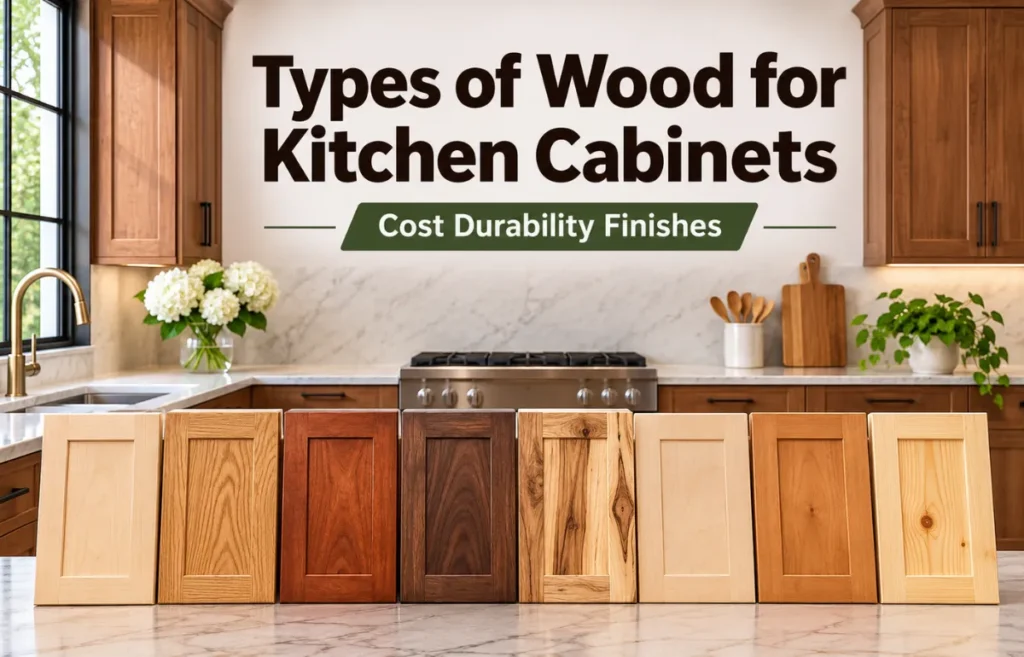
The most popular types of wood for kitchen cabinets include maple, red oak, white oak, cherry, walnut, hickory, birch, alder, and pine. These woods differ in hardness, grain patterns, natural color, moisture resistance, price, and compatibility with paints and stains. Hardwood options like maple, oak, and hickory offer excellent durability, while softer woods like pine and alder provide affordable alternatives with a more rustic appearance.
Maple is an excellent all-around choice, oak offers a balance between affordability and strength, and walnut works particularly well in high-end kitchens.
However, choosing the right cabinet wood involves more than finding a color you love. I recommend considering how often you cook, how much maintenance you’re comfortable with, and how you want your cabinets to look several years from now.
9 Best Types of Wood for Kitchen Cabinets
Each wood species brings something different to a kitchen. Some handle everyday wear better, while others stand out for their natural beauty or finishing options.
Here’s how the most popular choices compare.
1. Maple Wood Cabinets
Maple is a durable hardwood with a smooth texture, subtle grain, and naturally creamy appearance. Its relatively uniform surface makes it suitable for contemporary, traditional, and minimalist kitchens.
Hard maple has a Janka hardness rating of approximately 1,450 lbf, making it highly resistant to everyday dents and impacts.
I consider maple one of the safest choices for homeowners who want cabinets that look attractive without demanding complicated maintenance.
Maple works particularly well with white, cream, sage green, and other painted cabinet finishes. However, dark stains can sometimes appear uneven without proper surface preparation.
Advantages:
- Excellent resistance to dents
- Smooth surface for painting
- Versatile natural appearance
- Suitable for busy family kitchens
Disadvantages:
- Can absorb certain stains unevenly
- Usually more expensive than birch or pine
Best finishes: Painted, natural clear coat, and professionally applied light stains.
Price range: Mid-range.
2. Red Oak Wood Cabinets
Red oak is a traditional cabinet material known for its prominent grain, warm undertones, and dependable strength. Its natural color ranges from light brown to pinkish-red.
One advantage of red oak is that its visible grain helps disguise small scratches and signs of everyday wear.
If you’re renovating on a moderate budget but still want genuine hardwood cabinetry, I would put red oak near the top of your shortlist.
Red oak accepts many stains well, although its pink undertones can influence the final color.
Its open grain also means that standard paint applications may leave visible texture unless the surface is filled and properly prepared.
Advantages:
- Good durability at a reasonable price
- Accepts many stain colors
- Distinctive natural grain
- Widely available in North America
Disadvantages:
- Visible pores can complicate painting
- Less naturally decay-resistant than white oak
Best finishes: Medium brown stains, natural finishes, and grain-enhancing stains.
Price range: Affordable to mid-range.
3. White Oak Wood Cabinets
White oak has an attractive combination of earthy undertones, natural texture, and impressive hardness. Its colors generally range from beige and tan to medium brown, sometimes with an olive undertone.
Unlike red oak, white oak has greater natural resistance to moisture penetration and decay. However, it still needs a protective cabinet finish.
I particularly recommend white oak for kitchens featuring neutral countertops, natural stone, warm metals, and understated cabinetry.
Rift-sawn white oak is another option worth considering. Its relatively straight grain creates a more consistent appearance across cabinet doors, making it attractive in modern kitchens.
Rift-sawn and quarter-sawn material often costs more than conventional plain-sawn oak.
Advantages:
- Excellent everyday durability
- Attractive neutral undertones
- Greater natural moisture resistance than red oak
- Suitable for traditional and contemporary kitchens
Disadvantages:
- Premium cuts can be expensive
- Grain remains visible under ordinary paint
Best finishes: Natural matte, light stains, and low-yellowing clear coats.
Price range: Mid-range to premium.
4. Cherry Wood Cabinets
Cherry is a fine-grained hardwood with warm reddish-brown coloring and an elegant appearance.
One of its most interesting characteristics is how its color develops over time. Exposure to light gradually darkens cherry, giving it a richer appearance as it ages.
This natural aging process is attractive, but it can also create noticeable differences between areas that receive different amounts of sunlight.
I would choose cherry for a kitchen where warmth and character matter more than maintaining a perfectly consistent color.
Although cherry is softer than hard maple and oak, it remains a practical cabinet material when properly constructed and finished.
Advantages:
- Rich natural color
- Smooth, refined grain
- Develops an attractive patina
- Complements traditional kitchen designs
Disadvantages:
- More susceptible to dents than maple
- Color changes with light exposure
Best finishes: Clear coats, light stains, and warm satin finishes.
Price range: Mid-range to premium.
5. Walnut Wood Cabinets
Walnut is a premium hardwood recognized for its deep chocolate-brown tones and flowing grain patterns.
Its natural appearance provides plenty of visual interest without requiring heavy staining.
For a kitchen that needs a luxurious touch without making the entire renovation expensive, I recommend considering walnut for the kitchen island and using a more affordable material for the surrounding cabinetry.
This creates contrast while limiting the amount of premium wood required.
Black walnut has a Janka hardness rating of approximately 1,010 lbf. Although durable enough for normal kitchen use, it dents more easily than hard maple or hickory.
Advantages:
- Naturally rich, sophisticated color
- Attractive without dark staining
- Complements modern and mid-century interiors
- Suitable for feature cabinetry
Disadvantages:
- Relatively expensive
- Can gradually lighten with light exposure
Best finishes: Natural satin, matte clear coats, and compatible oil-based finishes.
Price range: Premium.
6. Hickory Wood Cabinets
Hickory is one of the hardest commonly used woods for kitchen cabinetry. It features striking variations between light cream and darker brown tones.
Shagbark hickory has a Janka hardness rating of approximately 1,880 lbf, making it particularly resistant to dents.
Its dramatic grain is a natural fit for farmhouse, country, and rustic kitchen designs.
However, I would avoid pairing strongly patterned hickory cabinets with equally busy countertops and backsplashes. Too many competing patterns can make a kitchen feel visually crowded.
Hickory is also relatively demanding to machine, and its dimensional movement makes careful construction important.
Advantages:
- Outstanding dent resistance
- Strong natural character
- Suitable for heavy-use kitchens
- Attractive under clear finishes
Disadvantages:
- Significant color variation
- Can be difficult to machine and finish
Best finishes: Natural clear coats and light stains.
Price range: Mid-range to premium.
7. Birch Wood Cabinets
Birch is a reasonably priced hardwood with a fine grain and naturally light appearance. It offers some of the visual qualities of maple without always carrying the same price tag.
Yellow birch has a Janka hardness rating of approximately 1,260 lbf, providing good resistance to everyday impacts.
Among affordable cabinet wood options, birch offers a particularly useful balance between appearance and durability.
I recommend requesting a stained sample before buying birch cabinets because some finishes can absorb unevenly, creating darker patches.
Painted birch can be an attractive alternative when you’re working with a limited remodeling budget.
Advantages:
- Good value for money
- Relatively smooth grain
- Suitable for painted finishes
- Dependable everyday durability
Disadvantages:
- Certain stains may appear blotchy
- Natural color can vary between boards
Best finishes: Painted, natural clear coats, and professionally applied stains.
Price range: Affordable to mid-range.
8. Alder Wood Cabinets
Alder is a relatively soft hardwood with warm honey-brown tones and a fine, understated grain.
Knotty alder is especially attractive in farmhouse kitchens, where natural imperfections contribute to the design rather than detract from it.
With a Janka hardness rating of approximately 590 lbf, red alder is considerably softer than maple and oak.
I would choose alder for its appearance and affordability rather than maximum impact resistance. In a household where cabinet doors frequently get bumped by cookware or children’s toys, a harder species may be more practical.
Advantages:
- Attractive rustic appearance
- Generally affordable
- Accepts a variety of finishes
- Easy to work with
Disadvantages:
- Dents relatively easily
- Knots may require additional finishing preparation
Best finishes: Warm stains, rustic finishes, and satin clear coats.
Price range: Affordable to mid-range.
9. Pine Wood Cabinets
Pine is a softwood commonly associated with cottage, farmhouse, and country-style kitchens. Its pale yellow coloring, visible knots, and natural grain create a relaxed appearance.
Eastern white pine has a Janka hardness rating of approximately 380 lbf, although other pine species can be considerably harder.
Pine is worth considering if you’re looking for inexpensive wooden cabinets and don’t mind the character that develops through everyday use.
I would be cautious about installing soft pine around heavily used lower cabinets, where accidental impacts are more likely.
Knots can also release resin or cause discoloration beneath paint unless properly sealed.
Advantages:
- Generally inexpensive
- Lightweight and easy to work with
- Attractive rustic character
- Suitable for budget makeovers
Disadvantages:
- Scratches and dents easily
- Knots require careful preparation before painting
Best finishes: Distressed paint, light stains, and natural satin finishes.
Price range: Budget-friendly.
Kitchen Cabinet Wood Types Comparison Chart
When comparing different types of wood for kitchen cabinets, hardness provides a useful starting point.
The Janka scale measures resistance to indentation. A higher rating generally means the wood is more difficult to dent, but it does not measure waterproofing, finish quality, or overall cabinet construction.
| Wood type | Janka hardness (lbf) | Relative cost | Best application |
|---|---|---|---|
| Hard maple | 1,450 | Moderate | Painted cabinets |
| Red oak | 1,220 | Low–moderate | Affordable hardwood cabinetry |
| White oak | 1,360 | Moderate–high | Natural wood kitchens |
| Black cherry | 950 | Moderate–high | Traditional kitchens |
| Black walnut | 1,010 | High | Luxury cabinetry |
| Shagbark hickory | 1,880 | Moderate–high | Heavy-use kitchens |
| Yellow birch | 1,260 | Low–moderate | Budget-friendly cabinetry |
| Red alder | 590 | Low–moderate | Rustic kitchens |
| Eastern white pine | 380 | Low | Cottage-style kitchens |
These are representative species-specific hardness values and relative price categories. Actual cabinet prices depend on wood grade, regional availability, construction, door design, and finishing requirements.
Solid Wood vs. Engineered Wood for Kitchen Cabinets
A cabinet advertised as maple or oak isn’t necessarily made entirely from that wood. The species name often refers to the doors, drawer fronts, or exposed decorative surfaces.
Understanding what’s behind those surfaces can help you avoid paying premium prices for construction that doesn’t meet your expectations.
| Cabinet material | Main advantage | Main drawback | Best use |
|---|---|---|---|
| Solid wood | Refinishable and naturally attractive | Expands and contracts with humidity | Doors and face frames |
| Plywood | Good structural strength and stability | Exposed edges require finishing | Cabinet boxes and shelves |
| MDF | Smooth and consistent surface | Vulnerable to prolonged water exposure | Painted door panels |
| Particleboard | Affordable construction | Can swell when water penetrates | Budget cabinet boxes |
| Wood veneer | Genuine wood appearance at a potentially lower cost | Limited sanding depth | Decorative panels and slab doors |
Is Solid Wood Always Better?
Not necessarily. Solid wood naturally expands and contracts as its moisture content changes. Wide wooden panels may experience noticeable seasonal movement.
Plywood’s cross-layered construction helps limit dimensional changes, while MDF provides a smooth, uniform painting surface.
I prefer a balanced construction approach: hardwood doors and frames, quality plywood cabinet boxes, and suitable engineered panels where they offer a practical advantage.
This combination can provide excellent durability without the unnecessary expense of making every hidden component from solid hardwood.
Which Wood Is Best for Painted Kitchen Cabinets?
Maple, birch, and poplar are particularly suitable for painted cabinets because their relatively fine textures allow smoother finishes.
Painted oak is also possible, but its open pores can remain visible. Achieving a completely smooth appearance may require grain filler and additional preparation, increasing labor costs.
For painted Shaker cabinets, a hardwood frame paired with an MDF center panel is worth considering.
The MDF panel provides a uniform painting surface, while the surrounding hardwood offers greater resistance to everyday edge impacts.
Which Cabinet Wood Looks Best With Stain?
White oak, red oak, walnut, and cherry are excellent options when the goal is to highlight natural wood grain.
Oak works well with many brown and neutral stains, while walnut often needs little color enhancement.
Cherry naturally darkens as it ages, so a heavy stain may not be necessary.
Maple, birch, and pine can require more careful stain preparation to avoid uneven color absorption.
My advice is to approve a finished sample made from your chosen wood rather than selecting a stain based solely on its name or a printed color chart.
How to Choose the Right Finish for Wooden Cabinets
The finish protects the underlying wood and influences cleaning, appearance, and long-term maintenance.
Paint provides consistent color, while stain enhances or modifies the natural appearance of wood. Stained cabinets generally require a protective topcoat.
A suitable polyurethane or professional cabinet coating can improve resistance to everyday spills and wear.
Matte finishes create a softer appearance, satin offers a gentle sheen, and glossy finishes reflect more light but may emphasize fingerprints and surface imperfections.
I generally favor satin finishes for busy kitchens because they provide a practical middle ground between appearance and maintenance.
Remember that a coating’s formulation and application matter more to its durability than sheen alone.
How to Choose Cabinet Wood Based on Your Kitchen’s Needs
Instead of choosing one wood species simply because it’s popular, I suggest thinking about where your cabinets will experience the most wear.
Consider the High-Wear Areas
Sink cabinets, trash pull-outs, lower drawers, and kitchen islands often experience more moisture or physical contact than upper cabinets.
Prioritize durable finishes, protected edges, and quality construction in these locations.
You don’t necessarily need the most expensive wood throughout the kitchen to achieve good performance.
Compare Full-Sized Cabinet Door Samples
A small wood sample cannot always show the amount of grain variation that appears across an entire cabinet door.
This is particularly relevant for hickory, walnut, and knotty alder.
Place a full-sized sample beside your countertop and flooring. Examine it under daylight and your kitchen’s evening lighting before making a decision.
Think About Future Repairs
Ask whether replacement doors and matching finishes will remain available.
Natural wood changes color over time, meaning a replacement cherry or walnut door may not immediately match older cabinetry.
I also recommend keeping a labeled touch-up kit and recording the wood species, stain name, and finish specification for future maintenance.
How to Save Money When Buying Wooden Kitchen Cabinets
One practical way to reduce cabinet costs is to spend money on visible surfaces rather than insisting on premium hardwood for every component.
For example, combining walnut island cabinets with painted birch perimeter cabinets can create a high-end appearance at a potentially lower overall cost.
Also, compare complete cabinet quotes rather than wood prices alone. Two suppliers offering the same species may use different materials for cabinet boxes, drawer bottoms, and center panels.
Ask about finish warranties and replacement parts before ordering.
For North American cabinetry, I would also look for ANSI/KCMA A161.1 certification, which evaluates cabinet construction, operation, and finish performance.
How to Protect Wooden Kitchen Cabinets From Damage
Even the strongest hardwood can deteriorate when exposed to persistent moisture or improper cleaning.
Wipe up spills promptly, avoid leaving damp towels against cabinet doors, and use an exhaust fan when cooking.
Clean with a soft cloth and a mild cleaner approved by the cabinet manufacturer. Avoid abrasive pads and excessive water.
Pay particular attention to the lower edges of sink cabinets and surfaces exposed to dishwasher steam.
Protecting these vulnerable areas can make a bigger difference to cabinet longevity than upgrading to a slightly harder wood species.
Conclusion
The best types of wood for kitchen cabinets depend on your budget, preferred finish, design style, and daily kitchen habits.
I recommend maple for versatility, birch and red oak for affordability, hickory for dent resistance, white oak for natural finishes, and walnut for premium kitchens.
Before committing to a purchase, shortlist two or three wood species, request finished door samples, and compare complete cabinet construction costs.
Choosing a material that suits your everyday routine will help you create a kitchen that remains functional and attractive for years.
Frequently Asked Questions
What is the best wood for kitchen cabinets?
Hard maple is an excellent all-around choice because it combines durability, a smooth grain, versatile finishing options, and relatively moderate pricing.
What is the most durable wood for kitchen cabinets?
Hickory offers exceptional dent resistance among commonly used cabinet woods. Hard maple and white oak are also highly durable choices.
What is the cheapest wood for kitchen cabinets?
Pine is often one of the least expensive solid wood options, while birch and alder offer affordable hardwood alternatives.
Which wood is best for kitchen cabinets in humid conditions?
White oak offers useful natural moisture resistance, but properly sealed plywood construction and quality protective finishes are equally important in humid kitchens.
Is maple or oak better for kitchen cabinets?
Maple is generally better for smooth painted finishes, while oak is ideal for stained cabinets with visible natural grain. Both offer good durability.