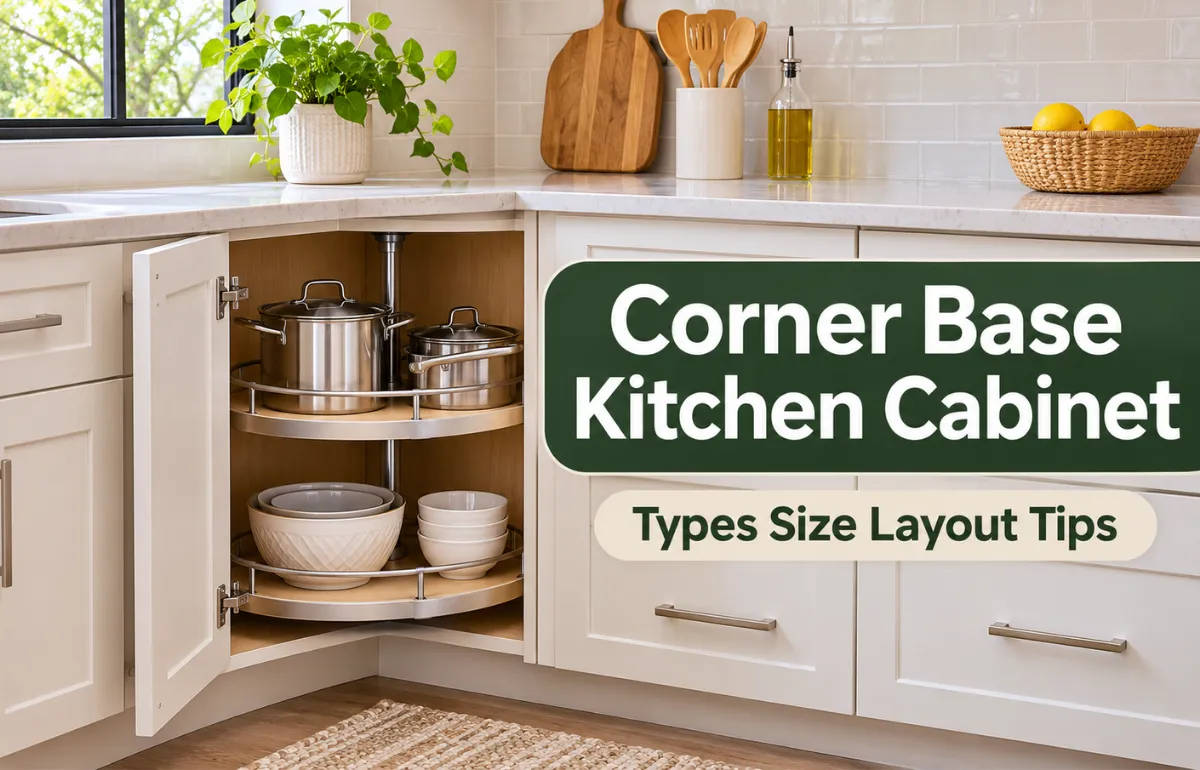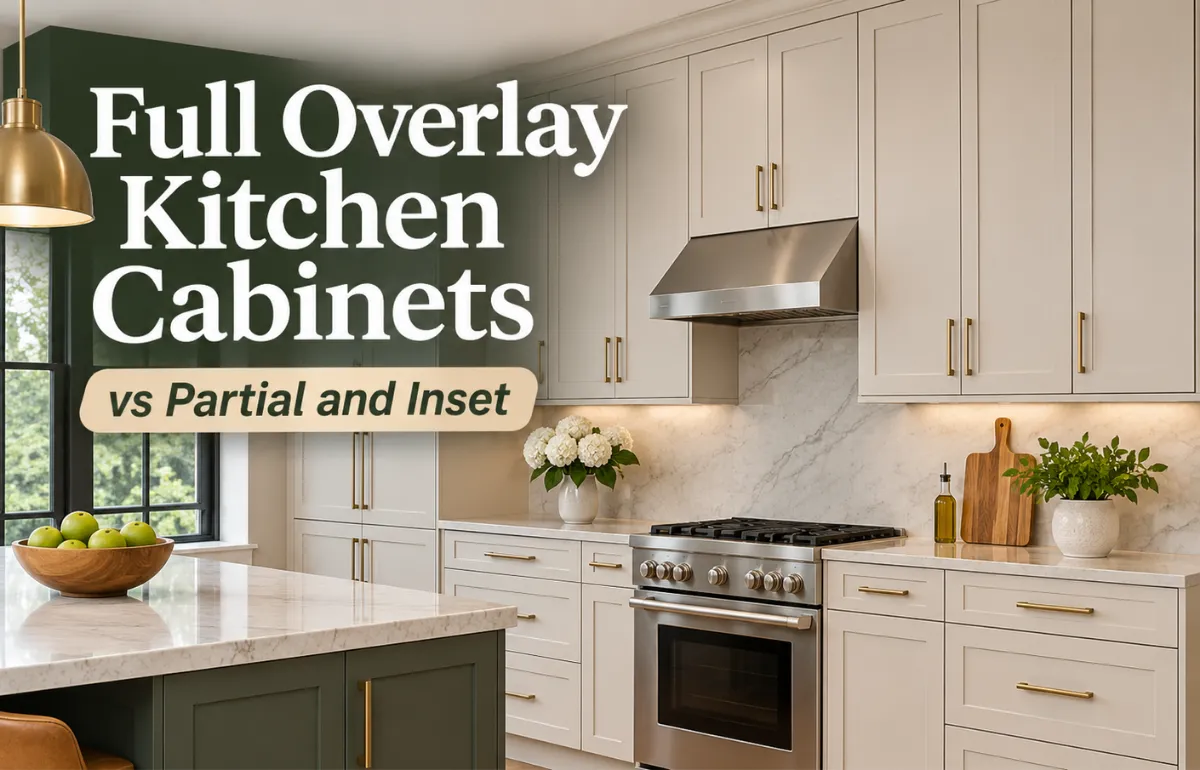
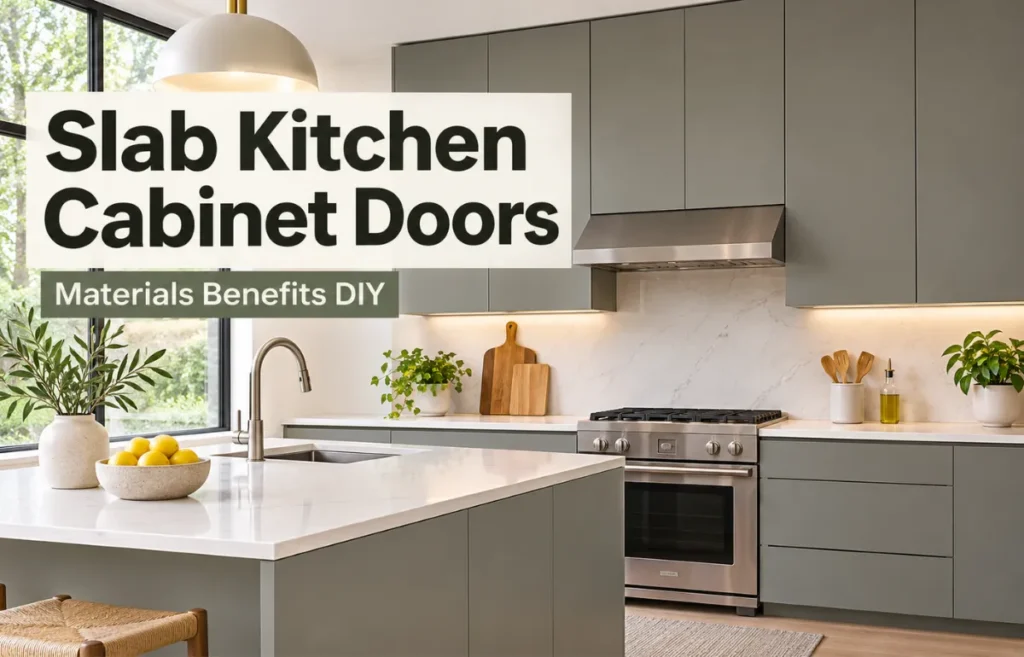
Slab kitchen cabinet doors are flat, solid-looking cabinet fronts with a smooth, uninterrupted surface and no decorative frames, raised panels, or recessed centers. Also known as flat-panel cabinet doors, they are typically made from MDF, plywood, solid wood, or engineered boards finished with laminate, paint, or wood veneer. Their simple construction creates a clean appearance that works particularly well in modern, minimalist, and contemporary kitchens.
What I particularly like about this cabinet door style is its ability to transform a kitchen without introducing unnecessary visual clutter. Even a small kitchen can feel more open and organized with the right combination of flat cabinet fronts, colors, and hardware.
However, not all slab doors offer the same durability or value. The underlying material, edge construction, finish, and installation quality can make a significant difference in how they perform over time.
What Makes Slab Kitchen Cabinet Doors Different?
Unlike traditional cabinet doors that feature decorative profiles or multiple visible components, slab doors have a continuous, flat face.
They may appear extremely simple, but their design offers more flexibility than many homeowners realize.
The main characteristics of slab cabinet doors include:
- Smooth surfaces without decorative grooves.
- Minimalist construction and clean lines.
- Compatibility with handles and handleless hardware.
- A wide range of colors, textures, and finishes.
- Relatively straightforward cleaning and maintenance.
- Compatibility with framed and frameless cabinetry.
Although these doors are commonly associated with modern kitchen designs, they are not limited to contemporary interiors.
Natural oak slab doors, for example, work beautifully in Scandinavian-inspired kitchens, while dark walnut fronts can complement mid-century modern interiors.
Types of Materials Used for Slab Kitchen Cabinet Doors
Material selection is one area where I would avoid making a decision based entirely on appearance. Two cabinet doors may look nearly identical but respond very differently to moisture, heat, impact, and everyday use.
1. MDF Slab Cabinet Doors
Medium-density fiberboard, commonly called MDF, is manufactured from wood fibers combined with resin and compressed into dense panels.
Its smooth, consistent surface makes it particularly suitable for painted cabinet doors. Unlike natural wood, MDF does not have visible grain patterns that may interfere with a uniform painted finish.
MDF is generally affordable and dimensionally stable under normal indoor conditions. However, standard MDF can swell when exposed to water, especially if its edges are poorly sealed.
I would consider MDF a practical choice for painted kitchen cabinets, provided the finish offers adequate protection.
2. Plywood Slab Cabinet Doors
Plywood consists of thin layers of wood bonded together with alternating grain directions. This construction helps reduce the movement commonly associated with solid wood.
Cabinet-grade plywood offers a useful combination of strength, stability, and relatively manageable weight.
It is particularly attractive for DIY cabinet projects because it can be cut into custom sizes and finished with wood veneer, paint, or clear protective coatings.
Exposed plywood edges usually require edge banding or solid wood edging unless the layered appearance is an intentional design feature.
3. Solid Wood Slab Cabinet Doors
Solid wood doors offer natural grain patterns, warmth, and individual character. Popular options include oak, maple, cherry, and walnut.
Unlike many engineered materials, solid wood can often be sanded and refinished when its surface becomes worn.
However, wood naturally expands and contracts as humidity changes. Wide solid wood slab doors may develop cupping, bowing, or twisting if their construction and environmental conditions are unsuitable.
For particularly large cabinet fronts, I would generally favor a stable engineered core with real wood veneer over solid lumber.
4. Laminate Slab Cabinet Doors
Laminate doors feature a decorative surface bonded to an underlying engineered board, typically MDF or particleboard.
They are available in solid colors, wood-effect patterns, textured finishes, and realistic stone-inspired designs.
High-pressure laminate can provide excellent everyday wear resistance, making it appealing for busy households.
The quality of the edge banding deserves particular attention because damage around the edges can expose the underlying material to moisture.
5. Wood Veneer Slab Cabinet Doors
Wood veneer consists of a thin layer of genuine wood applied over an engineered core.
It provides the natural appearance of solid wood while benefiting from the dimensional stability of the underlying panel.
Veneered cabinet doors are particularly suitable for kitchens where continuous wood grain is part of the design.
However, deep scratches can be difficult to repair because aggressive sanding may penetrate the thin decorative wood layer.
Slab Cabinet Door Material Comparison
The following comparison provides a practical overview of how common cabinet door materials differ.
| Material | Relative cost | Main advantage | Main drawback | Best suited for |
|---|---|---|---|---|
| MDF | Low to medium | Smooth painted finish | Vulnerable to water penetration | Painted kitchens |
| Plywood | Medium | Strength and stability | Requires edge finishing | DIY projects |
| Solid wood | High | Natural beauty and repairability | Seasonal wood movement | Premium cabinetry |
| Laminate | Low to high | Easy maintenance | Difficult to repair deeply | Busy family kitchens |
| Wood veneer | Medium to high | Authentic wood appearance | Limited sanding potential | Natural modern kitchens |
Actual durability depends on the manufacturing quality, underlying board, finish, and installation rather than the material name alone.
Advantages of Slab Kitchen Cabinet Doors
Easy to Clean and Maintain
One of the biggest practical benefits of flat-front cabinets is their uncomplicated surface.
Traditional decorative cabinet doors can collect grease, dust, and cooking residue around their grooves and corners. Slab doors eliminate many of these collection points.
In most cases, a soft cloth and a suitable mild cleaning solution are sufficient for routine maintenance.
Create a More Spacious Appearance
Flat cabinet fronts reduce visual interruptions across the kitchen.
This can make compact kitchens, apartment kitchens, and narrow galley layouts appear less crowded.
Light-colored slab cabinets combined with understated hardware can further enhance this effect.
Suitable for Affordable Kitchen Makeovers
Basic slab cabinet doors often require fewer construction operations than elaborate framed doors.
Homeowners who have structurally sound cabinets can potentially replace their existing fronts without purchasing entirely new cabinetry.
This approach can preserve the existing kitchen layout while reducing renovation expenses and unnecessary waste.
Flexible Design Options
Flat-panel doors accommodate a surprising variety of finishes.
Whether the preferred look is soft white, warm wood, charcoal gray, muted green, or glossy acrylic, the simple door profile allows the material and color to take center stage.
Disadvantages Worth Considering
Despite their advantages, slab doors are not ideal for every kitchen.
Their uninterrupted surfaces can make scratches, fingerprints, and uneven paint finishes more noticeable. Glossy and very dark finishes are particularly susceptible to visible smudges under certain lighting conditions.
Door alignment also matters more than many homeowners expect.
Because slab fronts create long, continuous visual lines, inconsistent gaps between neighboring doors can become surprisingly obvious.
Another consideration is moisture resistance. A durable decorative surface does not necessarily mean the underlying board is waterproof.
I recommend paying close attention to the edges, corners, and areas near sinks and dishwashers.
Slab vs. Shaker Cabinet Doors: Which Is Better?
Shaker and slab doors are both popular, but they create noticeably different kitchen environments.
Shaker doors feature a surrounding frame and recessed center panel, whereas slab doors have a continuous flat surface.
| Feature | Slab cabinet doors | Shaker cabinet doors |
|---|---|---|
| Appearance | Smooth and minimalist | Framed and classic |
| Cleaning | Generally easier | Grooves require extra attention |
| Design style | Modern and contemporary | Traditional and transitional |
| DIY construction | Relatively simple | More involved |
| Visual texture | Minimal | Moderate |
| Typical cost | Affordable to premium | Affordable to premium |
I would choose slab doors for a kitchen where simplicity, easy cleaning, and uninterrupted surfaces are priorities.
Shaker cabinets may be preferable when the room needs additional architectural character or a more traditional appearance.
Neither style is automatically superior. The right choice depends on the kitchen’s overall design and how the household uses it.
Best Finishes for Flat-Panel Kitchen Cabinets
Matte Finishes
Matte cabinet doors create a soft, understated appearance without strong reflections.
They are particularly attractive in kitchens with natural materials and neutral color palettes.
Specialized anti-fingerprint finishes may offer better smudge resistance than ordinary matte coatings.
High-Gloss Finishes
Glossy cabinet doors reflect light and can brighten darker kitchen interiors.
However, fingerprints, fine scratches, and cleaning streaks may become more visible.
Natural Wood Finishes
Wood finishes introduce warmth into otherwise minimal kitchens.
White oak, walnut, and light maple are appealing choices when a homeowner wants a modern kitchen that still feels comfortable and inviting.
Satin Painted Finishes
Satin offers a useful middle ground between matte and glossy surfaces.
For painted slab kitchen cabinet doors, I would generally consider a durable satin cabinet coating because it balances appearance with everyday cleanability.
How to Make DIY Slab Kitchen Cabinet Doors
Making flat cabinet doors is an achievable woodworking project for homeowners with suitable tools, accurate measurements, and some basic experience.
The process is relatively uncomplicated, but precision matters.
1. Measure the Existing Cabinets
Begin by measuring the current doors and cabinet openings.
Identify whether your cabinetry uses full-overlay, partial-overlay, or inset doors before determining the replacement dimensions.
Overlay doors cover part of the cabinet opening and surrounding structure, while inset doors sit inside the opening.
Record the dimensions of each door individually. Do not assume neighboring cabinets are identical.
For example, a 15-inch-wide opening with a half-inch overlay on both sides requires a 16-inch-wide single door, provided neighboring clearances permit that size.
2. Select the Door Material
Cabinet-grade plywood and MDF are both practical options for homemade slab doors.
A thickness of approximately 3/4 inch (19 mm) is a common starting point, although the final choice must be compatible with your cabinet hardware.
I would select plywood for natural wood finishes and MDF for a smooth painted appearance.
3. Cut the Panels Accurately
Use a suitable table saw or track saw to produce straight, square cuts.
Support the panels properly, wear appropriate eye and hearing protection, and use effective dust extraction, particularly when cutting MDF.
Even a small cutting error can affect the alignment of an entire row of cabinets.
Label each finished panel with its intended cabinet location.
4. Finish the Edges
Apply suitable edge banding to exposed plywood or laminated panels.
Paint-grade MDF edges require careful preparation and sealing because they absorb coatings differently from the flat faces.
A slightly eased edge can also help reduce sharp corners and improve the durability of some painted finishes.
5. Prepare and Finish the Surfaces
Sand unfinished panels as appropriate for the selected coating.
Apply a compatible primer before painting MDF or other paint-grade materials.
Finish the front, back, and edges according to the coating manufacturer’s instructions. This helps protect the panel and reduces uneven moisture exposure.
Allow adequate curing time before installing hardware.
6. Drill for Hinges and Install the Doors
Many European-style concealed cabinet hinges use a 35 mm hinge cup.
However, boring depth, edge distance, mounting plate position, and door thickness requirements vary between hinge models.
Use the manufacturer’s drilling specifications and test the setup on a scrap piece before drilling your finished doors.
Once installed, adjust the hinges until neighboring cabinet fronts have consistent gaps.
Tall or heavy doors may require additional hinges according to the hardware manufacturer’s load recommendations.
Overlooked Details That Can Make or Break a Slab Cabinet Project
Test the Cabinet Door Sample Under Kitchen Lighting
A cabinet finish that looks attractive in a showroom may look completely different at home.
I recommend placing a sample vertically near your countertop and examining it in natural daylight and under artificial kitchen lighting.
Check how visible fingerprints and smudges are before committing to an entire kitchen.
Prioritize Edge Quality Over Surface Appearance
Cabinet door edges frequently experience contact with hands, cookware, moisture, and cleaning cloths.
Inspect the corners for visible seams, loose banding, or exposed material.
A beautifully finished surface with poorly protected edges may perform worse than a modestly priced door with excellent edge construction.
Consider Where Steam Travels
Moisture exposure is not distributed evenly throughout a kitchen.
Cabinet doors beside dishwashers, above kettles, and around sinks may encounter more steam or splashes than other fronts.
Before choosing a material, consider these individual exposure zones rather than treating every cabinet as though it operates under identical conditions.
Plan Wood Grain Across Multiple Doors
When choosing wood veneer slab doors, ask whether the grain can be matched across neighboring cabinet fronts.
Grain matching can create the appearance of one continuous wooden surface, especially across large drawer banks or pantry cabinets.
This detail can make relatively simple cabinetry look considerably more refined.
Keep a Record of the Finish
Save the manufacturer’s finish name, color code, door measurements, and hinge model.
I would also retain a small finished sample for future color matching.
If a cabinet door becomes damaged several years later, having this information can simplify repairs or replacement.
How to Save Money When Buying Replacement Slab Cabinet Doors
Replacing cabinet doors is often more economical than removing functional kitchen cabinetry.
However, the price of the doors represents only part of the project.
Remember to account for hinges, drawer fronts, handles, painting supplies, edge treatments, matching end panels, delivery, and installation.
For DIY projects, include material waste and the cost of any tools you need to purchase.
My preferred approach would be to order or manufacture one sample door before committing to the entire kitchen. This allows you to check the finish, hinge compatibility, weight, and appearance without risking the full project budget.
Unfinished slab cabinet doors can also offer savings if you already have suitable painting equipment and the time required for proper preparation.
How to Maintain Slab Kitchen Cabinet Doors
Flat-front cabinets generally require straightforward maintenance.
Wipe cooking splashes promptly using a soft, damp cloth and a cleaner compatible with the cabinet finish. Dry the surface afterward, particularly around seams and edges.
Avoid abrasive scrubbing pads, excessive water, and harsh chemical cleaners unless specifically approved by the manufacturer.
For painted doors, address chips before moisture reaches the exposed board.
Periodically inspect the hinges and tighten loose hardware as needed. Preventing doors from rubbing against neighboring fronts can help preserve their finish.
Conclusion
Slab kitchen cabinet doors offer an appealing combination of simplicity, design flexibility, and practical functionality. They can give an outdated kitchen a fresh appearance without requiring a complete renovation.
I recommend choosing the underlying material and edge construction before focusing on colors or decorative finishes. A well-made cabinet door should look attractive while standing up to everyday kitchen conditions.
Start by measuring your existing cabinets, comparing material samples, and testing one replacement door. That small investment in preparation can prevent expensive mistakes and help you achieve a kitchen that remains attractive and functional for years.
Frequently Asked Questions
Are slab kitchen cabinet doors cheaper than Shaker doors?
Basic slab doors are often cheaper because of their simpler construction. However, premium veneers, acrylic surfaces, and specialty finishes can make them more expensive.
What is the best material for slab cabinet doors?
MDF is suitable for painted finishes, while cabinet-grade plywood offers good strength and stability. Laminate is another practical option for busy kitchens.
Can I replace my kitchen cabinet doors with slab doors?
Yes, provided your existing cabinet boxes are structurally sound and the replacement doors have compatible dimensions, overlays, and hinges.
Do slab cabinet doors warp over time?
They can warp under unsuitable conditions, particularly when made from wide solid wood panels. Properly manufactured engineered boards generally offer better dimensional stability.
Can slab kitchen cabinet doors be painted?
Yes. MDF, wood, plywood, and suitable laminate surfaces can be painted using compatible primers, appropriate surface preparation, and durable cabinet coatings.