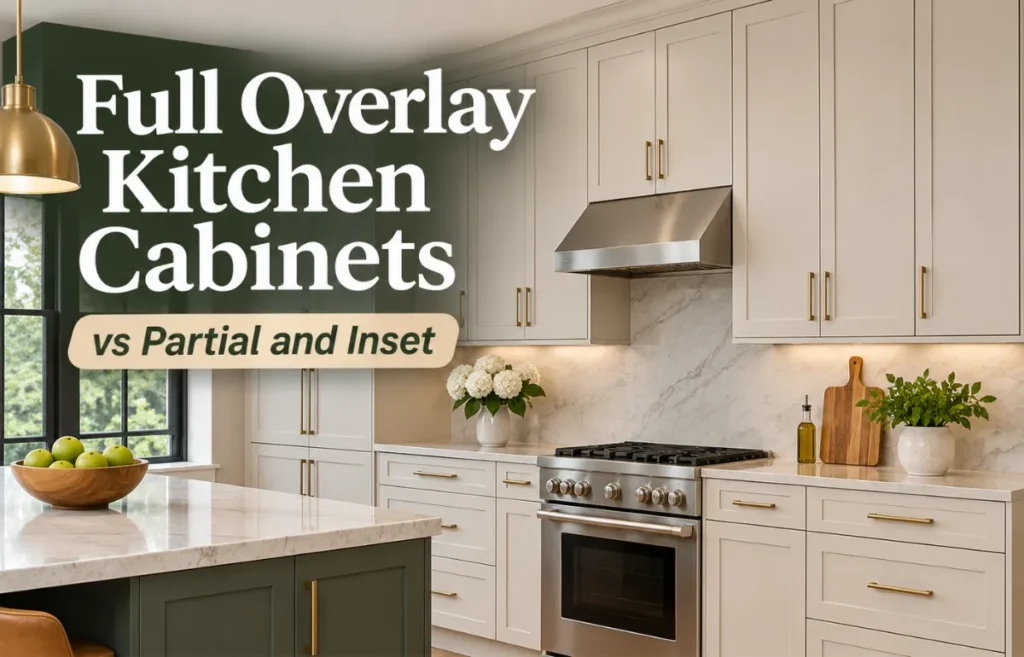
Full overlay kitchen cabinets are cabinets with doors and drawer fronts that cover nearly the entire cabinet face, leaving only narrow gaps between neighboring doors and drawers. Unlike partial overlay cabinets, which expose a noticeable portion of the face frame, or inset cabinets, which have doors fitted inside the frame, full overlay cabinets create a smooth, continuous appearance.
This construction style works with both framed and frameless cabinetry and is popular in modern, transitional, farmhouse, and contemporary kitchens.
What I particularly like about this cabinet design is its ability to deliver a high-end appearance without necessarily requiring a custom cabinetry budget.
However, appearance is only part of the decision. Door clearance, hinges, storage accessibility, installation requirements, and long-term maintenance all deserve consideration before you choose a cabinet construction style.
How Do Full Overlay Kitchen Cabinets Work?
The term overlay describes how far a cabinet door extends over the edges of the cabinet opening when closed.
With full overlay construction, the doors and drawer fronts are large enough to conceal most of the underlying cabinet frame or box edges. Small gaps remain to allow the doors and drawers to operate without rubbing against one another.
When the cabinets are closed, you see considerably more of the door surface and less of the supporting structure.
This creates a consistent appearance across the kitchen, particularly when several cabinets are installed side by side.
Full Overlay Cabinet Dimensions and Reveals
A reveal is the visible space around or between cabinet fronts.
On many framed full overlay cabinets, the doors cover approximately 1¼ inches of the face frame around applicable opening edges. However, overlay measurements vary depending on cabinet construction, frame width, and hinge specifications.
Some manufacturers leave approximately ¼ inch of visible frame at designated edges, while frameless designs may have gaps measuring only a few millimeters between adjacent fronts.
I recommend checking the manufacturer’s actual dimensions rather than assuming that all full overlay cabinet doors follow the same sizing standard.
Even a small measurement difference can affect door alignment and opening clearance.
Framed vs. Frameless Full Overlay Cabinets
One common misconception is that full overlay cabinets and frameless cabinets are the same thing.
They are not.
Framed cabinets have a supporting face frame attached to the front of the cabinet box. Full overlay doors conceal most of this frame when closed.
Frameless cabinets, sometimes called European-style cabinets, do not have a separate face frame. Their doors attach to the cabinet box using compatible hinges.
Both constructions can achieve a similar exterior appearance, but frameless cabinetry generally provides wider access to the interior because there is no face frame restricting the opening.
Full Overlay vs. Partial Overlay vs. Inset Cabinets
These three cabinet door constructions may look similar in product photographs, but their differences become noticeable once you examine how the doors fit against the cabinet box.
Here is how they compare.
| Feature | Full Overlay | Partial Overlay | Inset |
|---|---|---|---|
| Door placement | Over most of the cabinet face | Over part of the cabinet face | Inside the cabinet opening |
| Visible face frame | Minimal | More noticeable | Fully visible around doors |
| Appearance | Clean and continuous | Traditional and defined | Flush and furniture-like |
| Relative cost | Moderate | Generally lower | Generally higher |
| Installation precision | High | More forgiving | Very high |
| Hardware | Usually concealed hinges | Concealed or exposed hinges | Concealed or exposed hinges |
| Storage accessibility | Good, especially with frameless boxes | Depends on cabinet construction | May be slightly restricted |
| Suitable kitchen styles | Modern and transitional | Traditional and classic | Traditional and luxury |
These are general comparisons. Cabinet materials, manufacturer specifications, hardware quality, and customization can influence both performance and price.
Full Overlay Cabinets
Full overlay cabinetry emphasizes the doors rather than the surrounding framework.
This construction is particularly attractive in kitchens with long cabinet runs, tall pantry units, or large kitchen islands where consistent surfaces help reduce visual clutter.
It is also a practical option if you want a contemporary appearance without abandoning traditional door profiles such as Shaker or raised-panel designs.
Partial Overlay Cabinets
Partial overlay cabinets, also known as standard overlay cabinets, use smaller doors that leave more of the face frame visible.
The exposed framework creates a noticeable border around individual doors and drawers.
This style is frequently found in older kitchens and affordable cabinet collections. Its wider visible spacing can also make minor alignment differences less noticeable.
I would consider partial overlay construction for a budget-conscious renovation where dependable functionality matters more than achieving a seamless appearance.
Inset Cabinets
Inset cabinet doors sit within the cabinet opening rather than overlapping its edges. When closed, the front of the door is approximately flush with the surrounding frame.
This creates a carefully fitted appearance often associated with traditional furniture and custom woodworking.
Inset cabinetry requires accurate construction and installation because the clearance around each door must remain consistent.
Solid wood components may also expand or contract as indoor humidity changes, making proper fitting especially valuable.
For homeowners who appreciate fine architectural detailing, inset cabinets can be worth the additional expense.
Advantages of Full Overlay Kitchen Cabinets
Full overlay construction offers several benefits beyond its attractive appearance.
1. A Cleaner and More Spacious Appearance
Exposed cabinet frames introduce additional horizontal and vertical lines throughout a kitchen.
Full overlay doors minimize those interruptions, allowing the cabinetry to appear more unified.
This can make a compact kitchen feel less visually crowded, especially when paired with light-colored finishes, simple hardware, and consistent countertop materials.
The cabinets do not physically enlarge the room, but they can change how spacious it feels.
2. A Custom Appearance Without Custom Cabinet Prices
Inset cabinetry often involves more precise fitting and specialized labor.
Full overlay cabinets offer an alternative for homeowners who want refined cabinetry without necessarily paying for fully customized construction.
Many stock and semi-custom cabinet collections offer full overlay doors in a variety of finishes.
I would rather invest in well-built full overlay cabinets with durable hinges and drawer slides than choose more expensive inset cabinets while compromising on construction quality.
3. Compatibility With Different Kitchen Styles
Although full overlay construction is commonly associated with contemporary design, its appearance largely depends on the chosen door profile, finish, and hardware.
Flat-panel doors create a minimalist aesthetic, while Shaker doors introduce subtle architectural detail.
Natural oak finishes can soften a modern kitchen, and painted raised-panel doors can maintain a more traditional character.
This flexibility makes full overlay cabinetry suitable for kitchens that may undergo future decorative changes.
4. Convenient Storage Access
Overlay doors sit in front of the cabinet opening rather than occupying part of its depth.
When combined with frameless construction and suitable hinges, they can provide excellent access to shelves, interior drawers, and pull-out organizers.
However, switching from partial overlay to full overlay alone does not automatically increase storage capacity. Cabinet box dimensions and internal fittings determine how much usable space you gain.
Disadvantages of Full Overlay Kitchen Cabinets
Despite their benefits, full overlay cabinets have several limitations worth understanding before purchasing.
1. Door and Drawer Collisions
The narrow spaces between cabinet fronts leave less room for positioning errors.
A door near a wall may strike the wall before opening fully. Corner cabinet doors can interfere with adjacent handles, and oversized pulls may obstruct neighboring drawers.
These problems are particularly relevant around kitchen islands, blind corners, refrigerators, and tall pantry cabinets.
I recommend checking the complete opening movement of every potentially conflicting door and drawer during the planning stage.
2. Greater Installation Precision
Full overlay cabinetry depends heavily on consistent alignment.
If cabinet boxes are not installed level, square, and in the same plane, the doors may develop uneven gaps. Even good-quality cabinetry can look poorly finished when installation is inaccurate.
Adjustable concealed hinges help correct minor positioning differences, but they cannot compensate for every construction or installation problem.
3. Potentially Higher Refacing Costs
Replacing partial overlay doors with full overlay doors may require larger replacement fronts, different hinges, additional fillers, and modifications to existing hardware.
If your current face frames or cabinet boxes are unsuitable, the project can become more expensive than expected.
Before committing to a cabinet makeover, compare the complete conversion cost with the price of replacing the affected cabinets.
4. Fingerprints and Surface Marks
Full overlay cabinetry presents a larger uninterrupted door surface.
Glossy finishes and dark colors may make fingerprints more noticeable, particularly around frequently used drawers and cabinets.
Matte finishes, durable textured laminates, and appropriately positioned handles can make everyday maintenance easier.
Why Cabinet Hinges Matter More Than You Might Think
Full overlay cabinet hinges are specifically selected to position the door over the cabinet face while providing enough clearance for movement.
Concealed European-style hinges are a popular choice because they remain hidden when the cabinet doors are closed.
Many include adjustments for height, depth, and side-to-side positioning. Soft-close mechanisms can also reduce slamming.
However, the label “full overlay hinge” does not guarantee compatibility with every cabinet.
Face frame thickness, mounting plate dimensions, door thickness, hinge cup positioning, and the required opening angle all influence hinge selection.
Hardware manufacturers such as Blum publish technical planning charts that account for these variables.
I suggest confirming the hinge specifications before ordering replacement doors, especially if you are using thick wooden fronts or installing interior pull-out drawers.
Can You Convert Partial Overlay Cabinets to Full Overlay?
Yes, many partial overlay cabinets can be converted to full overlay kitchen cabinets without replacing the entire cabinet box.
The existing structure must be in good condition and capable of supporting the new doors and hinges.
Start by examining the face frames, cabinet openings, center stiles, neighboring appliances, and available wall clearance.
How to Calculate Cabinet Door Size
For a single overlay cabinet door, add the intended overlay on each side to the width of the cabinet opening. Apply the same method to the height.
For example, consider a cabinet opening measuring 15 inches wide and 25 inches high.
If the required overlay is 1¼ inches on all four sides, the replacement door would measure 17½ inches wide and 27½ inches high.
This example assumes the surrounding cabinet structure provides enough space for that overlay.
Double-door cabinets require separate calculations that account for the central meeting gap, any center stile, and neighboring cabinet fronts.
Always confirm the final measurements with your cabinet door supplier.
Check the Existing Cabinet Layout
Larger doors need more consideration than simply covering the original face frame.
Pay particular attention to the exposed ends of cabinet runs, corners, dishwasher panels, decorative trim, and countertop overhangs.
If I were planning a conversion, I would create a cardboard template of the proposed replacement door before placing an order.
This inexpensive mock-up can help identify potential spacing and handle conflicts before you purchase new materials, although final hinge movement must still be checked separately.
Overlooked Design Details That Can Prevent Expensive Mistakes
Cabinet showrooms generally display perfectly aligned cabinetry in carefully controlled layouts.
Real kitchens contain uneven walls, projecting appliances, window trim, and other obstacles that can affect cabinet performance.
Leave Enough Space for Cabinet Fillers
A filler is a narrow panel installed between a cabinet and an adjacent wall, appliance, or cabinet.
With full overlay doors, fillers provide clearance where the door or handle might otherwise strike a nearby surface.
The appropriate filler width depends on the hinge movement, handle projection, surrounding obstacles, and manufacturer’s recommendations.
Removing fillers simply to maximize cabinet width can create more problems than the additional storage space is worth.
Consider the Door Thickness
Two cabinet doors with identical width and height can behave differently when opened if their thicknesses differ.
A thicker door may require additional clearance or a different hinge configuration.
This becomes particularly relevant when replacing thin laminate doors with thicker solid wood or decorative cabinet fronts.
I recommend evaluating door thickness as a functional measurement rather than treating it exclusively as a design preference.
Check Interior Drawer Access
A cabinet door may open successfully while still preventing an internal drawer from extending completely.
This happens when the open door or hinge projects into the path of a pull-out organizer.
A compatible wide-angle or zero-protrusion hinge may resolve this problem, depending on the cabinet design.
Test the relationship between the door and internal storage accessories before finalizing the layout.
How Much Do Full Overlay Kitchen Cabinets Cost?
Full overlay cabinets generally occupy a middle price range between basic partial overlay cabinetry and premium inset cabinetry when comparing otherwise similar products.
However, the overlay style alone does not determine the final cost.
Cabinet box materials, door construction, finish quality, hardware, customization, and installation labor can have a greater impact on your budget.
| Cabinet construction | Relative price | Main cost considerations |
|---|---|---|
| Partial overlay | Lower | Smaller fronts and simpler fitting |
| Full overlay | Moderate | Larger fronts, compatible hinges and alignment |
| Inset | Higher | Precise fitting and specialized construction |
A premium solid wood full overlay cabinet can easily cost more than a basic inset cabinet made from less expensive materials.
When comparing quotes, I suggest requesting identical cabinet layouts, material specifications, and hardware features. This makes it easier to identify what you are actually paying for.
Best Door Styles for Full Overlay Cabinets
The right door profile can dramatically change the character of your cabinetry.
Shaker Cabinet Doors
Full overlay Shaker cabinets combine a recessed center panel with a straightforward frame.
Their balanced appearance works well in transitional, farmhouse, and contemporary kitchens.
Slim Shaker profiles offer a slightly more modern interpretation.
Flat-Panel Cabinet Doors
Flat-panel or slab doors feature a smooth surface without decorative framing.
They work particularly well with frameless construction, handleless designs, and minimalist kitchen interiors.
Their simple surfaces are also relatively easy to wipe clean.
Raised-Panel Cabinet Doors
Raised-panel doors introduce decorative depth and traditional detailing.
Combined with full overlay construction, they can update a classic kitchen without removing its architectural character.
Are Full Overlay Kitchen Cabinets Right for Your Home?
I would choose full overlay cabinetry for a kitchen that needs a coordinated appearance, flexible design options, and a reasonable balance between price and visual quality.
Partial overlay remains a sensible option when preserving an existing traditional kitchen or keeping renovation costs low is the priority.
Inset cabinets are particularly appealing when fine woodworking details, historical character, and furniture-like proportions are central to the design.
Whichever option you prefer, examine the physical cabinet sample with its doors both open and closed. Check the hinges, drawer movement, finish quality, and visible gaps.
A cabinet that performs well during everyday use is ultimately more valuable than one that simply photographs beautifully.
Final Thoughts
Full overlay kitchen cabinets offer an attractive middle ground between traditional partial overlay cabinetry and the precise craftsmanship of inset cabinets.
Their clean appearance, design flexibility, and availability across different price ranges make them suitable for many kitchen renovations.
My recommendation is to prioritize cabinet construction, hinge quality, door clearance, and accurate installation alongside appearance.
Before placing your order, compare physical cabinet samples and request detailed measurements from your supplier. Spending a little extra time on these decisions can prevent costly modifications and help you create a kitchen that looks good and functions comfortably for years.
Frequently Asked Questions
Are full overlay kitchen cabinets more expensive?
They generally cost more than comparable partial overlay cabinets but less than inset cabinets. Materials, hardware, customization, and installation ultimately determine the price.
Are full overlay cabinets the same as frameless cabinets?
No. Full overlay describes door placement, while frameless refers to cabinet box construction. Full overlay doors can be installed on both framed and frameless cabinets.
What is the difference between full overlay and inset cabinets?
Full overlay doors cover most of the cabinet face, while inset doors fit inside the cabinet opening and sit approximately flush with the surrounding frame.
Can you change partial overlay cabinets to full overlay?
Yes, provided the existing cabinet structure and surrounding clearances are suitable. The conversion usually requires larger doors, compatible hinges, and sometimes additional modifications.
Do full overlay cabinets have more storage space?
Not necessarily. Frameless full overlay cabinets often provide better interior accessibility, but actual storage capacity depends on cabinet box dimensions and internal construction.