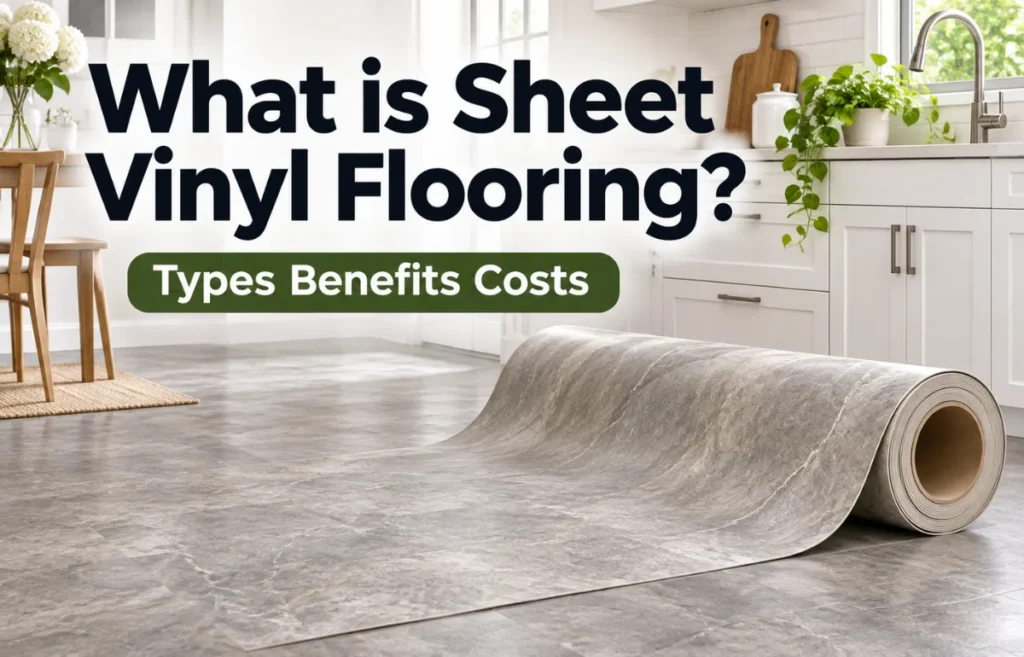
If you’re wondering what is sheet vinyl flooring, it’s a flexible, water-resistant floor covering made primarily from polyvinyl chloride (PVC) and supplied in large, continuous rolls rather than individual planks or tiles. Installers cut the material to fit a room, often creating a smooth surface with few or no visible seams.
Sheet vinyl flooring is popular in kitchens, bathrooms, laundry rooms, and other spaces where easy cleaning and moisture resistance matter. It can imitate wood, stone, ceramic tile, and decorative patterns without the cost or upkeep of many natural materials.
What makes it particularly useful is its combination of affordability, comfort, and low maintenance. However, sheet vinyl isn’t identical to luxury vinyl plank or tile flooring, and understanding the differences can help you avoid an expensive flooring mistake.
What Is Sheet Vinyl Flooring Made Of?
Modern sheet vinyl is usually manufactured with several layers that work together to provide flexibility, appearance, and durability.
Unlike hardwood or ceramic tile, it isn’t made from separate solid pieces. Instead, its construction creates a continuous surface that can be rolled, transported, cut, and fitted across a floor.
Most residential sheet vinyl products contain four main components.
1. Protective Wear Layer
The wear layer forms the protective surface of the flooring. It helps resist everyday scratches, stains, scuffs, and foot traffic.
A thicker or more durable protective layer generally improves wear resistance, although the quality of the surface coating also matters.
2. Printed Design Layer
This layer gives sheet vinyl its appearance.
Manufacturers use detailed printing and embossing techniques to reproduce wood grain, marble, slate, patterned tiles, and other decorative finishes.
3. Stabilizing Layer
Many modern products contain fiberglass or another stabilizing material that helps the flooring maintain its dimensions.
This reduces unwanted movement when temperatures and indoor conditions change, although proper installation remains necessary.
4. Backing Layer
The backing provides support and can influence comfort, sound absorption, and installation requirements.
Some products feature cushioned foam backing, while others use fiberglass-reinforced or felt-based constructions.
Not every sheet vinyl product has the same layers. Commercial homogeneous vinyl, for example, has a more uniform composition throughout its thickness.
How Is Sheet Vinyl Different From Vinyl Plank and Vinyl Tile?
This is where I think homeowners should pay the most attention.
Sheet vinyl, luxury vinyl plank (LVP), and luxury vinyl tile (LVT) may look similar in photographs. However, the biggest difference isn’t their appearance. It’s how they’re manufactured and installed.
Sheet vinyl comes in large rolls, commonly 6 or 12 feet wide, although other widths are available.
Vinyl planks resemble individual wooden boards, while vinyl tiles are manufactured as separate square or rectangular pieces.
Sheet Vinyl vs. Vinyl Plank vs. Vinyl Tile
| Feature | Sheet Vinyl | Vinyl Plank (LVP) | Vinyl Tile (LVT) |
|---|---|---|---|
| Format | Continuous roll | Individual planks | Individual tiles |
| Appearance | Wood, stone, and patterns | Mainly wood looks | Mainly tile and stone looks |
| Seams | Few or none | Joints between planks | Joints between tiles |
| Installation | Loose-lay or adhesive, depending on product | Click-lock or glue-down | Click-lock or glue-down |
| Comfort | Often softer underfoot | Depends on core and backing | Depends on construction |
| Repairs | Patches can be noticeable | Individual pieces may be replaceable | Individual pieces may be replaceable |
| Typical cost | Usually lower | Generally higher | Generally higher |
Why the Seam Difference Matters
Every plank or tile introduces joints into the finished floor.
Sheet vinyl can cover an appropriately sized room in one continuous piece, reducing the number of places where spilled water might reach the subfloor.
However, the perimeter, penetrations, and any necessary seams still require appropriate detailing.
I would favor sheet vinyl in a compact laundry room where minimizing joints matters more than achieving the appearance of individual wooden boards.
For a large living room where replacing damaged sections might be a priority, vinyl planks could be more practical.
What Are the Different Types of Sheet Vinyl Flooring?
Sheet vinyl isn’t a single product with identical performance across every brand.
Three common residential construction styles are worth understanding.
Fiberglass-Backed Sheet Vinyl
Fiberglass-backed vinyl is designed to offer dimensional stability and flexibility.
Depending on the manufacturer, certain products support loose-lay, modified loose-lay, or adhesive installation.
It’s commonly used in residential kitchens, bathrooms, and living spaces.
Felt-Backed Sheet Vinyl
Felt-backed vinyl uses a fibrous supporting layer and generally has different adhesive requirements from fiberglass-backed products.
Some versions are suitable for installation beneath fixed cabinetry, provided the manufacturer permits it.
I recommend checking the installation instructions rather than assuming every sheet can be installed the same way.
Cushioned Sheet Vinyl
Cushioned vinyl contains a softer backing that makes standing and walking more comfortable.
This can be particularly appealing in kitchens where people spend extended periods preparing meals.
The trade-off is that softer constructions may be more susceptible to impressions from concentrated furniture loads.
What Are the Advantages of Sheet Vinyl Flooring?
Sheet vinyl offers several practical benefits beyond its relatively low purchase price.
Affordable for Budget Renovations
Sheet vinyl is often less expensive than luxury vinyl planks, natural hardwood, and ceramic tile.
Its straightforward material format can also reduce installation expenses, especially when a room requires only one sheet.
Excellent Everyday Moisture Resistance
The vinyl material resists water, and a seamless installation reduces the number of joints exposed to spills.
This makes it especially attractive for kitchens, bathrooms, and laundry areas.
Comfortable Underfoot
Many sheet vinyl products feel warmer and softer than stone or ceramic tile.
Cushioned varieties can also reduce the harsh feeling of standing on a rigid surface.
Easy Cleaning
A continuous surface means fewer joints where crumbs, dirt, and cleaning residue can collect.
Regular sweeping and damp mopping are generally enough to maintain its appearance.
Wide Range of Designs
Modern designs include realistic oak, concrete, marble, geometric tile, and traditional patterned styles.
You can achieve a completely different room appearance without purchasing individual decorative tiles or wooden boards.
What Are the Disadvantages of Sheet Vinyl Flooring?
Despite its advantages, sheet vinyl isn’t suitable for every household or renovation.
Damage Can Be Difficult to Hide
Sharp objects, dragged furniture, and concentrated pressure can cut or permanently dent the surface.
Unlike plank flooring, where a damaged piece may be replaceable, sheet vinyl typically requires a carefully matched patch or a larger replacement.
Subfloor Imperfections May Show Through
Sheet vinyl is flexible, so bumps, ridges, old grout lines, and uneven joints may eventually become visible.
Installers call this telegraphing.
A smooth, properly prepared subfloor is essential, even when the vinyl itself has cushioning.
Large Sheets Can Be Awkward to Install
Working with one large piece sounds easier than fitting dozens of planks.
In reality, accurately cutting around door frames, pipes, cabinets, and fixtures can be challenging.
One incorrect cut may ruin a substantial section of material.
Not Completely Damage-Proof
Excessive heat, prolonged direct sunlight, sharp furniture legs, and abrasive cleaning can affect some products.
Sheet vinyl is durable enough for ordinary household use, but it shouldn’t be confused with an indestructible commercial floor.
Where Is Sheet Vinyl Flooring Best Used?
I prefer choosing flooring according to the conditions of a room rather than appearance alone.
Kitchens
Sheet vinyl works well in kitchens because cooking spills, food crumbs, and everyday cleaning are easy to manage.
Wood-look designs can also introduce warmth without requiring actual hardwood.
Bathrooms
A continuous sheet can reduce water-exposed joints, making it a practical choice for ordinary residential bathroom floors.
However, standard residential sheet vinyl isn’t automatically approved for shower floors or permanently wet areas.
Laundry Rooms
Laundry spaces benefit from easy cleaning and moisture-resistant surfaces.
Remember that a serious washing-machine leak can still cause damage beneath the flooring.
Bedrooms and Living Rooms
Cushioned sheet vinyl can provide a comfortable, relatively quiet walking surface.
It’s especially useful when an affordable flooring update is more important than the dimensional appearance of separate planks.
For exceptionally heavy traffic or specialized commercial settings, I would compare product-specific performance ratings before deciding.
Is Sheet Vinyl Flooring Really Waterproof?
Most modern vinyl sheet products are marketed as waterproof because the vinyl material doesn’t absorb water like wood does.
However, waterproof flooring doesn’t mean a waterproof room.
Water can still enter around walls, plumbing penetrations, poorly sealed seams, or damaged edges.
Moisture trapped beneath vinyl can also damage wood subfloors, interfere with adhesives, or contribute to mold problems when conditions allow.
The distinction I use is simple: the surface may resist water, but the complete installation must also manage moisture.
Proper edge detailing, a dry substrate, and prompt cleanup remain essential.
How Is Sheet Vinyl Flooring Installed?
Sheet vinyl installation generally begins with preparing the existing floor.
The subfloor must be clean, dry, stable, and sufficiently smooth. Cracks, uneven joints, and surface defects may need filling or leveling.
The material is then measured, positioned, trimmed, and secured according to its specific installation system.
There are three common approaches.
Loose-Lay Installation
Some sheet vinyl products can be installed without adhesive across most or all of the floor.
This method is typically limited to approved products and suitable room sizes.
It shouldn’t be assumed that any ordinary vinyl roll can simply be placed on the floor.
Perimeter-Bond Installation
Certain products allow adhesive or approved tape around designated areas to hold the sheet in position.
This can make installation more manageable while reducing the amount of adhesive used.
Full-Spread Adhesive Installation
With this method, the installer applies compatible adhesive across the prepared subfloor before positioning and rolling the material.
It is often appropriate for larger spaces, heavier use, or products specifically requiring full adhesion.
Manufacturer instructions determine the correct adhesive, site conditions, seam treatment, and curing requirements.
For an irregular room with multiple fixtures, I would usually choose a qualified installer over risking an expensive cutting mistake.
If you’re renovating an older home, avoid sanding or tearing up unidentified vintage flooring. Some older vinyl flooring and backing materials contain asbestos and may require professional assessment.
How Much Does Sheet Vinyl Flooring Cost?
One of the main reasons homeowners consider sheet vinyl is its affordability.
As a general U.S. pricing reference, basic residential sheet vinyl materials often cost approximately $1–$2 per square foot, while premium designs may cost more.
Basic installation labor may add approximately $1–$2 per square foot, according to published Home Depot estimates. Actual local quotes can be considerably higher, especially when subfloor preparation or removal is necessary.
For example, covering a 120-square-foot room at $1.50 per square foot would suggest $180 in material based on floor area alone.
However, that isn’t necessarily the actual purchase quantity.
Because vinyl comes in fixed roll widths, offcuts and pattern matching can increase the amount you need to buy.
Additional expenses may include floor leveling, old flooring removal, adhesive, seam treatment, transitions, and trim.
I recommend comparing complete installed quotes rather than looking only at the advertised material price.
How Much Sheet Vinyl Do You Actually Need?
Here’s a detail that’s easy to miss: room area doesn’t always equal the amount of sheet vinyl you must purchase.
Suppose your kitchen measures 11 feet by 13 feet.
Its floor area is 143 square feet. A 12-foot-wide roll can cover the room without a lengthwise seam if the material is oriented correctly.
But you would typically purchase a 12-foot-wide piece at least 13 feet long, before allowing for trimming and pattern alignment.
That’s 156 square feet of material, even though the room itself measures only 143 square feet.
Now imagine the room is 12 feet 4 inches wide.
A 12-foot roll no longer spans that dimension. Depending on the room’s length, the available roll widths, and the pattern, the installer may need to change orientation, introduce a seam, or order a wider product.
This is why I recommend planning the sheet layout before purchasing.
Check roll width, room dimensions, door openings, pattern direction, and the exact location of any seams.
A slightly higher-priced roll that fits without a seam may provide better overall value than a cheaper product requiring complicated fitting.
How to Choose Good-Quality Sheet Vinyl Flooring
The best sheet vinyl isn’t necessarily the thickest or most expensive option.
I would compare these factors before purchasing.
Check the Wear Layer
Wear-layer thickness is often expressed in mils, where one mil equals one-thousandth of an inch.
Don’t confuse mils with millimeters.
A thicker protective layer can improve wear resistance, but coating technology and the manufacturer’s intended-use rating also matter.
Examine the Backing
Choose a backing appropriate for your subfloor, comfort expectations, and installation method.
Don’t assume that thicker cushioning always means longer-lasting flooring.
Look at the Pattern in a Large Sample
A small sample may look convincing, but a repeated wood or tile pattern can become more obvious across an entire room.
I recommend viewing a larger sample under both natural and artificial lighting.
Read the Warranty Carefully
Check coverage for wear, stains, manufacturing defects, and moisture-related limitations.
A long warranty doesn’t necessarily cover installation errors, scratches, flooding, or damage caused by furniture.
Consider Indoor Air Quality
If chemical emissions are a concern, look for independently verified low-VOC certifications, such as FloorScore.
Also evaluate the adhesives and other installation materials rather than judging the flooring alone.
How Do You Clean and Maintain Sheet Vinyl Flooring?
Keeping sheet vinyl clean is relatively straightforward.
Sweep regularly or use a vacuum suitable for hard floors to remove grit that might scratch the finish.
Damp mop with a manufacturer-approved cleaner and avoid leaving pools of water around seams or edges.
Harsh abrasives, unsuitable solvents, and excessive heat can damage certain finishes.
I also recommend placing protective pads beneath furniture and using suitable entrance mats to reduce tracked-in dirt.
Promptly wipe up spills, particularly near walls and plumbing fixtures.
With appropriate installation, normal household use, and regular care, quality residential sheet vinyl can often last around 10–20 years. Its actual lifespan depends on product construction, traffic, maintenance, and environmental conditions.
Is Sheet Vinyl Flooring Worth It?
For many budget-conscious renovations, yes.
Sheet vinyl offers a useful combination of attractive designs, everyday moisture resistance, comfort, and manageable maintenance costs.
Its biggest advantage over vinyl planks and tiles is the possibility of covering an entire room with very few seams.
Its biggest compromise is repairability: damage to a continuous sheet can be more difficult to conceal.
My recommendation is to start with your room measurements, inspect the subfloor, and compare sheet layouts before selecting a design.
A properly chosen and installed sheet vinyl floor can deliver an attractive, practical result without the expense of many alternative flooring materials.
Frequently Asked Questions About Sheet Vinyl Flooring
1. Is sheet vinyl flooring better than vinyl plank flooring?
Sheet vinyl is often cheaper and has fewer seams. Vinyl planks may offer easier individual-piece repairs and a more realistic board-style appearance.
2. Can sheet vinyl flooring be installed over existing flooring?
Sometimes. The existing surface must be suitable, stable, dry, and smooth, and the new flooring manufacturer must approve the installation.
3. Does sheet vinyl flooring need underlayment?
Not always. Many products can be installed on a properly prepared subfloor, while others require specific underlayment or surface preparation.
4. How long does sheet vinyl flooring last?
Quality residential sheet vinyl commonly lasts around 10–20 years, depending on its wear resistance, installation quality, traffic, and maintenance.
5. Can you put sheet vinyl flooring in a bathroom?
Yes. Sheet vinyl is well suited to many residential bathroom floors, provided seams, edges, and plumbing penetrations are appropriately treated.