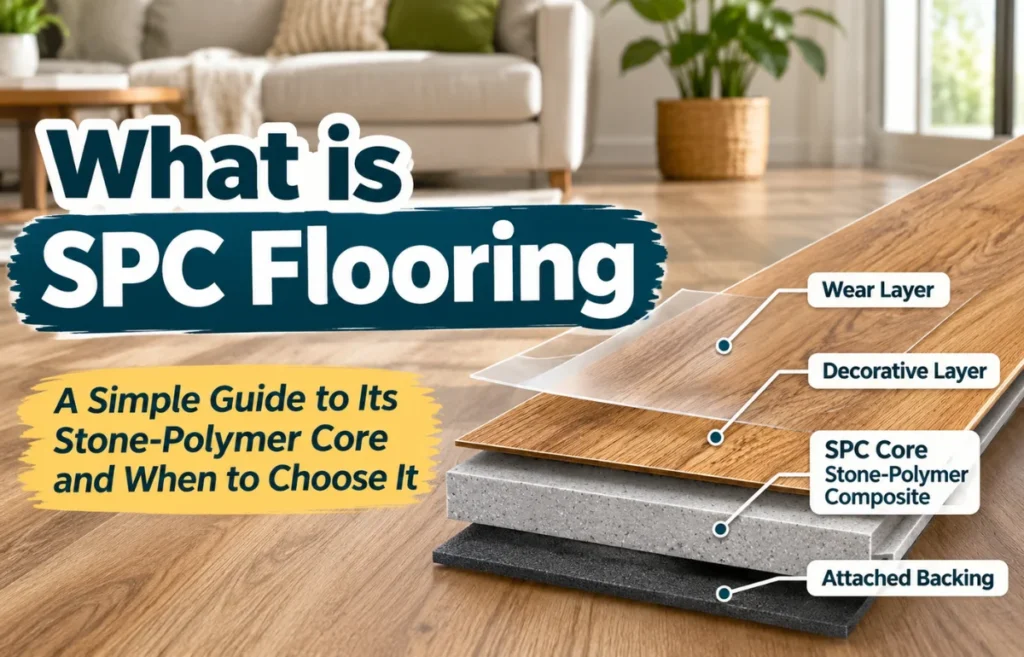
If you’re wondering what is SPC flooring, it’s a type of rigid-core vinyl flooring made with a dense center that combines finely ground limestone, usually calcium carbonate, with polymer materials and stabilizers. SPC commonly stands for stone-polymer composite or stone-plastic composite. It looks like wood or stone on the surface, but underneath, its solid mineral-filled core helps the planks resist dents, moisture, and changes in temperature.
I think the easiest way to understand SPC is to separate what the floor looks like from what makes it work. The printed layer provides the appearance. The protective wear layer handles daily traffic. The stone-polymer core gives the plank its firmness and stability. That construction makes SPC a practical choice for many busy homes, but it doesn’t automatically make it the best floor for every room.
What Is SPC Flooring Made Of?
Despite its stone-related name, SPC flooring isn’t cut from natural stone. It’s an engineered resilient floor covering, usually sold as interlocking planks or tiles.
Its distinguishing feature is the core. Manufacturers combine mineral filler, commonly limestone powder, with a polymer binder, typically PVC, plus processing additives. The result is a compact, relatively heavy core rather than the airy, expanded core used in many WPC products.
Core formulations, coatings, and locking profiles vary, so I wouldn’t judge two SPC floors by the letters on their boxes alone.
The Layers Inside an SPC Plank
Most SPC planks include some variation of these layers:
- Surface coating: A finish that helps resist scuffs and stains.
- Clear wear layer: A transparent shield against traffic and grit.
- Decorative film: A printed wood, stone, or other design.
- SPC core: The dense layer responsible for rigidity.
- Attached backing, if included: A pad for sound and underfoot feel.
Construction varies, so the specification sheet matters more than a generic layer diagram.
How Does the Stone-Polymer Core Change Performance?
The core is the main reason SPC feels different from flexible luxury vinyl flooring. Because it is dense and rigid, a plank distributes some concentrated pressure across its structure rather than bending as easily into every small low spot beneath it.
That firmness can improve resistance to indentation from ordinary furniture loads. It can also give the floor better dimensional stability as indoor temperatures fluctuate. The Resilient Floor Covering Institute describes SPC as a solid polymer core with these advantages compared with expanded-core WPC.
However, rigidity involves a trade-off. A hard plank usually feels less cushioned than WPC or carpet, and an uneven subfloor can put stress on the click-lock edges. SPC tolerates some minor imperfections, but it cannot fix a badly prepared floor.
Stability does not mean zero movement. SPC still needs manufacturer-specified perimeter clearances and indoor conditions.
A Useful Distinction: Core Strength Is Not Surface Strength
Imagine sliding a gritty chair leg across an SPC floor. The rigid core may resist a dent, but the clear surface can still scratch.
A dropped pointed object can also damage the surface. No thickness number predicts every impact.
This is why I evaluate SPC in two parts: the core for firmness and indentation performance, and the top layers for wear, stains, and scratches. Buying on core thickness alone overlooks half the floor.
What Are the Main Advantages of SPC Flooring?
Water-Resistant Construction for Everyday Spills
SPC’s vinyl-based layers and rigid core generally won’t swell like traditional wood-based flooring when exposed to routine spills. That makes it appealing for kitchens, entryways, and other places where water occasionally lands on the floor.
Still, “waterproof plank” doesn’t mean “waterproof room.” Water can travel through joints and around the edges, reaching the subfloor or walls. A hidden plumbing leak or flood needs proper drying and inspection, even when the planks look fine.
Strong Resistance to Everyday Indentations
The mineral-filled core is useful where furniture, foot traffic, and active households put flooring under pressure. It is particularly attractive for dining areas and multipurpose rooms.
Protection is still sensible: I’d use furniture pads, choose suitable casters, and avoid dragging heavy appliances directly over the finished surface.
Realistic Designs Without Wood’s Maintenance Needs
SPC vinyl flooring comes in wood-look planks and stone-look tiles, often with textured surfaces and beveled edges. It can create the visual warmth of timber without sanding, staining, or refinishing.
I’d inspect several full planks together; a small sample can hide repeated patterns.
Convenient Installation and Cleaning
Many SPC products use click-lock joints and float above approved subfloors without full-spread adhesive. Damaged individual planks may be replaceable, although the repair method depends on the locking system and where the plank sits.
Sweeping and manufacturer-approved damp mopping usually cover routine cleaning.
What Are the Disadvantages of SPC Flooring?
SPC is durable, but its limitations matter just as much as its benefits.
First, it can feel hard and relatively cool under bare feet. An attached pad may soften sound slightly, but it won’t turn a rigid plank into a cushioned floor.
Second, the click edges can be vulnerable when the subfloor is uneven, installation is rushed, or heavy fixtures prevent a floating floor from moving as designed. Damage may show as a gap or raised edge.
Third, SPC isn’t immune to scratches, fading, or heat damage. Abrasive dirt can mark the finish, and strong sunlight or excessive heat may exceed a product’s approved conditions.
Finally, the floor cannot be sanded and refinished like solid hardwood. If visible damage becomes severe, the practical repair is usually plank replacement rather than resurfacing.
Its mineral content doesn’t make SPC biodegradable; recycling options depend on local facilities and the product.
SPC vs. WPC, Luxury Vinyl, and Laminate Flooring
SPC is a type of luxury vinyl. In stores, “LVP” may mean flexible vinyl plank, while “rigid-core LVP” may mean SPC or WPC.
| Flooring type | Core construction | Underfoot feel | Water and moisture considerations | Best reason to choose it |
|---|---|---|---|---|
| SPC flooring | Dense mineral-filled polymer | Firm | Planks resist water; subfloor still needs protection | Indentation resistance and stability |
| WPC flooring | Expanded polymer composite | Generally softer and quieter | Water-resistant core; seams still matter | Comfort and sound absorption |
| Flexible LVP | Flexible vinyl construction | More flexible; depends on subfloor | Product-dependent; often water-resistant | A thinner, more pliable finish |
| Laminate flooring | Usually wood-fiber-based core | Firm, sometimes hollow-sounding | Joint and core moisture performance varies | Wood-look aesthetics and surface options |
SPC Flooring vs. WPC: Which Is Better?
I’d lean toward SPC for a busy entryway or dining room where indentation resistance matters. WPC may suit a bedroom if softness and quiet matter more.
Neither material wins every comparison. Wear-layer quality, subfloor preparation, and product-specific warranties can matter more than the category label.
Where Should You Use SPC Flooring?
SPC works best when its water-tolerant construction and firm surface match the needs of the room. The following is how I’d approach typical spaces.
| Room or setting | My assessment | What to check first |
|---|---|---|
| Kitchen and dining area | Often a strong fit | Spill cleanup, chair pads, appliance movement |
| Hallway or entryway | Strong fit for traffic | Grit-catching mats and durable wear layer |
| Bathroom or laundry | Possible with an approved product | Perimeter details, leaks, local wet-area requirements |
| Finished basement | Possible on a dry, suitable base | Concrete moisture, drainage, and vapor-control instructions |
| Bedroom or upstairs room | Suitable, but comfort varies | Footfall sound and underfoot feel |
| Sunroom or unconditioned space | Only if expressly approved | Direct sunlight and permitted temperature range |
Why I’m Cautious About Bathrooms and Basements
A waterproof surface isn’t waterproofing. For bathrooms, I’d check manufacturer approval and directions around tubs, toilets, and walls. SPC isn’t automatically suitable for shower floors.
For basements, I’d investigate moisture before choosing any finish. Concrete can look dry while still releasing vapor. If the slab has an unresolved water problem, putting waterproof flooring over it can conceal—not solve—the issue.
How to Choose Good SPC Flooring Without Relying on Marketing Claims
I’d start with the actual product specification sheet. Brand names and phrases like “commercial grade” tell me less than clear performance data.
1. Check the Wear Layer Separately From Total Thickness
The total plank thickness includes the core, decorative layers, and sometimes the attached pad. The wear layer is a different measurement.
You may see a 12-mil or 20-mil wear layer listed. Here, mil means one-thousandth of an inch, not a millimeter: 12 mil is about 0.30 mm, while 20 mil is about 0.51 mm.
A thicker wear layer can offer more material above the printed design, but the coating chemistry, test results, and intended use still influence scratch and wear performance. I wouldn’t assume every 20-mil product outperforms every 12-mil product.
2. Inspect the Locking Joint
A rigid core is only one part of a floating floor. The click connection must remain secure under daily loads and minor movement.
I’d join two sample planks, inspect seam alignment, and check the guide for room-size limits and transitions.
3. Look for Verified Standards and Emissions Information
For the product category, ASTM F3261-26 addresses requirements for modular resilient flooring with a rigid polymeric core. A manufacturer can tell you which standards and tests its specific product meets.
For indoor air quality, FloorScore certification provides independent verification against defined volatile organic compound emission limits. It isn’t a blanket guarantee that a product contains no potentially concerning substances. The FloorScore certification guidance explains what is tested.
I’d verify a certificate against the exact collection or product, especially if several floors share the same brand name.
4. Test the Sample in Your Actual Room
Here’s a simple check I find more useful than comparing polished catalog photos: place two or three large samples on the intended floor, examine them in daylight and evening light, and walk on them wearing your usual shoes.
Look at texture, glare, sound, and how the design meets your cabinets and trim. Ask whether the sample includes the same underlayment as the product you’ll receive. Showrooms can be misleading.
5. Read Warranty Exclusions Before Paying
Look specifically for exclusions involving sunlight, high temperatures, rolling chairs, moisture below the floor, unsuitable cleaning products, and incorrect installation.
A long residential warranty may sound reassuring, but its coverage matters more than the headline number. I prefer a clear installation manual and realistic warranty terms to an impressive promise with vague conditions.
What Does SPC Flooring Installation Require?
Click-lock SPC is often promoted as an easy DIY floor. The actual difficulty usually lies in preparing what’s underneath.
The base needs to be clean, sound, dry enough for the specified system, and flat within the product’s stated tolerance. Flat is not the same as level: a gently sloping floor may be acceptable, while a sharp dip on an otherwise level floor can cause problems.
I’d never assume that rigidity lets me skip subfloor repairs. Hollows can make planks flex at the joints, while high spots concentrate stress. Existing tile may be suitable under some products, but deep grout lines or loose tiles may need attention.
Installers must also follow rules for expansion gaps, doorways, transitions, fixed cabinetry, and heavy islands. Floating planks generally need room to move; pinning them under permanent fixtures can create trouble.
If a plank has attached backing, don’t automatically add another foam underlay. Extra cushioning may let the joint flex too much and can void a warranty. For concrete, any required moisture testing or vapor retarder must come from the flooring instructions and site conditions.
I’d also check whether the manufacturer requires acclimation. Different SPC products have different temperature and storage requirements, so a blanket “no acclimation needed” rule isn’t reliable.
How Long Does SPC Flooring Last, and Is It Worth the Cost?
There isn’t one honest lifespan figure for every SPC floor. Heavy grit, direct sun, poor subfloor preparation, and low-quality locking joints can shorten useful service, while good maintenance and suitable installation improve the odds of long-term performance.
Compare total installed cost: leveling, moisture work, old-floor removal, trims, door adjustments, waste, and labor can change the budget significantly.
For maintenance, I’d sweep or vacuum with a floor-safe setting, remove grit near entrances, wipe spills promptly, and use only approved cleaners. Steam cleaners, abrasive pads, and harsh chemicals should be avoided unless the manufacturer specifically permits them.
My rule is to judge value by total installed cost and suitability—not by the lowest price per square foot.
Is SPC Flooring Right for Your Home?
When someone asks me what is SPC flooring and whether it’s worth buying, I come back to three questions: Will the room get frequent spills? Will furniture or traffic create indentation risks? And is the subfloor suitable for a rigid floating product?
If the first two answers are yes and the third is also yes, SPC deserves a serious look. Its stone-polymer core offers practical benefits without demanding the upkeep of natural wood.
If softness, quietness, or a more forgiving feel is your biggest priority, I’d compare WPC, cork, or other approved flooring options before deciding. And if the room has unresolved moisture intrusion, fixing that problem should come before the flooring purchase.
Frequently Asked Questions About SPC Flooring
Is SPC flooring 100% waterproof?
The planks are generally highly water-resistant, but joints and perimeter gaps can let water reach the subfloor. SPC does not waterproof an entire room.
Is SPC flooring better than laminate?
SPC is often preferable where spills are common. Laminate may suit dry rooms, depending on the product’s design, comfort, and moisture rating.
Can SPC flooring be installed over tiles?
Often yes, if the tile is secure and the surface meets the SPC manufacturer’s flatness requirements. Deep grout lines may need preparation.
Does SPC flooring scratch easily?
Its surface can scratch, especially from grit or dragged furniture. Scratch resistance depends more on the wear surface than the stone-polymer core alone.
Is SPC flooring suitable for homes with pets?
Often yes. Its water-tolerant construction and firm core are useful, but nail marks, slipping, and cleaning needs depend on the surface finish.
Final Thoughts
SPC flooring makes the most sense when you want the appearance of wood or stone with a firm, water-tolerant, low-maintenance surface. Its stone-polymer core explains much of its appeal, but the wear layer, locking system, and subfloor conditions determine how well it performs in your home.
Before you buy, compare full-size samples, read the installation requirements, and request the product’s technical sheet. A floor chosen for the room—not just the marketing label—is a much better investment.