
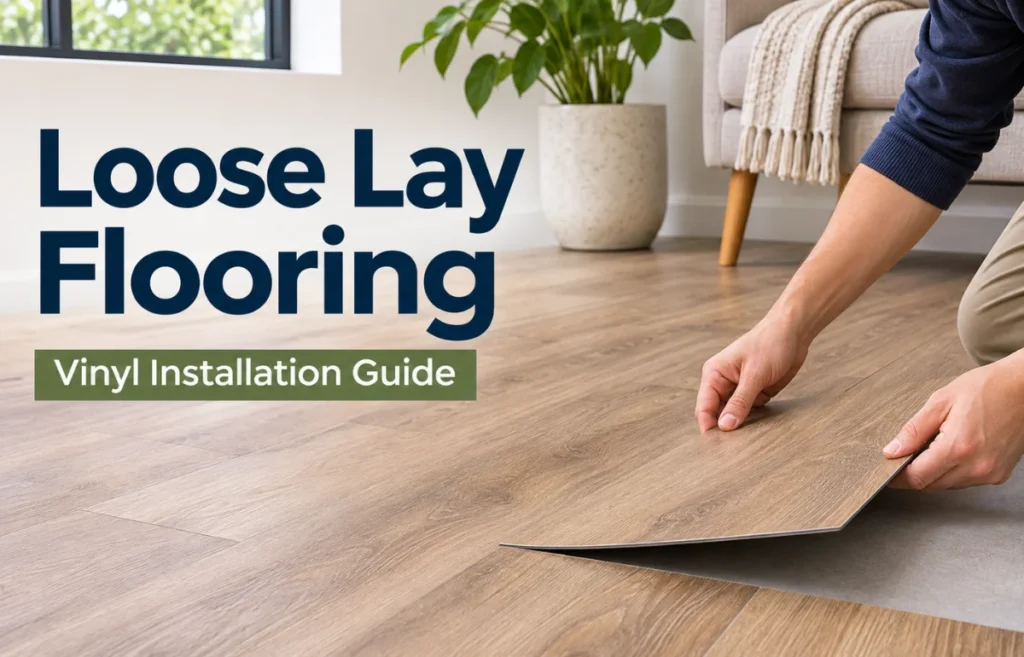
Loose lay flooring is a type of vinyl flooring installed by placing individual planks or tiles directly onto a prepared subfloor, usually without locking the pieces together or spreading adhesive across the entire floor. Its specially designed backing creates friction against the surface below, while the closely fitted pieces help the floor stay in position. Depending on the product and room conditions, the installer may still need adhesive around the perimeter, in a grid, or across the full area.
That last detail matters. Loose-lay vinyl is often described as a quick, glue-free alternative to traditional flooring, but it is not the same as floating click-lock vinyl. I see the real advantage in its simpler construction: each plank is independent, so a damaged piece can often be lifted without dismantling several rows.
What Makes Loose-Lay Vinyl Different?
Most loose-lay luxury vinyl planks and tiles have a flexible, relatively substantial body and a textured, high-friction backing. Instead of relying on tongue-and-groove joints, the backing grips a clean, suitable surface beneath it.
The planks sit alongside one another rather than snapping into a single connected sheet.
You may also see loose-lay vinyl sheet flooring advertised. It uses a related installation idea, but it comes in rolls and may require perimeter tape or seam treatment.
Does “loose lay” mean no glue at all?
Not necessarily. Some products permit installation without adhesive in particular small, stable rooms. Others require pressure-sensitive adhesive or tackifier at doorways, around the edges, or in a grid. High-traffic areas, rolling chairs, and direct sunlight can call for stronger fixing.
I would never choose the adhesive method based on a general online tutorial. The exact manufacturer’s installation sheet and the room’s conditions should make that decision.
Loose Lay Flooring vs. Floating Click-Lock Vinyl
Both systems are commonly called floating floors because they can be installed without fastening every plank to the subfloor. But they solve the problem of keeping the floor together in different ways.
Click-lock vinyl has shaped edges that connect neighboring planks. The installed floor behaves more like one continuous assembly, usually with manufacturer-specified movement gaps around fixed objects. Loose-lay planks have plain edges and remain separate pieces; many products instead call for a close fit to neighboring planks and walls.
| Feature | Loose-lay vinyl | Floating click-lock vinyl |
|---|---|---|
| How it stays in place | Friction backing, close fit, and sometimes adhesive | Mechanical joints connecting the planks |
| Plank edges | No click mechanism | Interlocking profiles |
| Replacing one damaged plank | Often possible to lift it individually | May require unlocking rows or an approved repair technique |
| Subfloor requirements | Very smooth, dry, stable surface | Flat, dry, stable surface; limits vary by product |
| Additional underlay | Usually unnecessary unless specifically approved | May be built in or separately approved |
| Edge spacing | Follow tight-fit or other product-specific directions | Usually requires specified expansion gaps |
| Best reason to choose it | Access, localized repairs, straightforward cutting | Connected installation across suitable room layouts |
Neither is automatically better. If I needed easy access to a raised access floor or expected an occasional plank replacement, loose lay would be worth a close look. If I wanted a connected floor across several rooms, I would compare click-lock specifications and transitions carefully before deciding.
The Benefits That Actually Matter
Faster handling and simpler repairs
Without click profiles to align and engage, individual planks can be positioned, trimmed, and adjusted directly.
The bigger long-term benefit is repair access. If a chair scratches one plank, an appropriate loose-lay installation may allow that plank to be lifted and replaced with a matching spare. A glued installation may require extra work to release adhesive, but the repair can still be more localized than on many click floors.
Comfortable, relatively quiet underfoot
Some loose-lay products use a resilient backing that helps soften footfall noise. They can feel less hollow than certain rigid floating floors, although acoustic performance depends on the exact product, subfloor, and room construction.
I would compare published acoustic test results rather than trust labels such as “silent” or “soundproof.”
Wood and stone looks without the same upkeep
Loose-lay luxury vinyl is available in timber-inspired planks and stone-look tiles. It is straightforward to sweep and damp mop, and the vinyl itself generally tolerates everyday splashes better than moisture-sensitive wood.
That does not mean water cannot reach the seams or damage materials underneath. Waterproof vinyl and a waterproof flooring system are two different promises.
Limitations You Should Know Before Buying
A loose-lay floor depends heavily on what is beneath it. Dust, uneven patches, old adhesive, and deep grout lines can reduce grip or become visible as ridges and depressions. Its flexible nature does not mean it will hide a poor subfloor.
Movement is another concern. Repeated sideways force from rolling office chairs, wheeled carts, or furniture dragged across the floor can make individual planks creep or open small gaps. Proper adhesive specification can reduce this risk, but that changes the installation from a purely loose-laid job.
Large windows deserve special attention. Sunlight can heat sections of the floor unevenly, encouraging movement or distortion. Some manufacturers call for full-spread, specialized adhesive in sunrooms or spaces with panoramic glass.
Finally, these products are not interchangeable with click-lock underlayments. Adding a thick, soft foam pad because it seems more comfortable may compromise the grip and void the warranty.
Where Loose-Lay Flooring Works Best
I find it more useful to judge the room by its conditions than by its name. A calm bedroom with a smooth subfloor is different from a home office where a wheeled chair travels the same route all day.
| Room or condition | My assessment | What to check |
|---|---|---|
| Bedroom or guest room | Often a good candidate | Stable temperature and smooth subfloor |
| Living room | Potentially suitable | Foot traffic, furniture loads, and installation size |
| Kitchen | Possible with the right product | Spills, appliance movement, and perimeter details |
| Bathroom | Product-dependent | Water exposure and whether the room remains regularly wet |
| Home office | Needs extra scrutiny | Chair casters and required adhesive coverage |
| Sunroom or heavily glazed room | Higher risk | Solar heat and specialized adhesive requirements |
| Basement | Depends on moisture testing | Concrete moisture, vapor movement, and substrate approval |
Loose-lay flooring can be especially practical over suitable raised access panels because individual pieces may be removable for maintenance.
Subfloor Preparation: The Part I Would Never Rush
The word “loose” can give the wrong impression. A floor that is not mechanically locked or fully bonded needs a dependable foundation. Before choosing colors, I would inspect three things: flatness, surface condition, and moisture.
Flatness and smoothness are not the same
A floor can look level from the doorway and still have shallow dips. Loose-lay vinyl may reveal those depressions after installation. It can also show the outline of tile grout, plywood joints, or old patching.
Check with a long straightedge, then compare the gaps against the specific manufacturer’s tolerance. Repair high spots, low spots, and cracks with an approved system.
Existing flooring needs individual assessment
Firm, well-bonded ceramic tile may be a suitable base after grout lines and defects are smoothed. A single layer of sound, non-cushioned resilient flooring may also be approved for certain products.
Loose tiles, thick cushioned vinyl, unstable wood, and contaminated surfaces are different stories. They may need removal or a suitable preparation layer. If old flooring or adhesive could contain asbestos, do not sand, grind, or disturb it without qualified assessment and appropriate precautions.
Dry to the touch is not a moisture test
Concrete can appear dry while releasing moisture vapor. That moisture can affect adhesives, cause problems beneath resilient flooring, and create conditions for failure. I would ask for the moisture test method and acceptable results stated in the flooring instructions, particularly over new concrete or a basement slab.
Different manufacturers—and even different adhesives from the same manufacturer—set different limits.
How Loose-Lay Vinyl Planks Are Installed
The work is often less mechanically complicated than installing click-lock flooring, but accuracy still matters. Here is how I would approach planning the job; the product instructions should control the actual installation.
1. Confirm the material and room conditions
Check the product code, batch, plank dimensions, intended use, and approved installation method. Measure the space and order extra material for cuts, pattern selection, and future repairs.
Condition the flooring in the room for the period specified by its manufacturer. For example, some loose-lay systems call for 48 hours of acclimation and controlled indoor temperatures.
2. Prepare and clean the base
Finish other dusty work first. Repair defects, smooth approved substrates, and complete moisture testing where required. Vacuum thoroughly so grit cannot interfere with the backing.
3. Dry-plan the layout
Measure the room at multiple points, especially if its walls are not perfectly square. I would arrange several rows without fixing anything first, checking that the starting line is straight and the final row will not end in awkward slivers.
Blend planks from different cartons to distribute variations in the printed pattern.
4. Fit and stabilize the planks
Place each plank closely beside the next, trimming with tools suitable for that product. Unlike click-lock installation, there is no joint to angle or snap together. That is the defining practical difference.
Apply approved adhesive wherever the installation plan requires it. As one example, Karndean’s published U.S. guidance specifies adhesive strips around the perimeter and in a grid for certain light-traffic installations, while other conditions require full coverage. Other brands use different rules, so do not treat those dimensions as universal.
5. Inspect before bringing furniture back
Check for visible gaps, lifted corners, rocking pieces, and poorly finished thresholds. Follow adhesive curing or access restrictions where applicable. Protect the surface when moving appliances and furniture into place.
Most importantly, do not substitute click-lock advice about perimeter gaps for loose-lay instructions. A manufacturer that specifies tight-fitting planks is describing a different system from one that requires an expansion gap.
Four Small Decisions That Prevent Big Problems
I would pay extra attention to these details because they are easy to miss when estimating a project.
The chair test: Mark where an office chair actually rolls, not simply where the desk sits. Repeated caster movement may change the required adhesive method.
The sunlight test: Notice where direct sun falls in the afternoon. A room may feel cool while one strip of floor becomes much warmer than the rest.
The doorway test: A threshold experiences concentrated traffic and sideways pressure. Check its fixing detail instead of assuming a tight plank fit will be enough.
The spare-box test: Keep a few matching planks flat in suitable storage. Replacement is only easy if you can obtain the same design, size, and preferably matching batch later.
What Does Loose Lay Flooring Cost?
The total price is more than the cost per square foot. Add the flooring material, wastage, subfloor preparation, any approved adhesive, transitions, and installation labor.
When comparing quotes, I would ask each installer to identify the precise product and fixing method. A no-adhesive quote for a low-traffic room is not directly comparable with one allowing for a full-spread adhesive system in a busy space.
For value over time, look beyond the initial price. Compare wear-layer specifications, residential or commercial suitability, warranty exclusions, cleaning requirements, and whether individual planks remain replaceable under the proposed installation method.
Cleaning and Maintaining Loose-Lay Vinyl
Routine care is refreshingly simple: sweep or vacuum with an appropriate floor-safe setting, remove grit before it scratches the finish, and damp mop using a cleaner approved for vinyl. Wipe up spills promptly and avoid leaving standing water around seams.
I would skip steam mops unless the flooring manufacturer specifically permits them. Use non-staining entrance mats and furniture protectors, and lift heavy objects rather than dragging them. If an edge starts moving, investigate the cause instead of simply pushing it back repeatedly.
Is Loose Lay Flooring Right for Your Project?
I would choose it when the subfloor is sound, the climate is controlled, the traffic is compatible with the specified fixing method, and individual plank access offers a real advantage. It is particularly appealing for targeted repairs or layouts where click profiles would be inconvenient.
I would look harder at click-lock or another approved flooring system if the room experiences frequent rolling loads, severe sun exposure, unstable conditions, or moisture that has not been resolved.
Before ordering, request the current technical data sheet, installation instructions, and warranty for the exact collection—not just the brand. That paperwork should answer more questions than the label “easy installation.”
Final Thoughts
Loose lay flooring deserves attention for its friction-backed installation, simple plank access, and flexible design options—not because it magically removes every installation requirement. For me, the deciding factor is whether the room suits the system. Start with a subfloor assessment, compare the exact product instructions with click-lock alternatives, and request an installation quote that clearly states where adhesive is required.
Frequently Asked Questions
Can loose lay flooring be installed without glue?
Sometimes. Certain products allow adhesive-free installation in suitable areas, but others require perimeter, grid, or full-spread adhesive depending on traffic and room conditions.
Can I install loose-lay vinyl over existing tiles?
Often, if the tiles are secure, dry, clean, and properly smoothed. Grout lines and uneven joints usually need treatment to prevent show-through.
Is loose lay flooring waterproof?
The vinyl material is generally water-resistant or waterproof, but plank seams do not automatically make the whole floor watertight. Subfloor moisture and standing water remain concerns.
Does loose-lay flooring need an expansion gap?
Not always. Many loose-lay systems specify tight fitting, while click-lock floors commonly need expansion gaps. Follow the exact product instructions.
How long does loose lay vinyl flooring last?
Its lifespan depends on product quality, wear layer, traffic, maintenance, and installation conditions. Check the manufacturer’s warranty rather than relying on one blanket number.