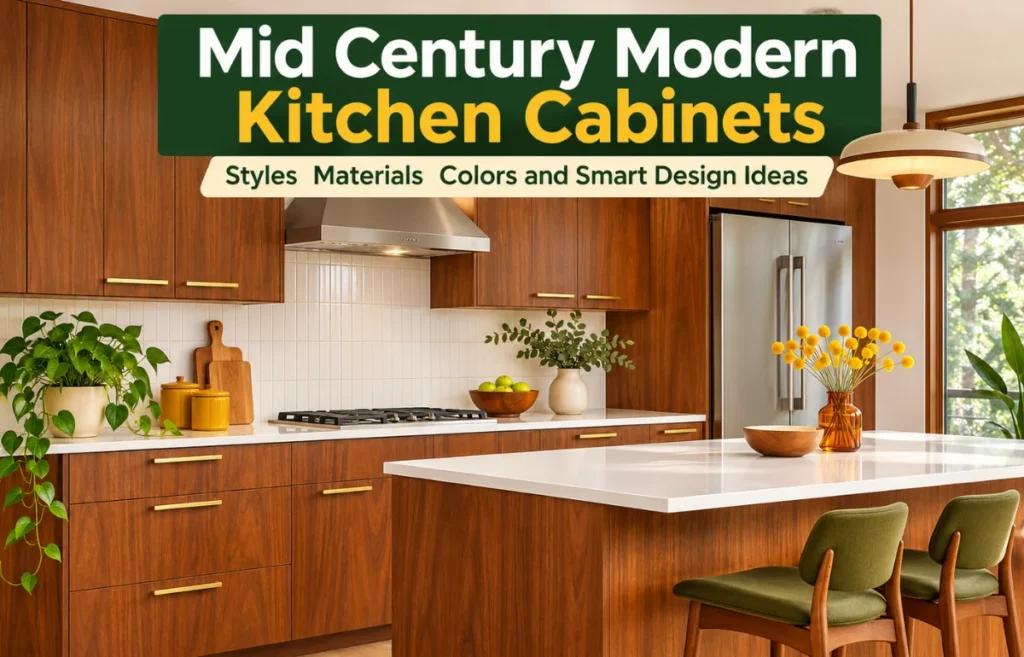
Mid century modern kitchen cabinets are cabinets inspired by the clean, practical design of the mid-twentieth century. They typically feature flat-front doors, simple geometric shapes, warm wood finishes, minimal ornamentation, and hardware that doesn’t compete with the cabinetry. Unlike heavily detailed traditional cabinets, they let the proportions, grain, and layout do the visual work. Walnut, oak, and painted slab doors are familiar choices, but the style is not limited to brown wood or vintage houses.
What I like most about this look is that it can feel both nostalgic and completely current. You can keep an original 1960s kitchen’s character, update standard cabinets with new fronts, or build a contemporary kitchen around mid-century principles. The trick is to understand which details create the look—and which choices make it comfortable to use every day.
What Makes Mid Century Modern Kitchen Cabinets Different?
Mid-century modern design favored useful spaces, honest-looking materials, and a close relationship between the home’s architecture and its interior. Kitchen cabinetry followed that thinking with broad, relatively unbroken surfaces instead of carved doors and decorative trim.
The strongest identifying features are slab or flat-panel doors, restrained hardware, continuous cabinet lines, and natural-looking finishes. A low-profile toe kick, neatly aligned drawers, and thoughtfully placed open shelves can reinforce the style without turning the room into a period set.
Not every kitchen from the 1950s or 1960s looked alike. Some used pale wood and understated pulls; others embraced colorful laminate, metal accents, or contrasting cabinet finishes. That’s why I don’t treat walnut and brass as a compulsory recipe. Mid-century design is a language of shape and proportion, not a checklist of trendy products.
Slab Doors vs. Shaker Doors
A slab door is one uninterrupted surface, making it the most direct route to the mid-century look. Its simplicity exposes every detail: uneven gaps, mismatched grain, and bulky handles become more noticeable.
Shaker doors have a recessed center panel and a surrounding frame. They’re attractive and versatile, but they lean more transitional than historically mid-century. If you already own Shaker cabinets, slim pulls, a quiet backsplash, and an appropriate color palette can still move the kitchen in the right direction.
Best Materials for Mid-Century-Style Cabinets
Cabinet doors and cabinet boxes do different jobs, so they don’t necessarily need the same material. A beautiful walnut front can sit on a sturdy plywood box; a painted slab front can use a well-finished engineered-wood core.
Before choosing, ask whether you’re paying for the visible finish, structural durability, or both. The Canadian Kitchen Cabinet Association’s material overview explains why wood, veneers, MDF, and laminates behave differently.
| Material or finish | Why it works | What to check before buying |
|---|---|---|
| Walnut veneer | Rich grain and a classic mid-century character without a solid-wood slab | Veneer matching, edge banding, and protective finish |
| White oak veneer | Lighter, calmer appearance with a visible natural grain | Whether the stain makes it too gray or yellow |
| Painted MDF doors | Smooth, consistent slab surfaces and flexible color choices | Edge sealing, paint quality, and moisture exposure |
| High-pressure laminate | Crisp colors, easy cleaning, and a retro-friendly surface | Substrate quality, seams, and damaged-edge repair options |
| Plywood cabinet boxes | Stable layered construction for a hardworking kitchen | Panel thickness, joinery, and finished edges |
Walnut, Oak, and Other Wood Finishes
Walnut mid century modern kitchen cabinets make a strong focal point because the grain brings movement to an otherwise simple design. But solid walnut doors aren’t the only way to get that effect. A well-made real-wood veneer can offer a more dimensionally stable broad surface, often at a lower cost than solid wood.
White oak suits rooms that need a lighter feel. Birch and maple are also worth considering, especially when you’re aiming for a pale or gently honey-colored finish. Ask for full-size samples rather than judging wood from a tiny online swatch.
I pay particular attention to how adjacent doors match. If every front has a dramatically different shade or grain direction, a sleek kitchen can suddenly look busy. Intentional grain matching matters more to the finished appearance than choosing the most expensive species.
Are MDF and Laminate Too Cheap-Looking?
Not necessarily. Quality MDF can create exceptionally flat painted doors, while laminate offers a clean, hard-wearing surface in colors that suit the era. Poorly sealed edges, weak hinges, and exposed low-quality particleboard are more concerning than the material name alone.
For cabinets near the sink or dishwasher, ask how vulnerable edges are protected from standing water and steam. For areas beside an oven, check the manufacturer’s heat-clearance requirements. A stylish door won’t compensate for swelling or peeling a few years later.
Colors That Actually Suit the Style
The easiest palette starts with one wood tone, one neutral, and one accent. This keeps the kitchen coherent without making it flat. Think walnut with warm white and muted olive, or light oak with cream and a restrained terracotta detail.
Wood and White for an Airy Kitchen
Wood base cabinets with white upper cabinets are especially useful in small spaces. The darker lower run anchors the room while the pale upper section reflects more light and reduces visual weight.
An all-wood kitchen can also look excellent, provided you break up the surface with a simple countertop and sufficient lighting. I would avoid using three competing wood tones across floors, cabinets, and stools unless their relationship is deliberate.
Green, Blue, and Warm Neutrals
Olive, sage, dusty teal, clay, and soft cream all work well as mid century modern kitchen cabinet colors. A vivid orange or mustard accent can be fun, but it usually has more impact on a stool, pendant, or small backsplash area than across every door.
Test cabinet samples in daylight and under your actual kitchen lights. A sage green that looks calm in a showroom might turn gray in a north-facing room; a walnut stain can read red under warm bulbs. Color is a room-specific decision, not just a paint-chip decision.
Hardware, Countertops, and Backsplashes That Fit
Mid century modern kitchen cabinet handles tend to be straightforward: slim bar pulls, small round knobs, edge pulls, and integrated finger channels. Brushed nickel, dark bronze, black, and warm brass can all work. The finish matters less than the scale and consistency.
If you want a nearly handle-free look, test how the door opens before committing. Finger pulls can be awkward with wet hands, and push-to-open fronts may show marks around the touch point. On a busy cooking run, a comfortable pull is usually more useful than an invisible one.
Countertops should complement the cabinetry rather than compete with it. Light quartz, durable laminate, and subtle solid-surface options maintain clean lines. A lightly patterned stone can work too, but aggressive veining beside active walnut grain often makes the room feel crowded.
For a backsplash, consider stacked rectangular tile, small square tile, understated ceramic, or a simple continuous panel. Straight grout lines often reinforce the horizontal rhythm. Use open shelves selectively: a short shelf for frequently used pieces feels intentional; an entire wall of exposed storage can make everyday clutter the main feature.
Plan the Layout Before Choosing the Door Finish
A beautiful cabinet front can’t fix an inconvenient kitchen. I start with the practical questions: Where will groceries land? Can the dishwasher open without blocking a drawer? Can two people work at the counter comfortably?
The National Kitchen & Bath Association’s kitchen planning guidelines recommend a work aisle of about 42 inches for one cook and 48 inches for multiple cooks. Those are planning recommendations, not universal building-code requirements; existing rooms and accessibility needs may call for a different solution.
Make Storage Work Behind Clean Fronts
Use deep drawers for pots and pans, dividers for utensils, and pull-outs where a narrow door would hide useful space. Flat cabinet fronts don’t mean the interiors have to be minimal. In fact, concealed organization helps the exterior stay uncluttered.
Tall pantry doors can give a compact kitchen a seamless wall of storage, but avoid placing a towering cabinet where it blocks natural light or crowds the entrance. In a small mid century modern kitchen, fewer carefully sized cabinets often work better than squeezing one more unit into every gap.
Check the Three Lines Most People Miss
Here’s a simple design check I find useful before ordering. Look at a drawing from the main doorway and trace three lines: the top of the upper cabinets, the horizontal gaps between drawer fronts, and the bottom edge of the base cabinets. Do those lines read as intentional, or do they jump around appliances and fillers?
Next, check where door edges meet the refrigerator and dishwasher. Modern appliances aren’t always flush with cabinet fronts. End panels, proper fillers, hinge clearance, and correct appliance specifications can make the difference between a cohesive mid-century kitchen and a collection of unrelated boxes.
Should You Restore, Reface, or Replace Existing Cabinets?
If your house has original cabinetry, don’t assume it needs to go. Older boxes may still be serviceable even when their finish looks tired. Preserving good frames can keep the home’s character intact and avoid unnecessary demolition.
I would inspect for water damage, sagging shelves, failing joints, and doors that no longer close correctly. If the structure is sound, cleaning, careful refinishing, new hardware, or replacement doors might be enough. Test any stain removal or finish repair in a concealed spot first, especially on thin veneer.
Refacing replaces the visible doors and drawer fronts and generally covers exposed cabinet faces while retaining the boxes. It’s an appealing option when the footprint works. Full replacement makes more sense when the layout is inefficient, the boxes are damaged, or you need major changes to storage and appliances.
One caution: if the kitchen has unusual original features, such as built-in dividers, sliding fronts, or distinctive hardware, photograph and assess them before removal. A small detail can be hard to reproduce later. If preservation matters, talk to a cabinetmaker familiar with vintage construction.
How Much Do Mid Century Modern Kitchen Cabinets Cost?
The style itself doesn’t dictate the price. Standard slab fronts can be economical; matched walnut veneer, special finishes, and custom integrated handles can increase it significantly.
As a broad U.S. planning reference, HomeAdvisor’s 2026 cabinet cost guide lists the following approximate installed ranges. Local labor, kitchen size, materials, and what an installer includes can change the quote.
| Cabinet route | Approximate installed U.S. cost per linear foot | Best for |
|---|---|---|
| Stock cabinets | $100–$300 | Straightforward layouts and tighter budgets |
| Semi-custom cabinets | $150–$650 | More choices in finishes, sizes, and storage |
| Custom cabinets | $500–$1,200 | Unusual dimensions, precise grain matching, and bespoke details |
Treat those as comparison ranges rather than a promise of what your kitchen will cost. A linear-foot estimate may count cabinets differently from one supplier to another. Ask whether the price includes upper and lower units, panels, hardware, delivery, installation, demolition, and taxes.
Where I Would Spend—and Save
I’d put money into dependable hinges, full-extension drawer slides, moisture protection, and doors that sit evenly. These details affect daily life and aren’t easy to fix with styling.
I’d save by keeping a functional layout, choosing standard cabinet sizes, using a single accent finish, and selecting veneer instead of solid hardwood where appropriate. Swapping cabinet fronts or painting sound existing doors can create a convincing makeover without replacing every box.
Common Design Mistakes to Avoid
The first mistake is confusing “minimal” with “featureless.” A kitchen with blank white slabs, gray floors, and harsh lighting may look contemporary, but it can lose the warmth associated with mid-century interiors. Texture, timber, and a little contrast help.
The second is forcing symmetry where function needs flexibility. Two identical-looking runs aren’t useful if one blocks access to the refrigerator. Good alignment matters, but drawer locations and clearances still need to follow how you cook.
The third is copying a vintage photo too literally. Older kitchens were designed around different appliances, storage habits, and electrical needs. Borrow their proportions and colors while updating task lighting, ventilation, outlets, and accessible storage to meet today’s requirements.
Finally, avoid ordering from photos alone. Check a physical door sample for finish, edge treatment, weight, and cleanability. Open and close the hardware. A mid-century look should feel good in your hand, not just in a picture.
How to Keep the Cabinets Looking Good
Wipe spills promptly with a soft cloth and the mild cleaner recommended by the cabinet manufacturer. Keep abrasive pads and harsh solvents away from wood veneers, painted doors, and laminates unless the finish instructions specifically allow them.
Use an exhaust fan while cooking, deal with leaks quickly, and avoid leaving wet towels over cabinet edges. Check hinges periodically so doors stay aligned. For stained wood, protect the finish rather than repeatedly applying oil or polish that may not suit its coating.
A little routine care is especially valuable with broad, flat doors: fingerprints, chipped edges, and uneven reveals have nowhere to hide.
Final Thoughts
The best mid century modern kitchen cabinets aren’t the ones with the most retro accessories. They’re the ones that combine simple fronts, well-chosen materials, clean proportions, and storage that suits real life.
Start by deciding what you can keep, then compare one slab-door sample, one wood or paint finish, and one hardware option in your kitchen’s actual light. That small test will tell you more than a crowded inspiration board—and give you a clearer brief when it’s time to request quotes.
Frequently Asked Questions
What style of cabinets is mid-century modern?
Flat-front or slab-door cabinets with clean lines, simple hardware, and natural wood or restrained color finishes are the clearest examples.
What wood is best for mid century modern kitchen cabinets?
Walnut is a classic choice, while white oak, birch, and maple also work well. Quality veneer can be an excellent alternative to solid wood.
Can I make Shaker cabinets look mid-century modern?
Yes. Try streamlined hardware, warm colors, an uncluttered backsplash, and simple lighting, although slab doors create a closer stylistic match.
Are mid-century modern cabinets expensive?
Not necessarily. Stock slab cabinets can be budget-friendly; custom walnut cabinetry and specialty details typically cost considerably more.
What countertop looks best with mid-century cabinets?
A quiet quartz, laminate, or solid-surface countertop usually complements the clean lines. Choose subtle patterning if your wood grain is prominent.