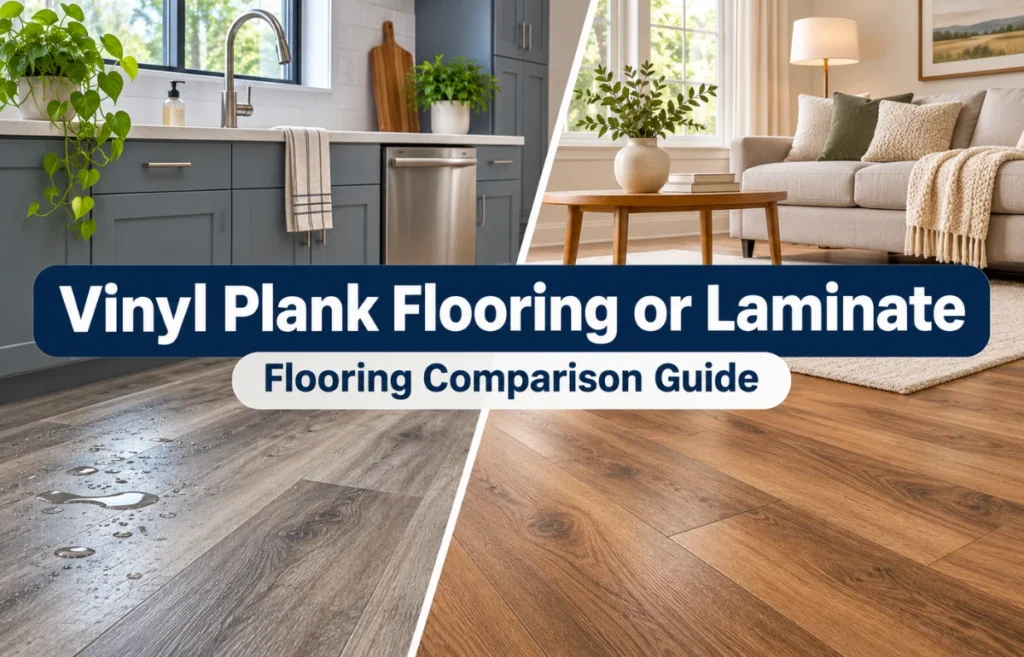
Choosing Vinyl plank flooring or Laminate comes down to how a room is used, how often it gets wet, and what you expect from the floor underfoot. Vinyl plank flooring is a layered, mostly synthetic floor covering designed to resemble wood or stone; many products have water-resistant or waterproof cores. Laminate flooring uses a dense wood-fiber core topped with a printed design and protective wear surface. Both mimic hardwood, but they behave differently around water, furniture, and daily wear.
My short answer: I generally favor vinyl plank for moisture-prone rooms and laminate for dry living spaces where a convincing wood look and strong surface wear resistance matter most. The right product, however, matters more than the category printed on its box.
Vinyl Plank vs. Laminate at a Glance
| Feature | Vinyl plank flooring | Laminate flooring |
|---|---|---|
| Main construction | Vinyl-based layers; flexible or rigid core | High-density fiberboard core with decorative and protective layers |
| Water exposure | Many planks resist water damage; seams and subfloors still need protection | Standard types can swell; selected water-resistant or waterproof systems offer greater spill protection |
| Scratches and dents | Finish varies; rigid cores help with indentation | Often good surface scratch resistance; edges can chip |
| Appearance | Realistic wood, stone, and tile patterns | Often convincing wood grain and embossed texture |
| Feel and sound | WPC may feel softer; SPC often firmer | Can feel solid but sound hollow without suitable underlayment |
| Typical best fit | Kitchens, laundry rooms, basements | Bedrooms, living rooms, dry hallways |
| Repairs | Individual planks may be replaceable, depending on installation | Damaged planks usually require replacement |
When comparing Vinyl plank flooring or Laminate, I find that a premium laminate can outperform cheap vinyl in a dry room, while well-specified vinyl is safer around recurring splashes.
What Is Vinyl Plank Flooring?
Vinyl plank flooring, often called LVP or luxury vinyl plank, is made in long boards that imitate timber. A printed design sits beneath a protective wear layer, while the core gives the plank its structure. Some products click together as floating floors; others are glued to a prepared surface.
SPC, WPC, and Flexible Vinyl Explained
SPC, or stone-plastic composite, has a dense, rigid core. I would consider it for busy areas where furniture legs, rolling traffic, and stable plank construction are priorities, although its firm feel may not suit everyone.
WPC, commonly called wood-plastic composite, generally uses a more cushioned core. It can feel warmer and quieter, but its softer structure may dent more readily under concentrated weight.
Flexible glue-down vinyl is thinner and depends heavily on the subfloor being smooth. It can be useful where floor height is restricted or individual plank replacement is a priority. Water ratings and warranties vary by product.
What Is Laminate Flooring?
Laminate is a manufactured board with a wood-fiber core, a photographic design layer, and a transparent protective surface. Some textured finishes closely follow printed wood grain.
Most laminate is installed using a click-lock floating system. Traditional boards are vulnerable if water reaches the fiber core through joints or exposed edges. Newer moisture-resistant systems use improved joints, coatings, and sometimes required perimeter sealing to increase spill protection.
I check approved rooms, water-exposure limits, and sealing instructions rather than trusting a “waterproof laminate” label.
How Do Vinyl Plank and Laminate Compare in Everyday Life?
1. Water Resistance: The Most Practical Difference
Water is where I see the strongest reason to choose carefully. Most waterproof-core vinyl planks won’t swell simply because the plank material gets wet. That makes suitable LVP a practical option near kitchen sinks, laundry appliances, and basement entrances.
But waterproof planks do not create a waterproof room. A dishwasher leak can reach the subfloor through joints or perimeter gaps, even if the planks survive.
Laminate requires a closer look at the product instructions. Basic laminate can swell permanently at its seams. Some modern water-resistant systems tolerate ordinary spills much better, provided installers follow joint and edge-sealing requirements. Pergo, for example, requires edge sealing in specified wet-prone applications.
My rule: if water is likely to sit unnoticed, vinyl has the stronger starting position. If splashes are occasional and quickly cleaned, an approved water-resistant laminate may be entirely reasonable.
2. Scratches, Dents, and Family Traffic
It’s tempting to ask which flooring is more durable, but that combines several different problems. Pet claws create fine scratches; dropped cookware creates impact damage; heavy furniture can leave dents; sandy shoes gradually wear away a surface.
Laminate often performs well against surface abrasion, especially in higher-quality lines. You may see an AC rating on the box, such as AC3, AC4, or AC5. That rating describes abrasion resistance, not a guarantee against gouges, water, stains, or fading. The North American Laminate Flooring Association evaluates multiple performance properties, not just abrasion.
Vinyl durability depends on its finish, core, and use rating. You’ll see wear-layer figures such as 12 mil or 20 mil; here, a mil is one-thousandth of an inch, not a millimeter. Thickness alone doesn’t establish coating quality or scratch resistance.
For pets, I compare samples, not categories. With heavy furniture, I check indentation resistance and use protective feet.
3. Realism, Texture, and Style
If your priority is a wood-like appearance, laminate deserves a serious look. Its crisp printed detail and embossed-in-register finishes can make knots and grain feel closely aligned with what you see.
High-quality vinyl also looks impressive, particularly with matte finishes, varied plank patterns, and realistic beveled edges. Vinyl also imitates stone and tile convincingly.
I check three things before choosing a color: how many repeated plank images appear in a display, whether the surface looks shiny under side lighting, and whether the shade works beside the room’s cabinets and doors. A vertical sample won’t reveal how an entire floor will look.
4. Comfort, Noise, and Temperature
Subfloors and underlayment affect comfort as much as plank thickness.
WPC vinyl generally has a little more give than dense SPC. Laminate can have a reassuringly solid feel, but a poorly prepared floating installation may sound clicky or hollow. Approved acoustic underlayment can help upstairs.
I would not add extra padding just to make a floor quieter. Some click-lock vinyl planks come with attached backing, and unauthorized additional underlayment may stress the locking joints or void the warranty.
Both may work over approved radiant heating, subject to manufacturer temperature limits.
Installation: Where Good Flooring Can Go Wrong
Click-lock laminate and rigid-core vinyl appeal to DIY homeowners because many designs don’t require glue. Still, easy assembly does not mean forgiving installation.
Both need a clean, sound, adequately flat subfloor. Rigid vinyl can bridge small surface textures, but it cannot safely hide major dips or humps. Uneven support can cause movement, joint failures, or visible telegraphing, depending on the product.
Concrete adds another concern: moisture coming from below. Even a waterproof vinyl plank may require moisture testing or an approved vapor-control layer. Laminate installations over concrete typically have specific vapor-barrier instructions too. I would follow the exact manufacturer’s limits instead of assuming the old slab is dry.
Leave the specified expansion space at walls, doorframes, and fixed objects. Check whether a long run needs transition strips. Avoid pinning a floating floor beneath fixed cabinets or kitchen islands unless the installation guide explicitly permits it.
I also check door clearance, stair nosings, appliance movement, and transitions to tile.
Which Is Cheaper: Vinyl Plank or Laminate?
Neither category wins on price every time. Entry-level laminate is often economical, but premium water-resistant laminate can cost more than basic vinyl. Luxury vinyl with thicker finishes or specialty designs can also command a premium.
For U.S. budgeting, HomeGuide’s 2026 cost guide reports these ranges:
| Flooring type | Approximate materials per sq. ft. | Approximate installed cost per sq. ft. |
|---|---|---|
| Laminate | $1–$6 | $4–$14 |
| Luxury vinyl plank (LVP) | $2–$10 | $4–$16 |
These are national planning ranges, not quotes for your address. Budget separately for removal, subfloor repairs, moisture work, transitions, and trim. Small jobs may have labor minimums.
A low shelf price can hide weak joints, limited warranties, or expensive preparation. Compare total installed quotes.
Best Flooring Choice for Every Room
Kitchen: Usually Vinyl, but Not Automatically
In a family kitchen, I lean toward quality vinyl plank because splashes, ice-maker leaks, and wet shoes are common. Its water-tolerant construction offers useful protection against everyday accidents.
I would still consider water-resistant laminate in a dry, carefully maintained kitchen where realistic wood texture is the main goal. Confirm kitchen approval and perimeter requirements in writing.
Bathroom and Laundry Room: Vinyl Has the Edge
For a powder room or laundry room, suitable waterproof-core LVP is generally the more forgiving choice. Avoid assuming it can replace the waterproofing required in a shower or wet room. A floor with a drain needs a system designed for that application.
Some laminate systems are approved for certain bathrooms, but I would not choose one without explicit written approval from the manufacturer.
Living Room and Bedroom: Let Appearance Lead
These are the rooms where I think laminate can shine. In dry, climate-controlled spaces, a good laminate delivers strong wear performance and a wood-like finish for a competitive price.
Vinyl is equally valid if you prefer a softer-feeling WPC option or want one continuous flooring style extending into a nearby kitchen. Compare the actual room conditions, not just the room name.
Basement and Entryway: Investigate Moisture First
Vinyl is often a better candidate for damp-prone entryways and suitable basements, but persistent moisture or an active leak is a building problem, not a flooring-selection problem.
Before either material goes down, identify the moisture source, confirm the subfloor meets product specifications, and address drainage issues. Covering a damp slab can conceal damage rather than solve it.
Five Buying Checks I Would Never Skip
Check the Complete Water Warranty
Look for what the warranty actually promises: protection against surface spills, protection for a stated number of hours, or coverage for specified residential rooms. Check exclusions for flooding, leaks, standing water, and installation mistakes.
A waterproof label is helpful, but the installation instructions and exclusions explain the real limits.
Compare Performance Ratings, Not Marketing Names
For laminate, look beyond AC ratings to impact, stain, and moisture performance. NALFA’s LF-01 program provides a broader set of tests and end-use classifications.
For vinyl, check the specified wear layer, coating, indentation information, and residential or commercial use classification. Product thickness and core type are useful clues, not standalone quality scores.
Read the Indoor-Air Documentation
Both categories can be available with independent low-emission certification. FloorScore evaluates specified VOC emissions, not every possible chemical.
For U.S. laminate containing regulated composite wood, check EPA TSCA Title VI compliance. I prefer verifiable certification records over vague claims such as “chemical-free.”
Test Samples in the Actual Room
I would take home at least two large samples and inspect them in daylight and evening light. Place them near the skirting board, kitchen cabinetry, and existing tile transition.
Look for repeated prints, visible seams, slippery finishes, and how easily dust shows against the color. A beautiful dark floor can demand more visible day-to-day cleaning than a mid-tone wood pattern.
Price the Hidden Installation Details
Ask for an itemized quote that names subfloor preparation, vapor protection, approved underlayment, thresholds, and trim. Also ask who handles appliance moving and whether stair installation is included.
That single habit makes quotes far easier to compare—and highlights missing work before it becomes a dispute.
Cleaning, Repairs, and Long-Term Value
For routine care, I would vacuum or sweep grit and use a manufacturer-approved cleaner with a lightly damp mop. Avoid soaking laminate. For vinyl, avoid harsh solvents, abrasive pads, and steam cleaning unless the manufacturer explicitly allows them.
Use felt pads under chairs, suitable mats at exterior doors, and protection under rolling furniture. Deal with leaks promptly even on vinyl, because moisture can still reach surrounding materials.
Neither floor is normally refinished like solid hardwood. A damaged click-lock plank may be replaceable, but reaching it can require disassembling boards. Glue-down vinyl can sometimes allow more localized replacement. Keep spare planks from the same production run in case a design is discontinued.
On environmental impact, I wouldn’t declare an automatic winner. Vinyl uses plastic-based materials; laminate incorporates wood fiber plus resins and surface coatings. Look for documented emissions, material disclosures, durability, and local disposal or take-back options rather than accepting broad “eco-friendly” labels.
My Simple Decision Rule
I start with the worst realistic event in the room, not its prettiest photograph. Will a washing machine overflow? Will wet boots sit by the door? Or is the bigger issue chairs scraping over a dry office floor?
Next, I compare two specific products at the same installed price. I review their warranty, water limitations, surface performance, underlayment rules, and replacement availability. This exposes trade-offs that a generic vinyl-versus-laminate debate misses.
If moisture is the main risk, I favor appropriately rated vinyl. If the room stays dry and wood realism matters most, I give quality laminate serious consideration. Where both meet the technical requirements, I choose the sample that looks and feels better in the space.
Final Verdict: Which Flooring Should You Choose?
Vinyl plank flooring is usually my first choice for kitchens, laundry rooms, and other spaces where spills are a recurring concern. Laminate can be an excellent value in bedrooms and living rooms, especially when a natural-looking wood surface is the priority.
Bring home samples, read the product warranty, and request a quote including subfloor preparation. Choose for the room, not the label.
Frequently Asked Questions
Is vinyl plank flooring better than laminate?
Vinyl is usually better where moisture is common; laminate can be preferable in dry rooms for its wood-like texture and strong surface wear performance.
Which flooring lasts longer, vinyl plank or laminate?
Either can last for many years. Product quality, traffic, moisture exposure, installation, and maintenance matter more than the name of the flooring category.
Is laminate flooring waterproof?
Some systems are marketed as waterproof under specific installation and spill conditions. Standard laminate is not, so check the exact product’s approved uses.
Is vinyl plank flooring good for homes with dogs?
Yes, many vinyl planks work well with pets, but claws can still scratch the finish. Compare scratch resistance and use rugs in high-traffic areas.
Can vinyl plank or laminate go over existing tile?
Often yes, if the tile is secure and the surface meets the new flooring’s flatness requirements. Follow the manufacturer’s installation instructions.