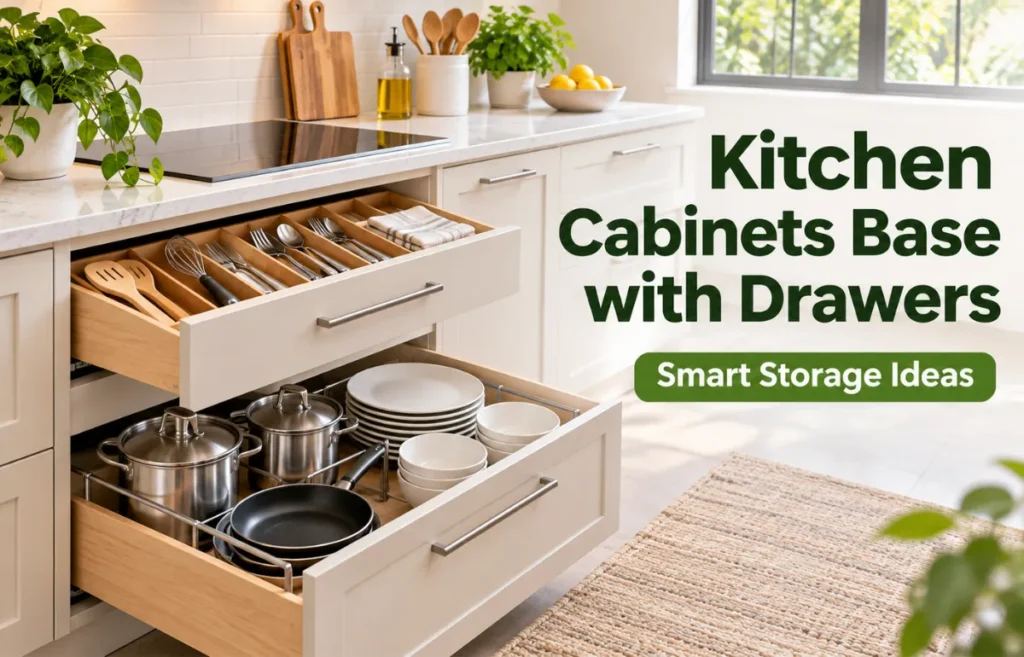
Kitchen cabinets base with drawers are lower kitchen storage units installed beneath the countertop that use pull-out drawers instead of traditional cabinet doors and fixed shelves. They provide accessible storage for cookware, utensils, dishes, food containers, and other everyday kitchen essentials. Unlike conventional cupboards, drawer base cabinets bring stored items forward, making them easier to see, organize, and retrieve.
When comparing drawer-base and door-base cabinets, I consider accessibility, usable storage space, organization, durability, and everyday convenience. While drawers generally work better for frequently used kitchen items, traditional cupboards remain practical for oversized appliances and tall cookware.
The best choice depends on how you cook, what you own, and how you want your kitchen to function. Often, combining both cabinet styles creates a more practical kitchen than relying entirely on one.
What Are Kitchen Base Cabinets With Drawers?
Kitchen base cabinets with drawers are floor-level cabinetry units designed to support countertops while providing organized storage underneath.
Instead of opening a hinged door and reaching inside a cupboard, you pull a drawer outward to access its contents.
These cabinets are available in several configurations, including two-drawer, three-drawer, and four-drawer units. Some feature shallow upper drawers for utensils and deeper lower compartments for heavy cookware.
Common features include:
- Full-extension drawer slides
- Soft-close mechanisms
- Adjustable drawer dividers
- Deep storage compartments
- Reinforced drawer bottoms
- Concealed or side-mounted drawer runners
I particularly like the practicality of full-extension drawers because they make the back portion of a cabinet easier to access, an area that often becomes wasted space in traditional kitchen cupboards.
Kitchen Drawer Base Cabinets vs. Door Base Cabinets
Both cabinet styles provide valuable storage, but they serve different purposes.
Traditional base cabinets usually feature hinged doors with internal shelving. Some also include a small drawer above the doors.
Drawer base cabinets divide the available space into individual pull-out compartments.
Here is how they compare in everyday use.
| Feature | Drawer Base Cabinets | Door Base Cabinets |
|---|---|---|
| Accessibility | Excellent | Moderate |
| Organization | Easier to maintain | Often requires organizers |
| Visibility | Contents visible from above | Items may hide behind others |
| Initial cost | Generally higher | Generally lower |
| Heavy cookware storage | Excellent with suitable hardware | Good |
| Tall appliance storage | Limited by drawer height | Excellent |
| Cleaning | Individual drawers are accessible | Fewer compartments to clean |
| Maintenance | More moving hardware | Simpler hardware |
| Everyday convenience | High | Depends on shelf arrangement |
| Storage flexibility | Limited by drawer dimensions | Adjustable shelving offers flexibility |
For frequently used kitchen essentials, I would prioritize drawers. However, I would still reserve some traditional cupboards for equipment that needs uninterrupted vertical storage.
Why Drawer Base Cabinets Work Better for Everyday Storage
A well-designed kitchen should make routine activities easier. Storage plays a surprisingly large role in achieving that.
1. Everything Is Easier to Reach
One disadvantage of conventional lower cabinets is the amount of bending and reaching involved.
Retrieving a saucepan from the back of a deep cupboard may require moving several other items first.
A full-extension kitchen drawer reduces this problem by bringing its contents forward.
This arrangement can be particularly helpful for older adults, people with limited mobility, and homeowners who cook frequently.
2. Better Visibility Reduces Clutter
Items stored behind cabinet doors can easily disappear from view.
Food containers accumulate, duplicate utensils go unnoticed, and cookware gets pushed into forgotten corners.
Drawers allow you to view most of their contents from above. This makes it easier to identify what you own and where everything belongs.
I would use this advantage for food storage containers, kitchen accessories, and pantry ingredients that tend to become disorganized.
3. Heavy Cookware Becomes More Accessible
Deep kitchen drawers are particularly useful for frying pans, saucepans, casserole dishes, and mixing bowls.
Instead of lifting several pots to reach the one underneath, you can arrange cookware across a drawer and access it more directly.
However, heavy-duty drawer slides and sturdy drawer construction are essential. A large drawer is only as reliable as the hardware and cabinet structure supporting it.
4. Organization Becomes More Sustainable
An organized kitchen is only useful if it remains organized after several weeks of daily cooking.
Drawer compartments create natural boundaries between different categories of kitchen items.
Utensils, cookware, lids, and food containers can each have a designated space.
I recommend avoiding overly complicated organizational systems. A drawer should be easy to use even when you are cooking dinner in a hurry.
When Traditional Door Base Cabinets Are the Better Choice
Despite the advantages of kitchen cabinets base with drawers, traditional cupboards should not be dismissed.
Certain kitchen items simply fit better behind cabinet doors.
Storing Tall Kitchen Appliances
Stand mixers, blenders, food processors, and large stockpots may require more vertical clearance than a standard drawer provides.
A cupboard with removable or adjustable shelving can accommodate these items more effectively.
Always measure appliances with their attachments, handles, and lids included.
Managing Under-Sink Storage
Plumbing pipes, water filters, and garbage disposal units can interfere with standard drawer installation.
Traditional sink base cabinets provide flexibility around these obstacles while keeping plumbing accessible for maintenance.
Specialized U-shaped drawers are another possibility, although they require careful planning.
Keeping Renovation Costs Under Control
Door-base cabinets generally require fewer moving components than multi-drawer units.
If you are renovating on a limited budget, combining traditional cupboards with a few strategically positioned drawer cabinets can provide excellent functionality without unnecessary spending.
I would rather invest in two high-quality drawer stacks than install inexpensive drawers throughout an entire kitchen.
Types of Kitchen Base Cabinets With Drawers
Choosing the right drawer configuration matters just as much as deciding between drawers and doors.
Two-Drawer Base Cabinets
These cabinets usually contain two relatively deep drawers.
They are ideal for bulky cookware, large serving bowls, mixing bowls, and taller kitchen accessories.
The main disadvantage is that smaller items can become difficult to organize without internal dividers.
Three-Drawer Base Cabinets
A three-drawer cabinet commonly features one shallow upper drawer and two deeper drawers underneath.
This configuration offers an effective balance between small-item organization and larger cookware storage.
I consider it one of the most versatile choices for an ordinary family kitchen, especially near the cooking or food preparation area.
Four-Drawer Base Cabinets
Four-drawer units provide multiple compartments for smaller kitchen essentials.
They work particularly well for cutlery, measuring spoons, kitchen gadgets, food wraps, and baking accessories.
However, they generally provide less uninterrupted vertical space for large pots and appliances.
Combination Drawer and Door Cabinets
Combination cabinets feature one or more drawers above a traditional cupboard.
They provide the accessibility of drawer storage while retaining flexible shelving underneath.
This arrangement is especially useful in smaller kitchens where every cabinet needs to accommodate different types of items.
Standard Kitchen Drawer Base Cabinet Sizes
In many American kitchen cabinet systems, standard base cabinets measure approximately 34.5 inches high and 24 inches deep before countertop installation.
Widths vary depending on the manufacturer and cabinet collection.
The following dimensions provide a useful starting point for planning.
| Cabinet Width | Recommended Storage |
|---|---|
| 12 inches | Spices, narrow accessories, small utensils |
| 15 inches | Cutlery, kitchen tools, food wraps |
| 18 inches | Baking accessories and smaller cookware |
| 24 inches | Dishes, containers, medium-sized pans |
| 30 inches | Pots, pans, plates and mixing bowls |
| 36 inches | Large cookware and bulkier kitchen essentials |
A cabinet’s advertised width is not the same as its usable internal drawer width.
Drawer slides, cabinet walls, drawer box construction, and framing all occupy space.
Before ordering cabinets, I recommend requesting the actual internal drawer dimensions. This is especially useful when storing large frying pans, plate stacks, or oversized organizers.
How to Choose the Right Drawer Depth
Drawer depth should reflect the items you intend to store rather than simply following the cabinet’s appearance.
Shallow Drawers
Shallow drawers work well for frequently used items such as cutlery, spatulas, peelers, measuring cups, and kitchen scissors.
Keeping these items in the uppermost drawer creates a convenient storage area close to the countertop.
Medium-Depth Drawers
Medium drawers are suitable for everyday dishes, food storage containers, small mixing bowls, and kitchen accessories.
Adjustable dividers can prevent items from shifting when the drawer opens.
Deep Drawers
Deep kitchen cabinet drawers accommodate pots, pans, larger bowls, and bulky cooking equipment.
Before selecting a deep drawer, check its usable internal height. A tall drawer front does not necessarily mean the entire space behind it is available for storage.
Also measure the height of cookware handles and lids, which are easy to overlook.
Where Should You Install Drawer Base Cabinets?
The location of a drawer cabinet influences its usefulness throughout the day.
Rather than distributing drawers evenly across the kitchen, I recommend organizing storage around specific activities.
Near the Stove
Store frying pans, saucepans, cooking utensils, and pot lids close to the cooking area.
This arrangement reduces unnecessary movement while preparing meals.
Keep heat-sensitive items away from areas that become excessively warm.
Beneath the Food Preparation Area
Drawers underneath your main preparation countertop are ideal for knives, measuring tools, mixing bowls, and other cooking accessories.
Frequently used tools should be available without crossing the kitchen.
Near the Dishwasher
Storing everyday plates, bowls, and cutlery near the dishwasher simplifies unloading.
A suitable deep drawer with adjustable plate dividers can make dish storage particularly convenient.
Inside a Kitchen Island
Kitchen island drawers provide useful storage for serving dishes, baking supplies, food containers, and preparation tools.
Check that extended drawers will not obstruct nearby appliances, seating areas, or narrow walkways.
A Practical Way to Calculate Which Cabinets You Actually Need
One common kitchen planning mistake is choosing cabinets before examining what needs to be stored inside them.
I suggest using an inventory-based approach that focuses on real household habits.
The Seven-Day Storage Audit
For one week, pay attention to the kitchen items you use regularly.
Group them into three categories:
- Daily-use items that require immediate access.
- Weekly-use items that need convenient storage.
- Occasionally used equipment that can occupy less accessible spaces.
Assign drawer space to the first two groups wherever practical. Reserve traditional cupboards or secondary storage areas for occasional-use appliances.
This approach prevents expensive, easy-access storage from being occupied by equipment you rarely use.
Consider the Retrieval Effort
Think about how many actions are necessary to retrieve an item.
Opening a cupboard, removing a bowl, moving a saucepan, and retrieving a frying pan requires considerably more effort than opening a well-organized drawer.
For example, eliminating two unnecessary storage actions for an item used three times daily saves 42 small actions over a week.
Although each action seems insignificant, the cumulative difference can make daily cooking more convenient.
I call this the retrieval-effort test, and it provides a useful way to decide where drawers offer the greatest practical value.
Leave Some Unoccupied Storage Space
Avoid filling every drawer completely during the initial organization.
As a personal planning guideline, I suggest leaving roughly 10–15% of usable drawer space unoccupied where possible.
This provides room for additional cookware, replacement utensils, and changing household needs.
A completely packed drawer may look efficient initially, but it leaves little flexibility for the future.
Do Drawer Base Cabinets Provide More Storage Space?
Drawer cabinets often provide more accessible storage, but they do not automatically offer greater physical storage capacity.
Drawer runners, compartment walls, and clearance requirements occupy internal space.
A traditional cupboard with removable shelving may accommodate larger objects more efficiently because its interior is less divided.
However, accessible space and total space are two different things.
If you cannot conveniently reach the back of a cupboard, that portion of the cabinet may remain underused.
This is where drawers have a meaningful advantage. They make a greater proportion of the available storage easier to use regularly.
What to Look for When Buying Kitchen Drawer Cabinets
The quality of kitchen base cabinets with drawers depends on more than their external appearance.
I would pay particular attention to the following construction details.
Full-Extension Drawer Slides
Full-extension hardware allows the drawer to open far enough to expose its rear storage area.
Partial-extension slides are often less convenient for deep kitchen cabinets.
Soft-Close Mechanisms
Soft-close hardware slows the drawer during the final stage of closing.
It reduces slamming and makes everyday operation quieter, especially in busy family kitchens.
Drawer Weight Capacity
Heavy cookware, ceramic plates, and cast-iron pans can create substantial loads.
Check the manufacturer’s weight rating for the specific drawer hardware and cabinet assembly.
Do not assume that every wide drawer can safely support heavy cookware.
Drawer Box Construction
Look for secure joints, adequately supported drawer bottoms, suitable materials, and properly installed hardware.
Dovetail joints can be a desirable feature in wooden drawers, but overall construction quality matters more than one particular joint type.
Can You Convert Existing Kitchen Cabinets Into Drawers?
Yes. Many traditional kitchen base cabinets can be upgraded with pull-out storage without completely replacing the cabinetry.
Possible options include:
- Installing sliding shelves behind existing doors.
- Adding pull-out baskets.
- Fitting internal drawers inside cupboards.
- Replacing cabinet doors with external drawer fronts and compatible drawer boxes.
Internal pull-out shelves are particularly useful when you want to retain your existing kitchen appearance.
However, you still need to open the cabinet doors before accessing the sliding storage.
For a complete drawer conversion, check cabinet framing, hinge clearance, internal dimensions, structural support, and hardware compatibility before purchasing components.
Common Mistakes to Avoid With Drawer Base Cabinets
Even high-quality cabinetry can become inconvenient when the layout is poorly planned.
I recommend avoiding these common mistakes:
- Selecting drawers based only on their external dimensions.
- Installing narrow drawers for wide cookware.
- Overloading drawer slides with heavy kitchen equipment.
- Forgetting clearance around corners and appliance doors.
- Using deep drawers for small utensils without organizers.
- Replacing every traditional cupboard without considering tall appliances.
- Buying decorative drawer organizers before measuring the actual interiors.
Another overlooked issue is the interaction between neighboring cabinets.
A drawer near a corner may collide with an adjacent cabinet handle if the layout lacks adequate clearance.
Checking these details before installation can prevent expensive modifications later.
Are Kitchen Drawer Base Cabinets Worth the Extra Cost?
For households that cook regularly, drawer cabinets can justify their additional cost through improved organization and accessibility.
However, installing drawers everywhere is not necessarily the best investment.
If I were planning a budget-conscious kitchen renovation, I would prioritize drawer cabinets near the stove, preparation countertop, and dishwasher.
I would retain conventional door cabinets for tall appliances, plumbing access, and occasionally used equipment.
This creates a balanced storage arrangement without paying for additional drawer hardware where it provides little benefit.
Frequently Asked Questions
Are drawers better than cupboards in a kitchen?
Drawers are generally better for frequently used utensils, cookware, and dishes, while cupboards provide greater flexibility for tall appliances and oversized kitchen equipment.
What are kitchen cabinets with drawers called?
They are commonly called drawer base cabinets, kitchen drawer units, or drawer stack cabinets, depending on their configuration and manufacturer.
What is the best width for kitchen pot and pan drawers?
A 30-inch or 36-inch drawer base cabinet is often suitable for pots and pans, provided its internal dimensions and hardware capacity meet your storage needs.
Are kitchen drawer cabinets more expensive than door cabinets?
Yes, drawer cabinets generally cost more because they require additional drawer boxes, slides, fronts, and assembly compared with conventional cupboards.
Can you install drawers inside existing kitchen cupboards?
Yes, compatible pull-out shelves and internal drawer systems can be installed inside many existing cupboards to improve storage accessibility.
Final Thoughts
Kitchen cabinets base with drawers offer a practical way to improve everyday organization, accessibility, and cooking convenience. Their greatest advantage is making frequently used kitchen essentials easier to find and retrieve.
However, traditional door cabinets remain valuable for tall appliances, oversized cookware, and storage around plumbing.
I recommend combining both cabinet styles according to your household’s cooking habits rather than choosing one exclusively.
Before purchasing new cabinetry, measure your cookware, identify your most frequently used kitchen items, and review your existing storage problems. Use that information to create a kitchen layout that works for your daily routine, not just one that looks attractive in a showroom.