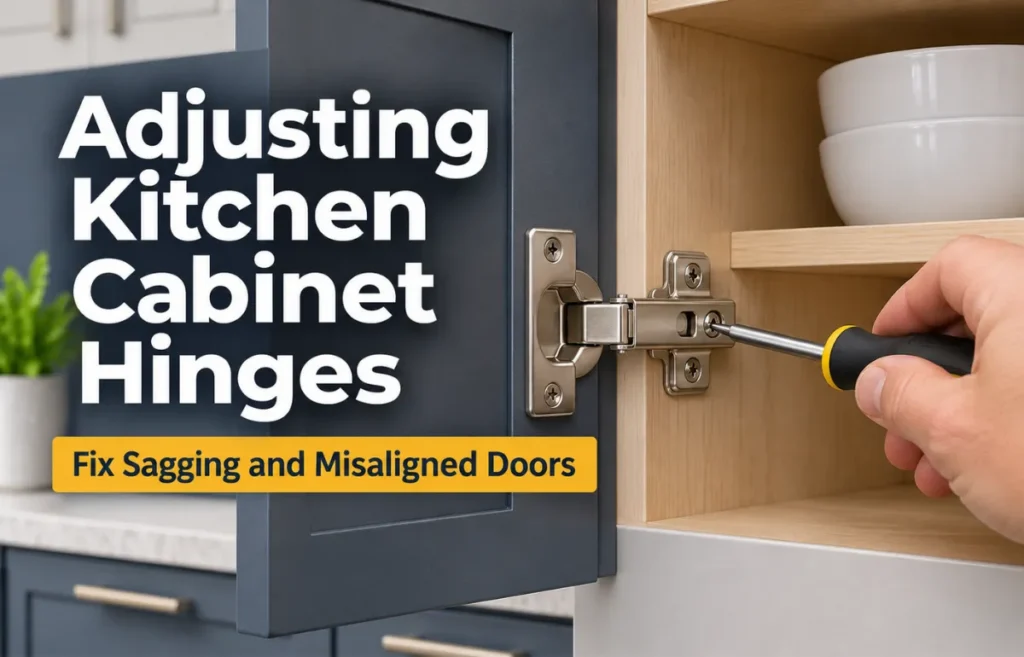
Adjusting kitchen cabinet hinges involves tightening or repositioning hinge screws to correct sagging doors, uneven gaps, rubbing edges, and closing problems. Most modern concealed hinges allow adjustments in three directions: sideways, vertically, and inward or outward. Older cabinet hinges may require tightening mounting screws, repositioning the hinge, or repairing worn screw holes.
To adjust kitchen cabinet hinges, identify your hinge type, tighten loose mounting screws, and turn the appropriate adjustment screw in small increments until the door sits correctly.
A manual screwdriver is usually all you need, and there’s rarely a reason to replace an otherwise functional hinge.
I recommend identifying what’s causing the misalignment before touching any adjustment screws. A sagging door, for example, requires a different correction than one that refuses to close completely.
Why Do Kitchen Cabinet Doors Become Misaligned?
Kitchen cabinets experience considerable wear from everyday use. Repeated opening and closing gradually puts pressure on hinges, mounting plates, and screw holes.
Even well-installed cabinet doors can lose their original alignment over time.
Common reasons include:
- Loose hinge mounting screws
- Worn or damaged hinges
- Stripped screw holes
- Changes in temperature and humidity
- Excessively heavy cabinet doors
- Warped wooden doors
- Shifting cabinet frames
- Incorrect hinge installation
Sometimes, the problem becomes noticeable after painting kitchen cabinets or replacing cabinet hardware. Even a slightly repositioned hinge can create an uneven gap.
Before making adjustments, gently lift the open door from its bottom corner. If the hinge moves independently of the cabinet, you probably have a mounting problem rather than an alignment issue.
Identify Your Kitchen Cabinet Hinge Type First
Not every cabinet hinge works the same way. Some have dedicated adjustment mechanisms, while others rely entirely on their mounting positions.
Knowing which type you have prevents unnecessary damage and makes the repair considerably easier.
Kitchen Cabinet Hinge Types and Their Adjustment Options
| Hinge type | Adjustment options | Common application |
|---|---|---|
| European concealed hinges | Side, height, and depth | Modern kitchen cabinets |
| Soft-close hinges | Alignment and damping on selected models | Contemporary kitchens |
| Traditional butt hinges | Tightening, shimming, and repositioning | Wooden and vintage cabinets |
| Surface-mounted hinges | Limited repositioning | Traditional face-frame cabinets |
| Compact concealed hinges | Model-dependent multidirectional adjustment | Face-frame cabinets |
| Inset cabinet hinges | Depends on hinge construction | Flush-fitting cabinet doors |
Remember that inset and overlay describe how a door fits against its cabinet, while concealed and surface-mounted describe the hinge design. These categories can overlap.
Tools You Need for Adjusting Kitchen Cabinet Hinges
I prefer keeping the tool collection simple for this particular home improvement task. Using unnecessary power tools can create more problems than they solve.
Gather the following:
- Phillips or Pozidriv screwdriver, depending on the screw head
- Small flathead screwdriver, if required
- Measuring tape or ruler
- Small spirit level
- Painter’s tape
- Pencil
- Thin wooden or plastic shims
- Soft cleaning cloth
Wood glue, hardwood dowels, and replacement screws may also be necessary if the original mounting holes are damaged.
Avoid using an electric drill for fine hinge adjustments. Its torque can strip screw heads, damage particleboard, and move adjustment mechanisms beyond their intended range.
Which Cabinet Hinge Screw Does What?
Modern European-style hinges generally have several screws serving different purposes.
Understanding these screws is the most useful part of learning how to adjust cabinet doors.
Side-to-Side Adjustment Screw
This screw moves the cabinet door horizontally.
It’s commonly positioned toward the front of the hinge arm, closer to the door. Adjusting it helps correct uneven gaps between adjacent cabinet doors and changes the amount of door overlay.
Height Adjustment Screw
The height adjustment mechanism raises or lowers the cabinet door.
Depending on the hinge design, you’ll either find an adjustment cam on the mounting plate or mounting screws passing through elongated holes.
Depth Adjustment Screw
The depth screw moves the door closer to or farther away from the cabinet.
On many concealed hinges, it sits toward the back of the hinge arm. This adjustment helps when a door protrudes beyond neighboring doors or doesn’t sit evenly against the cabinet.
Cabinet Hinge Screw Adjustment Chart
| Door alignment problem | Adjustment required | Screw or component |
|---|---|---|
| Door hangs too low | Vertical adjustment | Mounting plate or height cam |
| Doors rub against each other | Horizontal adjustment | Side adjustment screw |
| Door sticks outward | Depth adjustment | Rear adjustment mechanism |
| One corner appears lower | Angular correction | Different side adjustments at each hinge |
| Entire door feels loose | Secure the mounting | Mounting screws |
| Door closes too slowly | Check damping | Soft-close mechanism, if adjustable |
Screw positions and turning directions differ between manufacturers. Check your particular hinge design rather than assuming every clockwise turn produces the same result.
How to Adjust European Concealed Kitchen Cabinet Hinges
European hinges are popular because they provide a clean exterior appearance and allow precise door alignment without drilling new holes.
Their adjustment mechanisms make correcting everyday cabinet door problems relatively straightforward.
Step 1: Tighten Loose Mounting Screws
Open the cabinet door and inspect both the hinge cup attached to the door and the mounting plate inside the cabinet.
Tighten any loose fixing screws while supporting the door’s weight.
If a screw continues spinning without becoming tight, stop. The mounting hole may be stripped and require repair.
Step 2: Adjust the Door From Side to Side
Locate the lateral adjustment screw on the hinge arm.
Turn it approximately one-quarter turn, close the door, and observe the movement. If it moves in the wrong direction, reverse your adjustment.
To shift the entire door horizontally, make similar adjustments to the upper and lower hinges.
If only one corner is misaligned, adjust the hinges by different amounts to change the door’s angle.
Step 3: Raise or Lower the Cabinet Door
Support the door from underneath before making a height adjustment.
For hinges with slotted mounting plates, slightly loosen the appropriate fixing screws and move the door vertically until it aligns with neighboring doors.
Tighten the screws while holding the door in position.
If your hinge has a dedicated height adjustment cam, turn that mechanism instead. There is usually no need to loosen the mounting plate.
Step 4: Adjust the Cabinet Door Depth
Locate the depth adjustment screw or sliding mechanism toward the rear of the hinge arm.
Make a small adjustment and close the door to check whether it sits evenly with adjacent cabinet fronts.
Leave sufficient clearance for the door to open freely. Pulling it too tightly against the cabinet can cause the hinge or door edge to bind.
How to Adjust Soft-Close Kitchen Cabinet Hinges
Soft-close hinges contain a damping mechanism that slows the door during the final part of its closing movement.
Most European-style soft-close hinges use the same alignment principles as standard concealed hinges. However, their damping mechanism introduces another possible source of closing problems.
When the Cabinet Door Closes Too Slowly
First, check whether the door is rubbing against the cabinet frame or another door.
If the alignment is correct, inspect the soft-close mechanism. Some models feature a small activation switch or damping adjustment.
Certain Blum hinges, for instance, allow the soft-close function to be disabled on one hinge when a lightweight door experiences excessive damping.
Follow the manufacturer’s instructions because not all soft-close hinges offer this feature.
When the Cabinet Door Slams Shut
Check whether the damping mechanism is enabled and securely installed.
Remove any visible debris with a soft cloth. Avoid spraying general-purpose lubricants into the damper, as they may interfere with its operation.
If the door still slams despite correct alignment and settings, the damper may need replacement.
How to Adjust Old Kitchen Cabinet Door Hinges
Traditional cabinet hinges often lack the adjustment screws found on modern hardware.
Fortunately, correcting minor misalignment doesn’t necessarily require replacing them.
Adjusting Traditional Butt Hinges
Start by tightening the screws securing both hinge leaves.
Inspect the hinge pin and look for excessive movement, bent metal, or worn screw holes.
If the mounting is secure but the door remains uneven, a thin, firm shim behind an appropriate hinge leaf may help change its position.
Test the shim before permanently securing it. Too much thickness can create new clearance problems or prevent the hinge from closing properly.
Adjusting Surface-Mounted Cabinet Hinges
Surface-mounted hinges are usually visible from outside the cabinet.
If the mounting holes are slotted, loosen the screws slightly, reposition the supported door, and retighten them.
Hinges with fixed round holes may require repairing the old holes and drilling new pilot holes.
I would avoid repositioning these hinges until other causes, particularly loose screws and cabinet distortion, have been ruled out.
Adjusting Inset Cabinet Doors
Inset doors sit inside the cabinet opening rather than overlapping its edges.
This design makes uneven gaps particularly noticeable.
Adjust the door gradually while checking the clearance along all four edges. A correction at the top may affect the opposite bottom corner.
If a wooden inset door has swollen because of humidity, hinge adjustment alone may not permanently solve the problem.
How to Fix Sagging Kitchen Cabinet Doors
A sagging cabinet door typically drops at the corner farthest from its hinges.
Rather than immediately raising the entire door, determine whether it has shifted vertically or tilted diagonally.
Use the Corner-Lift Test
Open the door slightly and gently lift its unsupported bottom corner.
Watch the upper hinge while doing this.
Movement between the mounting plate and cabinet suggests loose or damaged screw holes. Movement inside the hinge joint may indicate worn hardware.
If everything remains secure, the door may simply need realignment.
Correct the Door’s Angle Instead of Its Height
Imagine a cabinet door with its hinges on the left and its handle on the right.
If the handle-side bottom corner has dropped, moving the whole door upward might improve the bottom gap while creating another problem at the top.
Instead, shifting the top of the door toward the hinge side relative to the bottom can help lift the unsupported corner.
Use very small lateral adjustments and check the result after each change.
For doors with three or more hinges, coordinate the intermediate hinges so they don’t resist the corrected alignment.
How to Adjust Cabinet Doors With Uneven Gaps
Uneven spacing can make otherwise attractive kitchen cabinets look poorly installed.
I recommend aligning cabinet doors as a group rather than treating each door as an isolated repair.
Establish a Reference Door
Choose a properly aligned door with secure hinges as your starting reference.
Compare neighboring doors against its upper edge, lower edge, and front surface.
Work outward from that reference rather than repeatedly switching between random doors.
Use Painter’s Tape as a Temporary Alignment Marker
Apply a strip of low-tack painter’s tape across the fronts of two neighboring doors, making sure it follows the intended horizontal alignment.
Mark the reference line, then separate the tape at the gap between the doors.
As you adjust the misaligned door, compare the two marks. This provides a visual reference that makes subtle changes easier to notice.
Test the tape on an inconspicuous area first, especially on painted or refinished cabinets.
Why Won’t My Cabinet Door Close Properly After Adjustment?
Sometimes adjusting kitchen cabinet hinges fixes the visible alignment but introduces a closing problem.
This usually happens because one adjustment affects clearance somewhere else.
Check for:
- Door edges touching the cabinet frame
- Adjacent cabinet doors overlapping
- Incorrect depth adjustment
- Misplaced rubber door bumpers
- Protruding shelves or stored items
- Damaged hinge springs
- Excessive soft-close resistance
A thin strip of paper can help locate hidden contact points.
With the door slightly open, position the paper between suspected surfaces and gently close it. Unexpected resistance may reveal where the door is rubbing.
Compare the result with a properly functioning door, and keep your fingers away from hinge pinch points.
How to Repair Stripped Cabinet Hinge Screw Holes
Repeatedly tightening a screw that no longer grips won’t fix a sagging cabinet door.
The mounting material needs to provide a firm anchor for the hinge.
Repairing Screw Holes in Solid Wood
Remove the affected hinge while supporting the cabinet door.
For a badly stripped hole, drill a controlled opening for a suitable hardwood dowel. Apply wood glue, insert the dowel, and allow the adhesive to cure fully.
Trim the dowel flush, mark the original screw position, and drill a correctly sized pilot hole.
Reattach the hinge without overtightening the screw.
Repairing Hinges in MDF or Particleboard Cabinets
Engineered wood can crumble around damaged screw holes, especially when screws have been tightened repeatedly.
A compatible cabinet hinge repair plate or purpose-made repair insert may provide a more reliable fixing point than forcing a larger screw into weakened material.
Check the panel thickness before installing replacement screws to avoid penetrating the cabinet’s finished surface.
When Should You Replace Cabinet Hinges Instead of Adjusting Them?
Adjustment is only useful when the hinge remains structurally sound.
Consider replacement if you notice cracked metal, excessive play, persistent corrosion, broken springs, or adjustment screws that no longer hold their position.
When purchasing replacement cabinet hinges, match the original cup diameter, mounting pattern, opening angle, overlay, and cabinet construction.
Many concealed hinges have a 35 mm cup, but that measurement alone doesn’t guarantee compatibility.
If several doors suddenly become misaligned, inspect the cabinet structure itself. A loose, distorted, or poorly supported cabinet may require professional attention rather than new hinges.
How to Keep Kitchen Cabinet Doors Properly Aligned
Regular maintenance can prevent minor alignment issues from developing into more expensive repairs.
Every few months, check frequently used cabinet doors for movement around their mounting plates.
Clean the hinges with a dry or slightly damp cloth, avoid hanging heavy objects from cabinet doors, and address moisture or plumbing leaks promptly.
I also recommend taking a close-up photograph of unfamiliar hinges before adjusting them. Having a record of the original screw positions makes it easier to reverse an unsuccessful adjustment.
If the door repeatedly sags after correction, investigate its mounting strength, weight, and hinge capacity rather than continuing to adjust it.
Final Thoughts
Adjusting kitchen cabinet hinges is an inexpensive way to restore the appearance and functionality of your kitchen without replacing the cabinets.
The key is understanding your hinge type, identifying the actual alignment problem, and making small, controlled adjustments.
Start with your most noticeably misaligned cabinet door today. Check its mounting screws, determine which direction it needs to move, and make one adjustment at a time.
A few careful corrections can make your entire kitchen look noticeably better.
Frequently Asked Questions
Which screw do I turn to adjust kitchen cabinet hinges?
On most concealed hinges, the front adjustment screw controls sideways movement, the rear mechanism controls depth, and the mounting plate controls height.
How do I adjust kitchen cabinet doors that are too close together?
Turn the lateral adjustment screws in small increments to move the doors apart until they have an even gap and open without rubbing.
Why does my kitchen cabinet door keep sagging?
Recurring sagging usually indicates loose mounting screws, stripped screw holes, worn hinges, or insufficient hinge support for the door’s weight.
Can all kitchen cabinet hinges be adjusted?
No. Modern concealed hinges generally offer multiple adjustment options, while traditional hinges may require shimming, repositioning, or mounting repairs.
Can I adjust kitchen cabinet hinges without removing the doors?
Yes. Most concealed and soft-close hinges can be adjusted while the doors remain attached. Removal may be necessary for damaged hardware or screw-hole repairs.