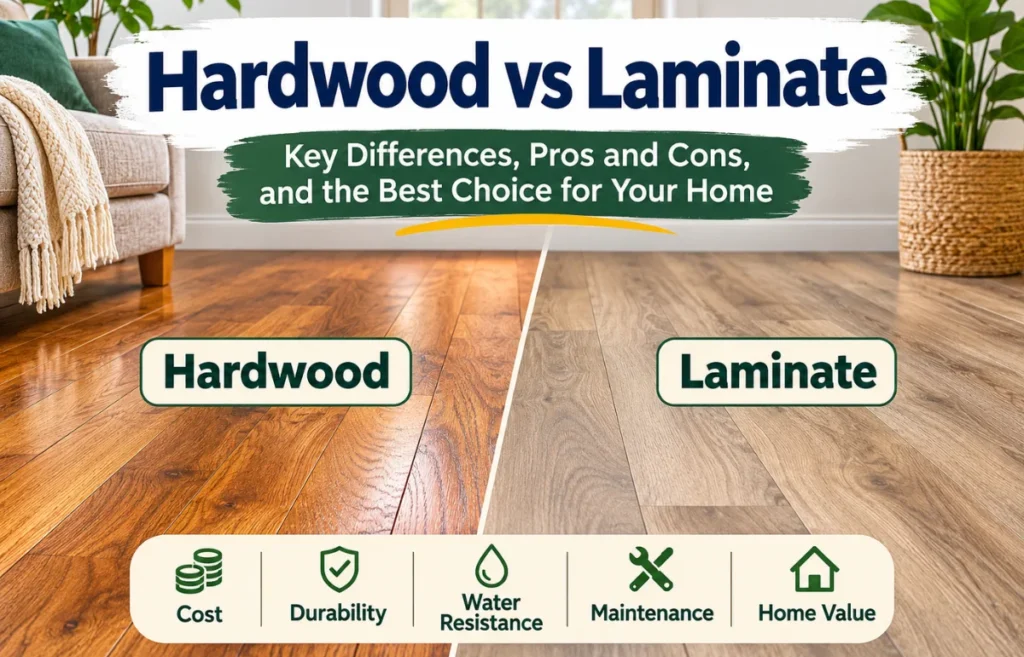
Hardwood vs Laminate is a flooring comparison that usually refers to solid hardwood versus laminate flooring. “Hardwood” is not a recognized flooring material category; it appears to be a variation or misspelling of “hardwood.” Solid hardwood is made from natural wood throughout each plank, while laminate uses a wood-look design layer over a manufactured fiberboard core, protected by a durable surface coating.
The biggest differences are price, appearance, moisture behavior, repair options, and long-term value. Laminate generally costs less and resists everyday surface wear well. Solid hardwood costs more initially but can be sanded and refinished, often giving it a much longer useful life.
I’d choose between them based on the room, household habits, and how long I expect the floor to stay in place.
What Are Solid Hardwood and Laminate Flooring?
Before comparing performance, I like to separate what a floor looks like from what it is made of. Two oak-colored planks can look nearly identical in a showroom yet behave very differently after years of use.
Solid Hardwood: Real Wood From Top to Bottom
A solid hardwood plank is milled from a single piece of timber, commonly oak, maple, hickory, or walnut. The grain, knots, and color variations run through real wood rather than a printed image.
Most traditional solid planks are installed by fastening them to a suitable subfloor, although approved installation methods vary.
Wood reacts to changing humidity, which means small seasonal gaps or movement can occur. Its major advantage is renewability: depending on the plank and its condition, a professional can sand away worn finish and refinish the surface.
Laminate: A Realistic Wood Look Built in Layers
Laminate typically has a protective wear layer, a photographic or digitally printed décor layer, a high-density fiberboard core, and a stabilizing backing. Its wood grain is visual, not a solid timber surface.
Many laminate floors use click-lock edges and float over suitable underlayment.
Better products can reproduce wood texture convincingly, but they cannot be sanded and stained like solid hardwood. If the printed surface is badly damaged, replacement is usually the practical repair.
Hardwood vs Laminate: Quick Comparison
| Feature | Solid hardwood (“Hardwood”) | Laminate flooring |
|---|---|---|
| Main material | One piece of natural timber | Layered product with a printed surface and fiberboard core |
| Appearance | Unique grain in each board | Consistent designs; some patterns repeat |
| Initial cost | Usually higher | Usually lower |
| Everyday scratches | Depends on species and finish; can mark | Wear layer often handles scuffs well |
| Moisture | Expands and contracts with humidity | Surface can resist spills, but joints and core remain vulnerable |
| Repair | Can often be refinished and locally repaired | Damaged planks are generally replaced |
| Installation | Often more demanding | Click-lock options suit experienced DIYers |
| Long-term potential | Can last generations with proper care | Life depends on product quality and use; cannot be refinished |
Appearance: Can Laminate Really Look Like Hardwood?
Up close, hardwood still has an advantage I find difficult to replicate: each board carries its own natural grain. Light moves across the surface differently, and refinishing can change the color years later without removing the floor.
Laminate has a more predictable appearance, which is useful if you want a uniform modern look.
Its weakness is design repetition. In a large open-plan room, identical knots can appear on several planks. I would ask to see a full display or installed room photograph, not just one attractive sample.
Another detail worth checking is how the floor meets adjoining tile. Thick solid wood and its subfloor system may require a taller transition strip.
A thinner laminate assembly can sometimes make door clearances easier, although the actual installed height must be measured.
Durability: Scratches, Dents, and Daily Wear
Which Surface Handles Pets and Busy Hallways?
Laminate’s protective top layer is designed to resist abrasion and stains. That makes it attractive for hallways, playrooms, and homes where chairs move frequently.
However, abrasion resistance is not the same as impact resistance. A dropped heavy object can chip a laminate edge even when shoes and pet claws barely affect the surface.
For products showing an AC rating, remember that the rating focuses on abrasion performance under a European standard.
The North American Laminate Flooring Association (NALFA) also evaluates properties such as impact, stains, and moisture. I would never choose a plank by an AC number alone.
Hardwood durability depends heavily on species and finish. Hickory and some oaks resist denting better than softer woods, but no wood finish is completely scratch-proof.
A hard species may still show marks in a glossy, dark finish more clearly than a lighter, matte floor.
The Difference Is What Happens After Damage
This is where solid hardwood earns much of its premium. Small scratches may be touched up; severe wear can sometimes be addressed by professional sanding and refinishing.
The number of refinishes depends on the flooring’s thickness, installation, and previous sanding.
Laminate damage is handled differently. Minor marks may be disguised with a manufacturer-approved repair kit, but a deep gouge or swollen seam usually means replacing planks.
That can be awkward if the original pattern has been discontinued.
I would keep an unopened spare box of laminate from the original purchase. Matching a discontinued shade five years later can be harder than fixing the actual damage.
Water and Humidity: The Most Misunderstood Difference
Neither conventional solid hardwood nor standard fiberboard-core laminate should be treated as a worry-free wet-room floor.
Solid wood absorbs and releases moisture as indoor conditions change. Prolonged wetness may cause cupping, swelling, or staining, while very dry air can lead to gaps.
The National Wood Flooring Association recommends managing indoor conditions rather than assuming a protective finish makes timber waterproof.
Laminate often copes well with promptly cleaned surface spills. Water-resistant models may use tighter locking joints, treated edges, or improved cores.
But the key question is how water gets in: through the top, between planks, or from the subfloor below.
A claim about top-surface spills does not automatically cover a leaking dishwasher or persistent concrete moisture.
I would read the manufacturer’s warranty for the exact exposure limits and required edge sealing. “Water-resistant,” “waterproof,” and a specified number of spill-protection hours are not interchangeable promises.
For bathrooms, laundry rooms with recurring leaks, or flood-prone spaces, I would consider porcelain tile or a genuinely water-tolerant flooring system instead of forcing either of these choices.
Cost: Purchase Price Versus Years of Use
For many homeowners, the answer to Hardwood vs Laminate begins with the renovation budget. Laminate usually wins on the initial bill, especially when a straightforward floating installation is possible.
For a U.S. planning reference, Angi’s 2026 guides put installed laminate at roughly $3–$13 per square foot and typical hardwood installation at about $6–$12 per square foot, with premium hardwood projects running higher.
These broad ranges overlap because products, labor, site conditions, and project size differ. They are not local quotations.
I would request itemized bids showing the planks, delivery, removal of the old floor, leveling, moisture protection, underlayment, labor, baseboards, and doorway transitions.
A cheaper plank can become an expensive project if the subfloor needs major repairs.
The more revealing number is cost over your expected ownership period.
If you will redecorate or move in five years, paying extra for hardwood’s refinishing potential may bring limited personal benefit.
If you plan to remain for decades, renewing the existing surface instead of replacing the entire floor may make hardwood a better long-term investment.
Installation: Why the Subfloor Matters More Than the Box
Laminate is often marketed as DIY-friendly, and click-lock systems can indeed be quicker to install than traditional nail-down hardwood.
Still, a floating floor needs a clean, flat, dry, stable base and the correct expansion gaps.
An uneven subfloor can make laminate flex and stress its locking joints. Incorrect underlayment may create noise or damage the connections.
Concrete often requires moisture assessment and a compatible vapor-control system.
Solid hardwood generally needs more planning. The installer must assess the timber’s moisture content, the room’s temperature and humidity, and the suitability of the subfloor.
Nail-down planks commonly need a wood-based substrate.
Solid hardwood can sometimes be installed over concrete using an approved assembly, but it is not a decision I would make without product-specific installation guidance.
Comfort and Noise: What Your Feet Will Notice
Laminate can feel firm or sound hollow when paired with the wrong underlayment or installed over an uneven floor.
A well-designed underlayment and stable substrate can improve its sound, but a thicker plank alone does not guarantee a quieter room.
I recommend testing samples under actual lighting and, if possible, walking on an installed display.
Check the sound of shoes, the feel in bare feet, and how confidently furniture sits on the surface. These everyday details matter more than a dramatic showroom photograph.
Maintenance: Which Floor Is Easier to Live With?
Both floors benefit from frequent dust removal, soft furniture pads, entrance mats, and prompt spill cleanup.
Grit is a common enemy because it acts like sandpaper under shoes and chair legs.
Laminate normally needs sweeping or vacuuming with a suitable floor setting and cleaning according to its manufacturer’s instructions.
Avoid steam cleaning unless the specific product expressly permits it; excessive moisture can damage joints and cores.
For hardwood, I would use a cleaner recommended for the existing finish rather than assuming vinegar, wax, or an all-purpose household spray is safe.
Wet mops and standing water are poor habits on either surface.
Lifespan, Environmental Impact, and Indoor Air Quality
A well-maintained solid hardwood floor has the potential to last many decades, and some remain serviceable for more than a century.
That lifespan depends on avoiding moisture damage and preserving enough usable wood for future refinishing.
Laminate lifespan varies substantially with product quality, traffic, installation, and moisture exposure.
I would be cautious about any single “guaranteed lifespan” quoted without warranty conditions. A long residential warranty does not mean the floor is covered for every type of damage.
Environmental claims deserve similar scrutiny.
Solid hardwood is renewable in principle, but sourcing and forest management matter; look for credible chain-of-custody information such as FSC certification where relevant.
Laminate can use wood fiber efficiently, yet its resin content, manufacturing process, and limited refinishing options complicate end-of-life decisions.
Indoor air quality is another buying question.
Laminate commonly contains composite wood, so I would check for applicable emissions compliance, including TSCA Title VI labeling in the United States.
I would also ask about low-emitting finishes and adhesives for hardwood installations.
Neither material should be called automatically “chemical-free” or healthier without supporting product documentation.
Which Floor Works Best in Each Room?
| Room or situation | My preferred starting point | Why |
|---|---|---|
| Formal living room | Solid hardwood | Distinctive natural grain and future refinishing |
| Children’s bedroom | Quality laminate or hardwood | Laminate favors lower upfront cost; hardwood favors repairability |
| Busy hallway | Durable laminate or hard-wearing hardwood | Compare abrasion, dents, and how damage will be repaired |
| Home office | Either | Chair protection, acoustics, and design usually decide |
| Kitchen | Carefully specified water-resistant laminate or hardwood | Both require prompt spill cleanup and moisture planning |
| Bathroom or leak-prone basement | Neither as a default | Moisture risks may justify a different flooring material |
These are starting points, not rules. The same home may benefit from solid hardwood in its main living space and laminate in a secondary bedroom.
I prefer a room-by-room decision over using one material everywhere just for visual consistency.
Five Overlooked Questions I Would Ask Before Buying
1. Can a Damaged Section Be Matched Later?
Ask whether replacement planks will be available and retain spare material.
Hardwood can be repaired or refinished, but matching an aged stain is not effortless either.
2. What Does the Warranty Actually Exclude?
Check the rules for pet accidents, standing water, rolling chairs, sunlight, humidity, and self-installation.
A warranty headline is not a substitute for its conditions.
3. Where Will Moisture Come From?
Think beyond spilled drinks. Inspect exterior doors, plumbing, concrete slabs, and seasonal indoor humidity.
The route water takes often matters more than the floor’s advertising label.
4. How Will This Floor Look After Normal Wear?
I prefer bringing several samples home and viewing them in morning and evening light.
On hardwood, assess whether you can live with real character marks. On laminate, look for repeated printed knots and visible seams.
5. What Happens When the Room Changes?
A future kitchen island, doorway alteration, or damaged plank can expose hidden limitations.
Floating floors may have restrictions on heavy fixed cabinetry, while solid wood requires allowance for seasonal movement.
I would make those plans before installation, not after.
My Verdict: Which Should You Choose?
For Hardwood vs Laminate, I would choose solid hardwood when natural character, long-term ownership, and the ability to refinish matter more than the initial price.
I would choose quality laminate when budget, convenient installation, and resistance to ordinary surface scuffs are the priorities.
Neither material can overcome a damp subfloor or poor installation.
Before purchasing, compare full installed quotes, take samples into the actual room, and read the manufacturer’s moisture and warranty requirements.
That is the simplest way to buy a floor you will still like once the new-floor excitement fades.
Frequently Asked Questions
Is Hardwood the Same as Hardwood?
“Hardwood” is not a standard flooring category. In this comparison, it means solid hardwood: planks made from natural wood rather than printed laminate.
Is Laminate More Scratch-Resistant Than Solid Hardwood?
Many quality laminates resist surface scuffs well, but impact damage can still occur. Hardwood may scratch more visibly, yet it can often be repaired or refinished.
Does Laminate Flooring Increase Home Value Like Hardwood?
Laminate can improve a room’s appearance, but solid hardwood often has stronger long-term buyer appeal. The actual resale benefit depends on the market and installation quality.
Can I Install Laminate Over Concrete?
Yes, if the slab meets the product’s flatness and moisture requirements and the correct underlayment or vapor barrier is used.
Which Lasts Longer, Hardwood or Laminate?
Solid hardwood generally has the greater long-term potential because it can be refinished. Laminate’s service life depends on its quality and care, and its surface cannot be sanded down.