
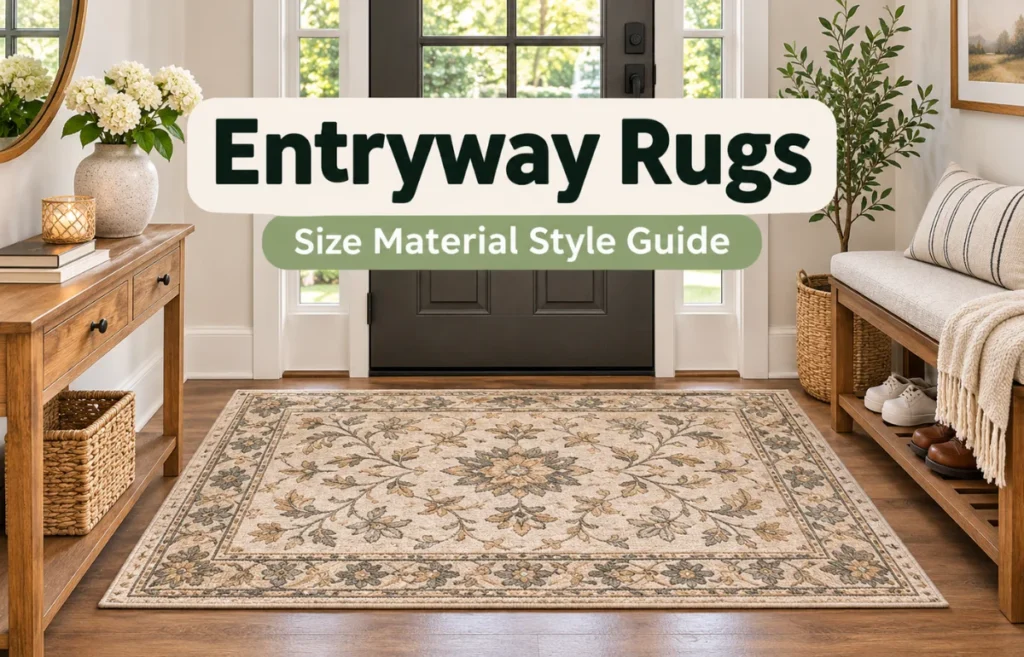
Entryway Rugs are floor coverings placed just inside a home’s entrance to catch dirt, reduce tracked-in moisture, protect flooring, and make the space feel welcoming. Unlike an outdoor doormat, an entryway rug usually covers more floor space and adds to the interior design. The best one is durable, easy to clean, low enough for the door to clear, and secure underfoot.
I think of an entryway rug as a hardworking piece of decor. It has to handle shoes, shopping bags, pets, and whatever the weather brings, yet still look good beside a console table or coat rack.
The prettiest catalog rug isn’t always right for your front door.
Why the Right Entryway Rug Makes Such a Difference
A front entrance is a transition between outside and inside. Dust, sand, rainwater, and small stones travel in on shoe soles, even when people wipe their feet. A suitable rug gives that debris somewhere to land before it reaches wood, tile, or nearby carpet.
It can also separate an open-plan entry from the living room or guide the eye through a narrow hall.
An attractive entryway area rug is not necessarily an effective dirt trap. For busy households, I favor a two-zone approach: a textured outdoor mat to scrape off heavier debris and an indoor rug to catch remaining particles and moisture.
Each has a different job.
How to Choose the Right Entryway Rug Size
Size depends on usable floor area and where people naturally step. Before shopping, measure the entrance from wall to wall and from the threshold to the first obstruction, such as a staircase, closet, or hallway turn.
Watch the route people take. Do they step ahead, turn toward a shoe bench, or cross diagonally? A rug positioned along that path works harder than one centered perfectly in an empty-looking space.
Practical Entryway Rug Size Guide
| Entryway layout | Size to consider | Why it works |
|---|---|---|
| Very small landing | 2 × 3 ft | Provides a compact landing spot when clearance allows |
| Typical single-door foyer | 3 × 5 ft | Creates room for more than one step |
| Spacious foyer | 4 × 6 ft or larger | Anchors the entry without looking undersized |
| Long, narrow hallway | 2 × 6 ft or 2.5 × 8 ft runner | Follows foot traffic while keeping the corridor visually connected |
| Wide double-door entrance | 3 × 5 ft, 4 × 6 ft, or wider | Can balance the doorway’s broader proportions |
These are starting points. I like a visible border of floor where space permits, but clearance matters more than symmetry.
Check Door Clearance Before Anything Else
A rug that catches under the door is frustrating. Open the door fully, check where its bottom edge passes, and measure the available vertical space at the tightest point. Include the thickness of any rug pad, not just the rug itself.
For a tight doorway, look at flatweave or other low-pile designs. If you are unsure, stack cardboard to roughly the proposed rug-and-pad height and see whether the door moves freely.
Check for catching at the threshold as well as across the swing.
Give Shoes Enough Landing Space
A tiny rug may catch only the first footprint. I find it more useful to estimate where the first two or three indoor steps land.
If those steps fall beyond the rug, choose a longer design or add a dedicated interior mat in the direction of travel.
Best Materials for Entryway Rugs
Material determines how a rug handles dirt, moisture, washing, and wear. A rug suited to a dry apartment may fail in a rainy mudroom.
| Material | Main advantage | Potential drawback | Best suited to |
|---|---|---|---|
| Polypropylene | Durable, generally stain-resistant, easy to spot-clean | Some constructions feel less soft; liquid may sit on the surface | Busy entrances and damp-prone areas |
| Polyester | Many colors and washable options | Quality and durability vary by weave | Families seeking easy-care patterns |
| Wool | Resilient fibers and a warm, refined look | Often costs more and needs fiber-appropriate care | Dry, sheltered foyers |
| Cotton | Soft, lightweight, often washable | Can absorb moisture and show wear quickly | Lower-traffic, dry entrances |
| Jute or sisal | Natural texture and earthy character | Moisture and embedded grit can be difficult to manage | Dry entries where appearance comes first |
Synthetic Rugs for High-Traffic Front Doors
For households with children, frequent visitors, or pets, I usually start with tightly woven polypropylene or a well-made washable polyester rug. These options are often more forgiving of muddy footprints than delicate natural fibers.
But don’t assume every synthetic rug is absorbent. Water resistance and water absorption are different qualities.
A rug designed to resist wetting may be easy to wipe clean without being the best at soaking up rainwater from shoes. If wet boots are routine, consider a moisture-absorbing entrance mat or boot tray alongside it.
Natural Fiber Rugs for a Warmer Look
Wool is worth considering when comfort and appearance are priorities. It can recover well from ordinary foot traffic, but its cleaning requirements depend on the product, dyes, and construction.
Jute and sisal have an appealing organic look, especially in coastal or minimalist interiors. I would use them at a protected, mostly dry entrance rather than where soaked shoes regularly land.
Cotton feels approachable and casual, although a thin cotton rug may need a compatible nonslip pad and more frequent washing.
The Details That Matter More Than the Pattern
Choose Low Pile and Strong Edges
A low-pile or flatwoven rug is easier to clear with a swinging door and less likely to hold noticeable crumbs at the surface. It can also be simpler to vacuum than a shag rug.
Avoid loose fringe, curling corners, and raised seams.
A darker border or small-scale pattern can disguise ordinary footprints between cleanings. That doesn’t mean dirt has disappeared; it simply keeps the entrance looking composed until it’s time to vacuum.
Treat Slip Resistance as a Safety Requirement
A beautiful rug that slides on polished tile is a bad purchase. Choose a product with a stable, floor-compatible nonslip backing or use a pad specifically approved for both the rug and the floor finish.
Check the manufacturer’s instructions, because some backings can discolor sensitive flooring.
Even secured rugs are not suitable for every household. For an older adult or someone using a walker, small area rugs can create a tripping hazard.
The National Institute on Aging advises avoiding throw rugs; a clear, unobstructed floor may be safer than adding one.
Look Underneath the Rug
Backings need attention, especially on wood or laminate. Moisture trapped underneath can be a problem even when the top looks dry.
I would lift the rug periodically after rainy days, dry both surfaces completely, and check that the backing still grips without leaving marks.
Entryway Rug Ideas That Work with Your Decor
A rug should complement the entrance without matching everything. I prefer choosing one connection: a color drawn from wall art, a shape that echoes the furniture, or a texture that balances smooth flooring.
Modern and Minimalist Entryways
Try a low-profile rug with a subtle geometric design, narrow stripes, or a quiet tonal pattern.
Charcoal, warm gray, olive, and beige can feel refined without announcing every speck of dirt.
Farmhouse and Rustic Entrances
A muted vintage-inspired pattern brings warmth to painted furniture, wood benches, and woven baskets.
If you love the look of jute but have a muddy entrance, a synthetic rug with a natural-fiber-style weave may offer a more practical compromise.
Traditional and Colorful Foyers
A distressed Persian-style runner or patterned rectangular rug can add character to an otherwise simple hallway.
Deep reds, faded blues, and mixed midtones often conceal everyday marks better than a single pale shade.
Small or Dark Entryways
A lighter rug can make a compact area feel open, but pure white may be demanding near exterior doors.
I lean toward warm stone, muted taupe, or a cream-and-gray pattern.
Match the Rug to Your Household, Not Just Your Style
The same rug won’t perform equally well in every home. These scenarios help me assess material and shape.
Homes with Children or Pets
Prioritize tight weaves, washable constructions, and patterns that forgive paw prints.
Avoid loose fringe that can catch on shoes or become a pet’s favorite chew toy. Check that washable rugs fit your machine.
Rainy or Snowy Climates
Put a scraper mat outside and leave space for a boot tray inside.
An absorbent, quick-drying entrance mat may be more useful than an ornamental rug at the wettest spot. Never leave a soaked rug sitting on a moisture-sensitive floor.
Apartments with One Narrow Doorway
A compact flatweave can define the entry without consuming precious floor space.
I would avoid forcing a long runner into an area where it blocks a closet door or ends awkwardly at a hallway turn.
Large Open-Plan Homes
Use a larger rectangular rug to establish a visual arrival zone.
It can sit near a console or bench, provided furniture legs don’t create bunching or pinched edges.
A Simple Way to Test a Rug Before Buying
People often measure the empty room, not the room in motion. I recommend a quick paper-outline test before ordering a large or expensive rug.
Mark the proposed rug dimensions on the floor with painter’s tape, checking that the tape is safe for your finish. Open every nearby door.
Walk through carrying groceries, then turn toward the coat rack or shoe cabinet. Notice whether your feet land inside the outline and whether the edges would cross a common walking route.
Next, imagine a rainy day. Where would someone pause to remove wet shoes?
If that spot falls beyond the proposed rug, adjust its position or add a boot tray. This test can prevent a stylish but impractical purchase.
I also use a three-question filter: Can the door clear it? Can the household realistically clean it? Can it stay flat and stable where people walk?
If any answer is no, I keep looking, regardless of the pattern.
How to Clean Entryway Rugs Without Wearing Them Out
Cleaning depends on the care label, but waiting until a rug looks filthy makes maintenance harder. Grit works its way into the weave, while damp debris can create odors.
For most everyday entry rugs, a manageable routine looks like this:
- Shake out loose debris when the label and rug size permit, ideally outdoors.
- Vacuum regularly, paying special attention to edges and the area nearest the door.
- Blot spills promptly rather than scrubbing them into the fibers.
- Spot-clean using a product and method approved for the material.
- Let the rug and its underside dry fully before returning it to the floor.
The Carpet and Rug Institute’s care guidance likewise emphasizes frequent entry-mat cleaning and complete drying after washing.
Follow the manufacturer’s directions over any one-size-fits-all cleaning hack.
If a rug develops persistent odors, shed fibers, curling corners, or backing that no longer grips, assess whether it is still fit for a high-traffic entrance.
Sometimes replacing a worn mat is more sensible than trying another cleaning product.
Common Entryway Rug Mistakes to Avoid
I often see foyer rugs chosen like living-room rugs, despite very different conditions.
- Choosing by appearance alone: A thick plush rug may look luxurious but trap grit and interfere with a door.
- Buying too small: One decorative footprint doesn’t protect much of the path into the home.
- Ignoring the backing: A rug that shifts or curls can create a fall hazard.
- Assuming washable means effortless: Check weight, machine capacity, drying requirements, and whether the pad needs separate care.
- Picking the wrong color for real dirt: Very pale solid colors may reveal every mark, while jet-black rugs can show lint and dust.
- Skipping the outdoor mat: An indoor rug shouldn’t have to remove gravel and dry rain-soaked soles by itself.
What Should You Spend on an Entryway Rug?
There is no universal price that guarantees quality. A budget-friendly polypropylene rug may be more useful at a busy front door than a premium wool piece.
Before comparing prices, look at the total cost: rug, compatible pad, cleaning supplies, and the likelihood of replacement.
If you’re renting or refreshing a space on a limited budget, start with a low-pile washable option in a versatile pattern.
In a quieter foyer, investing in better construction can make sense.
Make Your Entrance Work Harder and Look Better
Entryway Rugs work best when they are chosen for real life: the shoes that cross them, the weather outside, the door above them, and the floor beneath them.
I would start by measuring the landing zone, then prioritize a secure low-profile construction and a material you can comfortably maintain.
Then choose a color and pattern that make coming home more inviting.
Frequently Asked Questions About Entryway Rugs
What type of rug is best for an entryway?
A durable, low-pile polypropylene or washable polyester rug suits many busy entrances. Match the weave and moisture handling to your household.
What size rug should go in front of an entry door?
A 2 × 3 ft or 3 × 5 ft rug often works for a single door, but measure your landing area and door clearance before choosing.
Should an entryway rug go under the front door?
Only if the door swings freely over the entire rug-and-pad thickness. Otherwise, position the rug beyond the door’s swing.
Are washable rugs good for entryways?
Yes, if their construction suits heavy foot traffic and the rug fits the washing equipment available to you. Always follow its care label.
Do I need a rug pad for an entryway rug?
Use a compatible non-slip pad if the rug lacks secure backing and a rug is appropriate for the space. Avoid loose rugs where fall risk is a concern.