
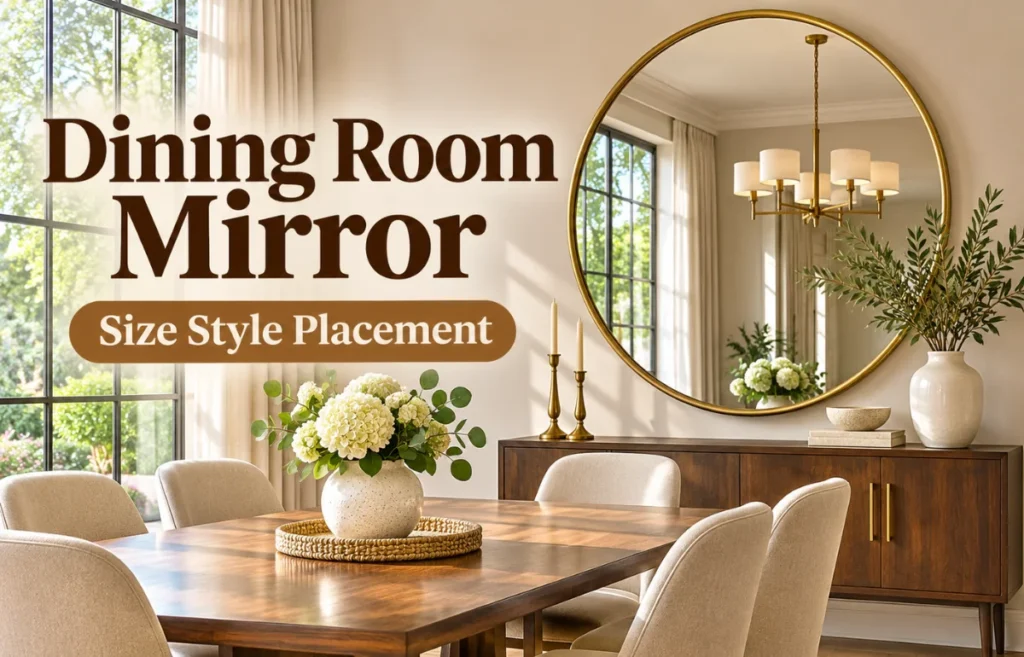
A dining room mirror is a decorative or functional mirror placed in a dining area to reflect light, create a sense of depth, and complement the room’s furniture. It often hangs above a sideboard or on a feature wall. Unlike a bathroom mirror, its main purpose is usually to improve the room’s atmosphere rather than support everyday grooming.
I think the best dining room mirror does more than fill an empty wall. It reflects something worth seeing, feels proportionate to the furniture, and looks comfortable from a seated position.
Those details can make even a modest mirror feel special. Here’s how I would choose one.
Why a Mirror Can Transform a Dining Room
Dining rooms tend to have a few large, solid pieces: a table, chairs, perhaps a cabinet or buffet. A mirror offers a visual break from all that weight. Its reflective surface adds a different texture without introducing another strong color or pattern.
Near a window, a mirror can reflect daylight; after dark, it can catch the glow of a lamp or chandelier. It doesn’t generate light, but it can make existing light more noticeable.
In smaller homes, a mirror suggests depth beyond the wall, so a compact dining nook may feel less enclosed. I wouldn’t promise that it will make every room look twice as big; what it reflects matters just as much as its dimensions.
What to Consider Before Buying a Dining Room Mirror
Start With the View, Not the Frame
Before choosing a finish, I would stand where the mirror is likely to go and look toward the opposite side of the room.
Will it reflect a window, plant, or pendant light? Or will it double the view of mail and hallway clutter?
A mirror is effectively a second view of your dining room. Treat that reflected view as part of the decoration, not an accident. A slight change in position or orientation may improve the view.
Check the Room From a Seated Position
Most wall decor is judged while standing, yet dining rooms are experienced while sitting. This difference gets overlooked. I suggest pulling out a chair at the head and sides of the table before deciding on placement.
Look for a reflection that feels balanced rather than a distracting view of another guest’s face, a bright bulb, or the television in the next room.
Aim for comfortable sightlines during meals.
Think About Visual Weight
A thick black frame, an ornate gilded design, and a thin wood-framed mirror of identical dimensions can feel surprisingly different. Heavier-looking frames anchor a blank wall, while slim frames keep a crowded room from feeling overdesigned.
My preference is to repeat one existing finish, such as the wood of the chairs or the metal on a light fixture, rather than introduce a completely new material that competes for attention.
Which Mirror Shape Works Best?
The shape influences how a dining room feels. There’s no universal winner, but some forms solve particular layout problems more easily than others.
| Mirror style | Best suited to | What to watch for |
|---|---|---|
| Round | Square rooms, rectangular sideboards, angular furniture | Very small circles can look lost above long buffets |
| Rectangular | Long walls, large sideboards, formal dining areas | Wide frames can emphasize an already narrow room |
| Arched | Traditional, transitional, and softly modern interiors | Tall arches need enough space above furniture |
| Oval | Narrow wall sections and gentle, classic schemes | Can seem undersized beside bulky furniture |
| Irregular or sculptural | Minimal rooms needing one artistic focal point | Unusual shapes may be harder to balance with nearby art |
Round Mirrors Soften Straight Lines
If a dining room contains a rectangular table, straight-backed chairs, and a boxy sideboard, I often lean toward a round dining room mirror. The curve gives the eye a resting point and stops the arrangement from becoming a grid of rectangles.
A thin frame feels contemporary; textured wood feels more relaxed.
Rectangular and Arched Mirrors Make Different Statements
A horizontal rectangle reinforces the width of a buffet and can visually stretch a feature wall. A vertical rectangle draws the eye upward, making it useful on a narrow section of wall between a doorway and a cabinet.
An arched dining room wall mirror sits somewhere between architectural detail and decoration. I especially like it when a room feels too rigid, but a round mirror would not provide enough height.
How Big Should a Dining Room Mirror Be?
Scale is where attractive mirrors often go wrong. A tiny design above a wide sideboard can look incidental; an enormous frame may overwhelm the furniture beneath it.
For a mirror centered above a sideboard, I use a starting width of roughly two-thirds to three-quarters of the furniture’s width. These are styling guidelines, not rules.
| Sideboard width | Suggested mirror width | Approximate proportion |
|---|---|---|
| 48 inches | 32–36 inches | 67–75% |
| 60 inches | 40–45 inches | 67–75% |
| 72 inches | 48–54 inches | 67–75% |
| 84 inches | 56–63 inches | 67–75% |
Measure the outside edge of the frame, not just the reflective glass. Decorative borders can add several inches and change the balance significantly.
For an empty wall without a sideboard, the furniture-based rule doesn’t apply. Instead, outline the proposed size using painter’s tape and check how it relates to the table, doorways, and nearby artwork.
A mirror should look intentional in the whole room, not merely impressive in a product photograph.
For an extra-long buffet, two coordinated mirrors may work better than one oversized piece.
Where to Place a Mirror in a Dining Room
Above the Sideboard or Buffet
This is usually the easiest location to style because the furniture gives the mirror a visual anchor. Centering the frame over the sideboard, rather than automatically centering it on the entire wall, often creates a stronger arrangement.
I would leave enough room for practical items such as a serving tray, small lamp, or vase without letting them cover a large portion of the glass.
Adjust by eye when a nearby doorway changes the composition.
Opposite or Near a Window
A mirror opposite a window can bring the outdoor view into the dining area and brighten the overall impression. However, the strongest reflection isn’t always the most comfortable one.
Watch the room in morning and afternoon light. Direct sun reflected toward a regular dining seat can cause glare.
If that’s the case, try a wall perpendicular to the window, or select a position that catches a softer slice of daylight.
On a Narrow Feature Wall
A tall mirror can turn an awkward strip of wall into a purposeful feature. It also works in open-plan homes.
Keep enough clearance from door swings, chair backs, and busy walking routes. A dining room mirror should not become something guests have to dodge as they move around the table.
Behind the Dining Table
Placing a mirror on the wall behind one side of the table can make the setting feel layered. It may also repeat a view of the table setting, candles, or overhead lighting.
Here, I would pay close attention to eye level. Seeing a bright pendant reflected directly behind another guest can be tiring, even when the arrangement looks beautiful in photographs.
How High Should You Hang a Dining Room Mirror?
For a mirror above a sideboard, a gap of approximately 4–8 inches between the furniture top and the frame’s lower edge is a useful place to start.
Taller vases or lamps may require more clearance. Keep it visually connected to the buffet.
On an otherwise empty wall, positioning the mirror’s center around typical standing eye level can be a starting point, often roughly 57–60 inches from the floor.
But dining rooms deserve a second check from seated eye level, particularly when the mirror is meant to catch a specific view.
Tape up a paper outline before drilling. Check it from the table and doorway; even a two-inch adjustment can help.
Hang It Securely, Not Just Beautifully
Large glass mirrors are heavy. Check the product’s weight, its specified hanging points, and the manufacturer’s installation directions before choosing hardware.
Wall studs, masonry, and hollow drywall require different fixings; generic adhesive strips are not a substitute for a properly rated mounting system on a heavy mirror.
I would use suitable hardware for the actual wall and mirror weight, and hire a qualified installer when either is uncertain.
In homes with children or pets, avoid leaving a large mirror unsecured or casually leaning against furniture.
Matching the Mirror to Your Dining Room Style
Modern and Minimalist
A frameless design, slim black border, or understated metal frame keeps attention on the proportions of the room.
If the dining table already has a dramatic base or statement light, I would choose a quieter mirror rather than add another focal point.
Farmhouse and Rustic
Wood frames with visible grain, gently aged finishes, or softly distressed edges complement natural linen, woven seating, and timber furniture.
The trick is restraint: one weathered element often looks more convincing than a room full of deliberately distressed pieces.
Traditional and Elegant
Decorative gold, bronze, or carved frames can make a dining room feel established and layered. An arched or oval silhouette can echo classic cabinetry and molding.
I prefer matching the warmth of the metals rather than demanding that every finish be identical.
Small or Scandinavian-Inspired Spaces
Light oak frames, clean curves, and modest profiles add softness without creating clutter.
A carefully sized round mirror paired with one simple vase may do more for a compact dining nook than a complicated gallery wall.
Use Lighting to Make the Mirror Work Harder
A dining room mirror changes character throughout the day. Daylight might give it a crisp, open look, while evening lighting can make the reflection intimate or uncomfortably bright.
My favorite practical check is a two-light test: view the planned position in daylight, then again with the actual dinner lighting switched on.
If the mirror reflects exposed chandelier bulbs at seated eye level, change its location, angle, or the lighting arrangement before hanging it permanently.
Shaded lamps and dimmable fixtures often produce gentler reflections than bare bulbs. I would also check whether the mirror doubles an attractive pendant or creates a distracting cluster of bright points.
Common Dining Room Mirror Mistakes to Avoid
A few avoidable choices can undermine an otherwise attractive room.
- Choosing by appearance alone: A beautiful frame is still the wrong purchase if it reflects clutter or glare.
- Hanging it too high: A mirror floating far above the buffet can make the wall look disconnected.
- Ignoring chair clearance: Oversized or protruding designs may interfere with movement around a narrow dining area.
- Using a mirror that’s too small: A tiny frame on a long wall often looks like an afterthought unless it belongs to a deliberate grouping.
- Overdecorating the reflection: Too many candles, shiny accessories, and mirrored surfaces can create visual noise.
- Guessing at mounting hardware: A stylish installation isn’t successful if the fixings aren’t suitable for its weight and wall type.
Before replacing a mirror, I would try moving a lamp, simplifying the sideboard, or adjusting the height.
Budget-Friendly Ways to Refresh the Look
You don’t need a custom mirror to achieve a polished dining area. Secondhand and vintage shops can be good places to find distinctive frames, although I would check for loose joints, damaged backing, dark spots, and chips before buying.
Repainting an existing frame is another option. A warm off-white, dark bronze, or muted wood-toned finish can help an old mirror connect with newer furniture.
Protect the glass carefully and use products appropriate for the frame material.
For renters, a smaller, lighter mirror may offer more flexibility, but it still needs a mounting method approved for its weight and wall construction.
I would avoid assuming that a supposedly removable hook can safely hold substantial glass.
How to Keep a Dining Room Mirror Clean
Dining rooms collect fingerprints, dust, and sometimes fine cooking residue from nearby open kitchens.
For routine care, I use the simplest approach: a clean microfiber cloth first, followed by a small amount of mirror-safe cleaner applied to the cloth rather than sprayed heavily onto the glass.
Keep excess liquid away from the edges and backing, where moisture may damage the reflective coating over time.
Check the manufacturer’s cleaning advice for antique, specialty-coated, or decorative mirrors, and dry the surface with a separate clean cloth to reduce streaks.
A Final Check Before You Commit
I like to think of mirror selection as a three-view decision. First, does it look balanced from the doorway? Second, does the reflection feel pleasant from a dining chair? Third, does it still work under evening lighting?
If the answer is yes to all three, you’re probably looking at a good fit. If not, adjust the location or size before purchasing.
That beats blindly following a trend.
Frequently Asked Questions
Is it a good idea to put a mirror in a dining room?
Yes. A dining room mirror can reflect light, add depth, and provide a focal point when its size and reflected view suit the space.
Where should a mirror be placed in a dining room?
Above a sideboard is a reliable choice. Near or opposite a window can also work, provided the reflection doesn’t create glare for people at the table.
How large should a mirror be above a dining room buffet?
As a starting point, choose a mirror about two-thirds to three-quarters as wide as the buffet, then adjust for the frame and surrounding wall space.
Is a round or rectangular mirror better for a dining room?
A round mirror softens angular furniture; a rectangle emphasizes width or height. The better choice depends on the room’s lines and the wall available.
Should a dining room mirror face the dining table?
It can, especially if it reflects a pleasant table setting. Check the view while seated so it doesn’t double harsh lighting or distracting activity.
Bring the Room Together
The right dining room mirror isn’t necessarily the largest or most expensive one. It’s the piece that fits your furniture, reflects a view you enjoy, and remains comfortable during real meals.
Before you buy, measure the wall, tape out the frame size, and test the reflection from your usual dining seat. A little preparation now can turn a simple mirror into one of the room’s most effective design choices.