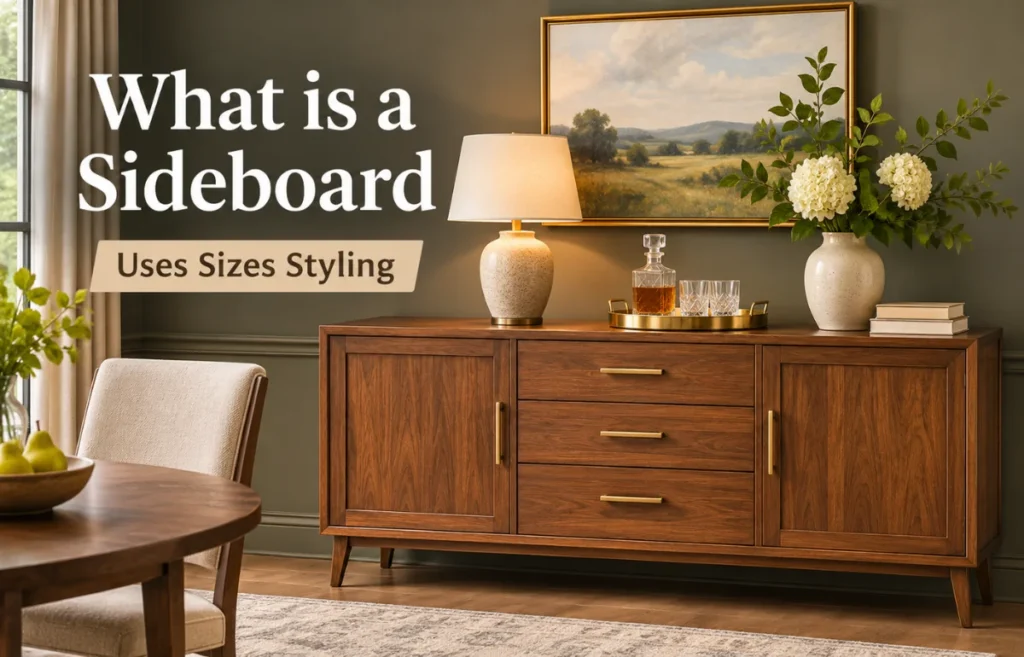
What is a Sideboard? A sideboard is a low, usually wide storage cabinet with a flat top and enclosed space beneath it, typically in the form of cupboards, drawers, or both. Traditionally placed against a dining room wall, it keeps plates, cutlery, table linens, and serving dishes close at hand. Its top also provides extra space for setting out food or displaying decorative objects.
Today, a sideboard is just as useful in a living room, hallway, or open-plan home. You might see one described as a buffet cabinet or credenza, although those terms have slightly different associations.
I think of a sideboard as furniture that does two jobs without demanding attention: it hides everyday clutter and gives a room a purposeful surface. The trick is choosing one that fits how you live, not simply how a staged photograph looks.
What Makes a Sideboard Different From an Ordinary Cabinet?
The defining feature isn’t a particular wood, color, or number of doors. It’s the combination of a broad, accessible top and practical storage below. Most sideboards sit against a wall, have a horizontal shape, and are low enough that you can comfortably reach whatever is displayed on top.
Inside, you may find adjustable shelves for dinnerware, shallow drawers for utensils, or deep compartments for bulky serving bowls. Some designs include glass doors, wine storage, or sliding panels. A sideboard doesn’t need legs, and it doesn’t have to match the dining table.
I find it more helpful to judge a piece by its proportions and function than by its product label. A handsome cabinet with nowhere to fit your largest platter may be attractive, but it won’t solve your storage problem.
A Short History of the Sideboard
Sideboards began as simple tables positioned beside the main dining table. They gave households an extra surface for food, plates, and the equipment used during meals. Over time, makers added drawers and enclosed compartments, turning a serving table into a dedicated storage cabinet.
The Getty Research Institute’s furniture terminology traces this change and describes the sideboard’s long connection with dining rooms. Eighteenth- and nineteenth-century examples could be elaborate, with carved details, polished wood, and raised displays for valued tableware.
Modern sideboards often remove the ornament but keep the useful idea. Whether the cabinet has vintage brass handles or a smooth, handleless front, its purpose remains familiar: store dining essentials and make them easy to reach.
What Is a Sideboard Used For Today?
In the Dining Room
This is the classic location. A dining room sideboard holds dinner plates, glasses, napkins, serving utensils, candles, and the pieces you don’t need on the table every day.
During a meal, its top becomes a serving station for bread, drinks, or dishes waiting to be brought over.
I like keeping frequently used items in the upper drawers and heavier serving pieces on the lower shelves. That arrangement makes setting the table easier and avoids lifting a heavy stack of dishes from an awkward height.
In the Living Room
A living room sideboard can hide board games, paperwork, photo albums, and electronic accessories while giving you space for a lamp, artwork, or a few books.
It can also serve as a media cabinet if the model is designed for the weight of your television and has suitable cable access and ventilation.
One benefit is visual calm. Closed doors make a mixed collection of objects look intentional, even when the contents aren’t especially photogenic.
In an Entryway or Hallway
A narrow sideboard creates a landing place for keys, mail, and bags without leaving everything on show. Drawers can hold dog leads, chargers, or reusable shopping bags, while cupboards keep shoes or seasonal accessories tucked away.
In tight hallways, though, depth matters more than width. A beautiful cabinet that makes everyone turn sideways to pass is the wrong cabinet.
In a Home Office or Multipurpose Room
I also see value in a sideboard outside traditional living spaces. It can store printer paper, craft supplies, files, or spare bedding, provided the internal dimensions work.
Unlike an open shelf, it keeps the room presentable when work and home life share the same space.
Sideboard vs. Buffet vs. Credenza vs. Console Table
These names are often used interchangeably, particularly in online furniture shops. There are traditional differences, but no universal rule that every manufacturer follows.
| Furniture piece | Usual appearance | Common use | Key distinction |
|---|---|---|---|
| Sideboard | Wide cabinet with drawers, cupboards, or both | Dining room or general storage | Storage and display in one piece |
| Buffet | Cabinet with a generous serving top | Dining room | Name emphasizes serving food |
| Credenza | Often low, streamlined, with doors | Living room, office, dining room | Commonly a sleeker, lower profile |
| Console table | Slim table, often with little storage | Entryway, behind a sofa | Generally narrower and more open |
A buffet and sideboard may be exactly the same item. A credenza may work equally well in a dining room, and some console tables have drawers.
I wouldn’t reject a suitable cabinet because its listing uses the “wrong” word. Compare its measurements, door arrangement, and actual storage capacity instead.
Common Types and Styles of Sideboards
Traditional and Farmhouse Sideboards
Traditional designs often feature solid-looking wood, raised panels, decorative handles, or a painted finish.
Farmhouse versions may use warm oak tones, a lightly distressed surface, or simple shaker-style doors. They suit rooms where furniture should feel welcoming rather than sharply minimal.
Modern and Minimalist Sideboards
Modern sideboards favor clean lines, flat fronts, and restrained hardware. Wood veneer, lacquered finishes, metal bases, and fluted details are common design choices.
A modern cabinet can look lighter than a heavily carved one, especially when its legs reveal some floor underneath.
Mid-Century and Vintage-Inspired Designs
Tapered legs, warm wood, and understated handles often give these pieces a mid-century feel.
I particularly like the way a long, low silhouette can anchor a room without competing with a large artwork above it.
Compact, Corner, and Tall Storage Options
Small sideboards work well in apartments, while taller cabinets may offer more storage on a limited footprint.
Strictly speaking, very tall models start to resemble cupboards rather than classic sideboards. That distinction matters less than whether the doors open easily and the shelves accommodate your belongings.
What Size Is a Standard Sideboard?
There is no single standard size, but many sideboards are approximately 30–36 inches (76–91 cm) high and 16–20 inches (41–51 cm) deep.
Width varies considerably, commonly from around 48 to 84 inches (122–213 cm), with smaller and larger options available.
| Approximate width | Best suited to | What to check |
|---|---|---|
| 36–48 in (91–122 cm) | Apartments and short walls | Enough internal room for your essentials |
| 48–66 in (122–168 cm) | Average dining and living rooms | Balance with table and wall length |
| 66–84 in (168–213 cm) or more | Long walls and substantial storage needs | Delivery access, visual weight, and floor clearance |
These are shopping ranges, not rigid furniture categories. A shallow 60-inch sideboard might occupy less usable floor space than a deeper 48-inch model.
How Much Space Should You Leave Around It?
In a dining room, I would aim for at least about 36 inches (91 cm) between the table edge and the front of the sideboard so a chair can move.
Where people need to walk behind occupied chairs, roughly 42–48 inches (107–122 cm) is a more comfortable planning target. Measure to the cabinet’s front, not to the wall behind it.
Also open an imaginary door or drawer when measuring. Hinged doors, protruding handles, radiator positions, and nearby room doors can change whether the placement actually works.
How to Choose the Right Sideboard for Your Home
Start With What You Need to Store
Before considering finishes, I would write down the five bulkiest items the cabinet must hold.
A serving platter, stock of glasses, folded tablecloths, and a large vase each demand a different kind of compartment.
Measure the widest platter and the tallest stored object. Then check the cabinet’s internal shelf dimensions, not just its overall depth.
Back panels, hinges, and door frames reduce usable space. Adjustable shelves are especially helpful when your collection changes.
Choose Doors and Drawers for Daily Habits
Drawers make cutlery, napkins, candles, and other small items easy to sort. Cupboards are better for tall vases, dinnerware, and larger serving dishes.
Sliding doors can be useful where a hinged door would block a narrow walkway, although you can usually access only part of the cabinet at once.
My preferred all-round layout is a combination of drawers and cupboards. It offers flexibility without needing extra storage boxes for everything.
Look Beyond the Exterior Finish
Solid wood can be durable and repairable, but it expands and contracts with changes in humidity.
Wood veneer can give a consistent appearance while using a stable engineered core, provided its edges and finish are well made. Painted MDF or particleboard can be budget-friendly, though moisture and impact damage may be harder to repair.
Check how the drawers move, whether doors align, how the back is attached, and whether the shelves sag under a reasonable load.
Quality of construction often matters more than the marketing description of the material.
Consider the Room’s Existing Furniture
A sideboard doesn’t have to be part of a matching set.
In fact, I often prefer a little contrast: a warm wooden cabinet beside a painted dining table, or a quietly textured front in a room full of smooth surfaces.
Repeat one detail, such as wood undertone, metal finish, or leg shape, to make it feel connected.
Avoid placing a very ornate sideboard next to several equally demanding pieces unless that layered look is intentional.
Check Practical Details Before Ordering
Measure doorways, stair turns, and the delivery route, particularly for a long assembled cabinet.
Confirm the product’s weight limit if you plan to display heavy pottery or a television. If electronics will live inside, look for cable openings and enough airflow.
I would also check the return policy and replacement-part availability. A missing hinge or damaged shelf is much less frustrating when the manufacturer can supply the right component.
How to Style a Sideboard Without Making It Cluttered
The top of a sideboard is useful, but it doesn’t need to hold everything you own.
I prefer giving it three distinct roles: one source of light, one focal point, and one small area that can remain clear for daily use.
A lamp adds warmth, a framed picture or mirror creates height, and a bowl or vase introduces shape.
Mix tall and low objects rather than arranging everything at the same level. If the wall is busy with artwork, keep the cabinet top simpler.
For dining rooms, leave enough surface free for a serving tray when guests visit.
For entryways, place a small dish near the most convenient end, so keys have an obvious home. In living rooms, choose accessories that won’t block a television or interfere with ventilation.
A useful test is to remove one decorative object after you think you’re finished. I usually find that the remaining pieces look more deliberate.
Mistakes That Make a Sideboard Less Useful
One common mistake is shopping by appearance before measuring the room. Another is choosing a cabinet with lots of doors but shelves that don’t fit the items you actually need to store.
Watch for deep cabinets in narrow spaces, drawers that hit dining chairs, and tall decorations that compete with a mirror or wall art.
A sideboard should support how the room functions, not create an obstacle course.
Safety belongs on the checklist too. Heavy items are best kept low, and freestanding cabinets should be secured appropriately to reduce tip-over risks, especially where children may climb.
The U.S. Consumer Product Safety Commission recommends following the manufacturer’s instructions for securing furniture and televisions.
Caring for a Sideboard So It Lasts
Dust with a soft cloth and use cleaning products suitable for the actual finish, not merely the wood color.
Wipe spills promptly, protect the top from hot serving dishes, and use coasters beneath drinks and plant pots.
I would avoid placing a wood cabinet directly beside strong heat sources or in persistent dampness.
Check hinges and handles periodically, and don’t overload shelves beyond the manufacturer’s stated limits. A few small habits do more for longevity than aggressive polishing.
Is a Sideboard Worth Buying?
A sideboard makes sense when you need enclosed storage and have a wall where a broad cabinet won’t interrupt movement.
It can be especially valuable in homes without a separate pantry, linen closet, or dedicated display unit.
It may not be the best choice if your hallway is extremely narrow, your belongings require tall vertical storage, or you already have plenty of cupboards.
In those cases, a slim console, wall-mounted shelving, or tall cabinet might serve you better.
Final Thoughts
So, what is a sideboard in practical terms? It’s a flexible storage cabinet that earns its place by keeping useful things close and visible clutter under control.
Start by measuring your wall, walkway, and largest items; then choose the storage layout and style that genuinely suit your home.
A sideboard that works every day will look better in the long run than one bought for photographs alone.
Frequently Asked Questions
What is the main purpose of a sideboard?
Its main purpose is to store tableware or household essentials while providing a flat surface for serving food or displaying decor.
Can you put a sideboard in a living room?
Yes. A sideboard works well for storing games, books, and accessories, and it can hold a television if designed for that purpose.
Is a sideboard the same as a buffet?
Usually, yes. The terms often refer to similar dining-room cabinets, although “buffet” places more emphasis on serving food.
How tall should a dining room sideboard be?
Many measure about 30–36 inches (76–91 cm) tall, but the ideal height depends on how you’ll use its top and your room’s proportions.
Should a sideboard match the dining table?
No. Coordinating one finish, color, or design detail is usually enough to make different pieces look harmonious.